

How to Make Teeth Whitening Results Last Longer
Teeth whitening longevity, the clinical term for how long brightening effects hold after treatment, depends almost entirely on what you do in the days and weeks that follow. Professional whitening results last anywhere from 6 months to 3 years, with in-office treatments holding the longest under good care. The gap between 6 months and 3 years is not luck. It comes down to a handful of specific habits that most people skip because no one explains them clearly. This guide covers every step, from the first 48 hours after treatment to monthly maintenance routines that make teeth whitening results last longer without turning your life upside down.
Why teeth whitening results last longer with proper aftercare
The first 48 to 72 hours after whitening are the most critical window for color stability. Peroxide-based whitening agents temporarily open microscopic pores in your enamel, the hard outer layer of your teeth, to lift embedded pigments. Those pores stay open and highly absorbent until the enamel fully rehydrates. Any dark pigment that reaches your teeth during this window embeds deeper than it normally would, undoing results before they even stabilize.

You may also notice your teeth look almost unnaturally bright right after treatment. That is not your final shade. Enamel rehydrates over 48–72 hours, and the color settles into a natural, stable tone as that process completes. Mistaking this for early fading leads some people to over-whiten, which damages enamel and causes lasting sensitivity.
The white diet protocol addresses this directly. During the first 48 to 72 hours, enamel pores remain open and vulnerable to staining from coffee, tea, red wine, berries, tomato sauce, and dark sodas. Sticking to white or pale foods, such as chicken, rice, bananas, and plain yogurt, protects the color while rehydration completes.
What to avoid in the first 72 hours:
- Coffee, tea, and dark sodas
- Red wine and grape juice
- Berries, beets, and tomato-based sauces
- Soy sauce and balsamic vinegar
- Tobacco products in any form
Pro Tip: If you must have coffee during the first 72 hours, use a straw and rinse your mouth with water immediately after. This reduces direct enamel contact significantly.
Sensitivity post-whitening is also normal during this window. It fades within 24 to 48 hours as the enamel rehydrates. Using a desensitizing toothpaste or a gel recommended by your dental provider speeds up that recovery.
Daily habits that extend whitening effects over months
Consistent small habits protect your results far more effectively than periodic intensive treatments. The goal is to reduce how much pigment reaches your enamel every day, not to eliminate every staining food from your diet permanently.
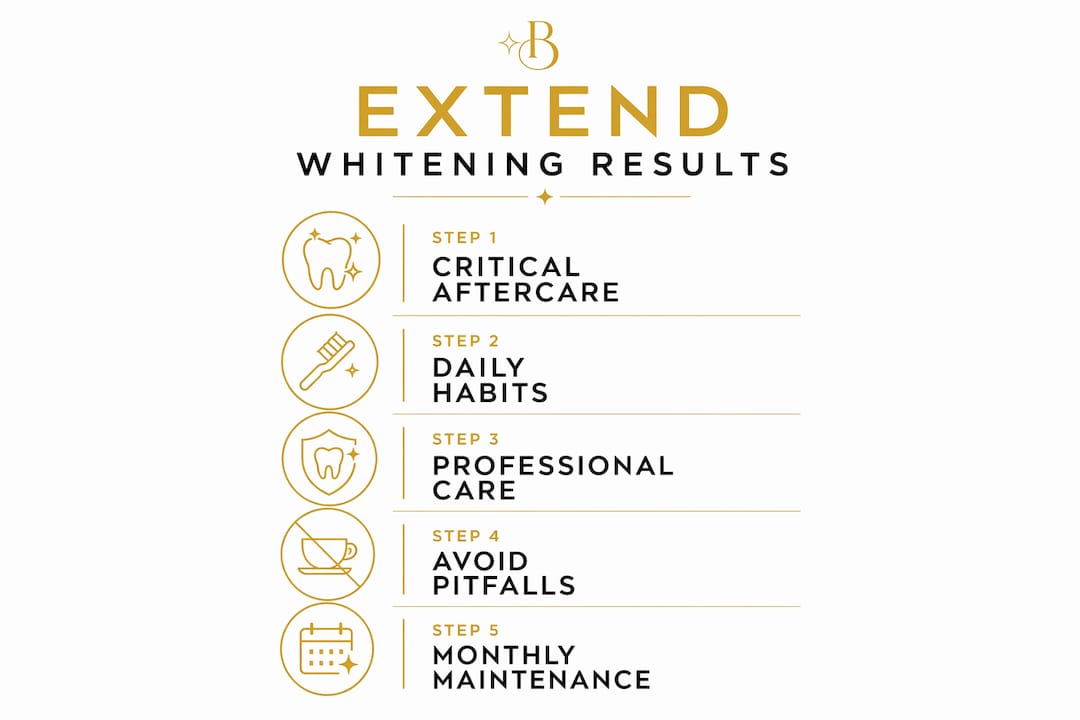
Rinsing with water after consuming pigmented foods or drinks neutralizes chromogens, the color compounds in food and beverages, before they bond to enamel. This takes about 10 seconds and meaningfully slows stain accumulation between touch-ups. It is one of the most underused habits in teeth whitening maintenance.
Daily habits that protect whitening results:
- Brush twice daily with a whitening maintenance toothpaste that contains mild abrasives or low-concentration peroxide
- Use a straw for coffee, iced tea, and dark sodas to reduce enamel contact with staining liquids
- Rinse your mouth with water within 30 seconds of finishing any pigmented food or drink
- Floss daily to remove plaque from between teeth, where surface stains accumulate quickly
- Avoid smoking or using tobacco products, which cause rapid and deep enamel discoloration
Oral hygiene quality matters as much as what you eat. Plaque, the soft bacterial film that forms on teeth throughout the day, traps pigments and accelerates staining. Brushing with an electric toothbrush removes plaque more thoroughly than manual brushing, which directly supports whitening longevity. Blancawhitening’s electric toothbrush is designed specifically to support this kind of daily maintenance without irritating sensitive post-treatment enamel.
Pro Tip: Brush your teeth before drinking your morning coffee, not after. Brushing removes the thin protein film that forms on enamel overnight, which actually helps pigments adhere. Removing it first reduces staining potential.
Smoking deserves a direct mention. Tobacco contains tar and nicotine that penetrate enamel at a molecular level. No maintenance routine fully compensates for regular tobacco use. Quitting or significantly reducing smoking is the single highest-impact lifestyle change for whitening longevity.
How professional cleanings and custom trays preserve whitening
Clinical maintenance methods extend whitening results in ways that daily habits alone cannot. Two practices stand out: biannual professional cleanings and monthly custom tray touch-ups.
Tartar, which whitening gels cannot remove, accumulates on teeth and creates a rough, porous surface that traps stains aggressively. Even with perfect daily brushing, tartar builds up in areas a toothbrush cannot reach. Professional cleanings every six months remove these deposits and restore the smooth enamel surface that resists staining. Skipping cleanings while maintaining a whitening routine is like painting over rust: the surface looks fine briefly, then deteriorates faster than expected.
Custom whitening trays work differently. They deliver a low-concentration whitening gel directly against your enamel for a controlled period, typically one to two nights per month. Monthly tray use resets early staining before it becomes visible, catching chromogen buildup at the surface level before it embeds deeper into the enamel. This is far more economical than waiting until results fade significantly and requiring a full retreatment.
| Maintenance method | Frequency | Primary benefit |
|---|---|---|
| Professional dental cleaning | Every 6 months | Removes tartar and surface stains gels cannot address |
| Custom tray touch-up | 1–2 nights per month | Resets early chromogen buildup before visible fading |
| Whitening maintenance toothpaste | Daily | Slows surface stain accumulation between touch-ups |
| Water rinse after staining foods | After each exposure | Neutralizes pigments before enamel bonding occurs |
The economic argument for maintenance is straightforward. Touch-ups are more economical than full pretreatments, and teeth maintained consistently rarely return to their original shade. Investing in a monthly tray session costs a fraction of a full in-office treatment. The at-home whitening options available today make this routine accessible without repeated clinic visits.
- Schedule your first professional cleaning within 6 months of your whitening treatment.
- Ask your dental provider for custom-fitted trays if you had in-office whitening.
- Use your trays for one to two nights each month with a low-concentration maintenance gel.
- Track your shade against a reference photo taken immediately after treatment to catch fading early.
- Adjust tray frequency to two nights per month if you consume coffee or wine daily.
Common pitfalls that cause whitening to fade faster
Most whitening fading is gradual and predictable. Rapid relapse, where results disappear within weeks, almost always traces back to one of a few specific mistakes.
The most common causes of premature whitening fading:
- Skipping the 48-hour white diet after treatment
- Drinking coffee or tea without a straw daily
- Neglecting professional cleanings, allowing tartar to accumulate
- Over-whitening by using high-concentration products too frequently
- Brushing immediately after consuming acidic foods, which spreads enamel-softening acids
Over-whitening is a real and underappreciated risk. Using high-concentration peroxide products more often than recommended does not produce brighter results. It causes enamel erosion, which makes teeth appear more translucent and gray rather than white. It also causes persistent sensitivity that makes eating and drinking uncomfortable. The best practices for teeth whitening always include rest periods between treatments to allow enamel recovery.
Sensitivity that persists beyond 48 hours after treatment signals that the concentration or frequency of whitening is too high for your enamel. Switching to a lower-concentration product or extending the gap between sessions resolves this in most cases. Blancawhitening’s guide for sensitive teeth covers how to choose the right product concentration based on your enamel’s tolerance.
Natural gradual fading is different from rapid relapse. Teeth naturally pick up pigment over weeks and months. Seeing a slight shift in shade after two or three months is normal and expected. That is the signal to use your custom tray for a one-night touch-up, not to start a full treatment cycle again.
Key Takeaways
Teeth whitening results last longest when the first 72 hours of aftercare, consistent daily habits, and monthly tray touch-ups work together as a single maintenance system.
| Point | Details |
|---|---|
| First 72 hours are critical | Follow a white diet and avoid dark pigments while enamel pores rehydrate and color stabilizes. |
| Daily habits slow stain buildup | Rinsing after staining drinks and using a straw reduces chromogen contact with enamel every day. |
| Professional cleanings are non-negotiable | Biannual cleanings remove tartar that whitening gels cannot address, preventing dull relapse. |
| Monthly tray touch-ups prevent visible fading | One to two nights per month with custom trays resets early staining before it becomes visible. |
| Over-whitening causes harm, not brightness | Excessive peroxide use erodes enamel and causes persistent sensitivity without improving shade. |
What I’ve learned about realistic whitening maintenance
Most people approach whitening as a one-time event. They invest in a treatment, see great results, and then return to every habit that caused staining in the first place. Six months later, they are back to square one and frustrated.
The shift that actually works is treating whitening as a cycle, not a destination. Your teeth will pick up pigment. That is biology, not failure. The goal is to intercept that process early and consistently, not to prevent it entirely. A monthly tray session and a straw for your morning coffee are not burdens. They are the difference between results that hold for two years and results that fade in four months.
I have also seen people become so focused on restriction that they stop enjoying food and social situations. That rigidity is not sustainable, and it is not necessary. Consistent small habits yield lasting effects far better than occasional perfect compliance followed by abandonment. Rinse after your glass of red wine. Use your tray once a month. Get your cleaning every six months. That is the whole system.
Confidence in your smile should not require perfection. It requires a manageable routine you can actually keep.
— Blanca
Blancawhitening products that support your whitening routine
Maintaining a bright smile between treatments is straightforward when you have the right tools. Blancawhitening was founded by dental professionals specifically to make that maintenance routine accessible at home, without compromising on the clinical quality that makes results last.
From at-home whitening strips designed for monthly touch-ups to electric toothbrushes and water flossers that keep enamel clean and plaque-free, every Blancawhitening product supports the maintenance habits covered in this article. The full oral care collection pairs whitening tools with everyday hygiene products so your routine works as a complete system. Browse the current sales and promotions to find the right combination for your smile goals.
FAQ
How long do professional whitening results typically last?
In-office whitening lasts 2–3 years under good maintenance, while take-home trays last 1–2 years and over-the-counter products last 3–6 months. Care practices after treatment determine where your results fall within those ranges.
Why do my teeth look overly white right after whitening?
The stark white shade immediately after treatment is temporary. Enamel rehydrates over 48–72 hours, and the color settles into its true, stable shade as that process completes. This is a normal physiological response, not a sign of over-whitening.
How often should I use whitening touch-up trays?
Dental practitioners recommend using custom trays for 1–2 nights per month to reset early staining before it becomes visible. Increasing to two nights per month is appropriate if you consume coffee, tea, or wine regularly.
What causes whitening results to fade faster than expected?
Skipping the 48-hour white diet, neglecting professional cleanings, and daily consumption of staining beverages without a straw are the primary drivers of rapid fading. Tartar buildup also accelerates staining because it creates a rough, porous surface that traps pigments.
Is sensitivity after whitening a sign that something went wrong?
Sensitivity after whitening is normal and typically resolves within 24–48 hours as enamel rehydrates. Persistent sensitivity beyond 48 hours usually indicates the product concentration is too high for your enamel tolerance, and switching to a lower-concentration option resolves it.