

Teeth Whitening with Crowns and Veneers: The Real Truth
Teeth whitening crowns and veneers is one of the most misunderstood topics in cosmetic dentistry. Whitening agents do not change the color of crowns, veneers, or composite bonding because these dental restorations are made from non-porous materials that do not absorb or react to bleaching chemicals. Hydrogen peroxide and carbamide peroxide, the active agents in every whitening product, work by penetrating the microscopic channels in natural enamel and breaking down stain molecules through oxidation. Porcelain and ceramic surfaces have no such channels. The result is a treatment that works beautifully on natural teeth and does nothing to dental restorations.
How does teeth whitening work on crowns and veneers?
Natural tooth enamel is porous. Bleaching agents penetrate those pores and break apart the pigmented compounds that cause discoloration. That oxidation process is what makes your teeth visibly lighter after a whitening treatment.
Crowns and veneers are made from porcelain or ceramic, materials that are fired at high temperatures and polished to a glass-like finish. Hydrogen peroxide and carbamide peroxide cannot penetrate these surfaces. Applying a whitening gel to a porcelain crown produces no color change at all.
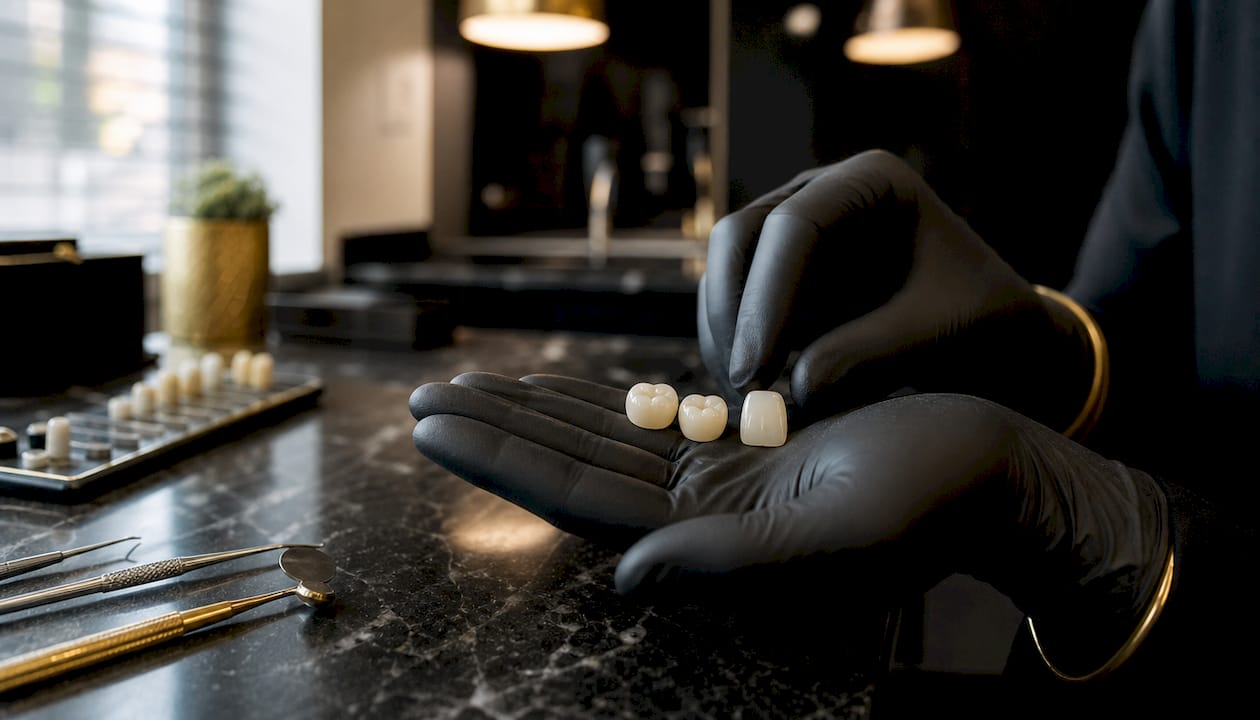
Composite bonding sits in a similar category. The resin used in bonding is also non-porous and does not respond to bleaching agents. Whitening should always precede bonding so the composite resin is matched to the final, whitened shade of your natural teeth.
The practical consequence is straightforward. If you whiten your natural teeth after placing crowns or veneers, your natural teeth will get lighter while your restorations stay the same shade. That mismatch is the central challenge in cosmetic dentistry, and it is entirely avoidable with the right sequence.
- Natural enamel: Porous, responds to hydrogen peroxide and carbamide peroxide via oxidation.
- Porcelain crowns and veneers: Non-porous, no reaction to whitening chemicals.
- Composite bonding: Non-porous resin, cannot be whitened after placement.
- The risk: Whitening after restorations creates visible shade mismatches between natural teeth and dental work.
Pro Tip: Before any whitening treatment, ask your dentist to map which teeth have restorations. That single step prevents the most common cosmetic mistake people make.
What is the correct sequence for whitening before getting restorations?
The recommended clinical sequence is clear: whiten your natural teeth first, wait for the shade to stabilize, then place crowns, veneers, or bonding matched to that final color. Skipping any step in this order leads to mismatched results that are expensive to correct.
The 2-week stabilization period after whitening is not optional. Tooth shade continues to shift slightly after active treatment ends. Placing permanent restorations too early means the lab matches the crown or veneer to a shade that will not hold. Once your natural teeth settle to their final color, the restoration can look noticeably different.
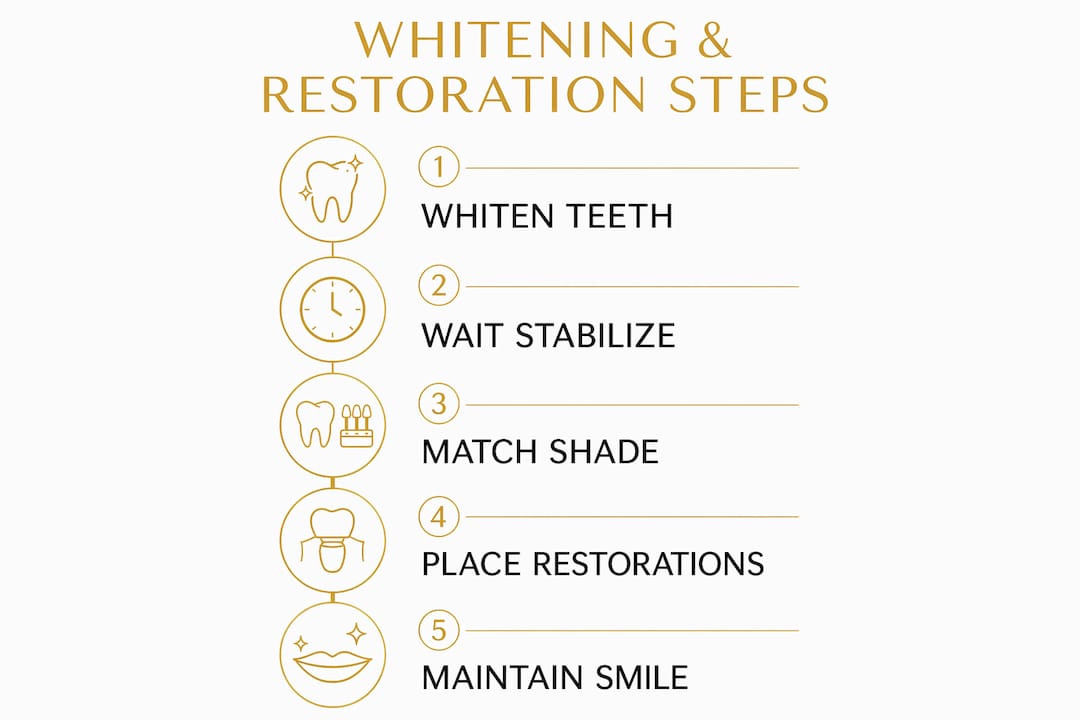
The full process from initial whitening to completed restorations takes approximately 5–6 weeks. That timeline accounts for the whitening treatment itself, the stabilization period, and the lab fabrication time for the restoration. Rushing it costs more in the long run.
Here is the correct sequence to follow:
- Complete a full whitening course on your natural teeth using a clinically backed peroxide-based system.
- Wait two weeks for your tooth shade to fully stabilize before any shade-matching appointment.
- Schedule your shade-matching appointment with your dentist so the lab can select the correct porcelain color.
- Have your crown, veneer, or bonding placed once the restoration is fabricated to match your whitened teeth.
- Begin a maintenance routine to keep your natural teeth at the whitened shade and prevent future mismatch.
“The biggest challenge when whitening with existing restorations is shade mismatch, not damage. Getting the sequence right is the only reliable way to achieve a uniform smile.”
Patients who skip the stabilization step often return within months reporting that their natural teeth look different from their new crown. The fix requires either re-whitening or replacing the restoration. Neither is cheap.
What are your options if your restorations already look mismatched?
If you already have crowns or veneers that no longer match your natural teeth, you have a limited but workable set of options. The most direct solution is replacing old restorations to match the shade of your whitened natural teeth. This is the only way to achieve true color harmony when the existing restoration is significantly lighter or darker than your surrounding teeth.
Some people try applying whitening strips or gels directly to their restorations hoping to blend the color. This does not work and can cause harm. Whitening gels can roughen the polished surface of porcelain, creating microscopic etching that picks up stains faster over time. The result is a restoration that looks darker sooner, not lighter.
- Replace the restoration: The only reliable fix for a significant shade mismatch.
- Avoid whitening products on restorations: Gels can etch the polished surface and accelerate staining.
- Use non-abrasive toothpaste: Abrasive formulas scratch porcelain and dull its surface over time.
- Maintain your natural teeth: Keeping natural teeth at their whitened shade with consistent whitening habits prevents the gap from widening.
For some people, skipping whitening entirely and focusing on maintenance is the better call. If your restorations are relatively new and well-matched to your current natural tooth shade, aggressive whitening of natural teeth will only create a new mismatch. A dentist consultation clarifies which path makes sense for your specific situation.
Whitening, bonding, and veneers: which treatment does what?
These three treatments are often grouped together in cosmetic dentistry conversations, but they solve different problems. Choosing the wrong primary treatment is the most common reason people end up disappointed with their results.
Whitening addresses color only. It brightens natural enamel and removes staining caused by coffee, tea, wine, and aging. It does not fix chips, gaps, or shape irregularities. If your teeth are well-shaped but discolored, whitening is the right starting point. Understanding how whitening works before committing to a treatment plan saves both time and money.
Composite bonding reshapes or repairs teeth but cannot whiten the tooth or the bonding material itself. Whitening must precede bonding so the composite resin is color-matched to your final natural shade. Bonding typically lasts 3–7 years and works best for minor cosmetic corrections rather than full smile redesigns.
Porcelain veneers provide a full aesthetic redesign. They cover the entire visible surface of a tooth, allowing your dentist to control color, shape, length, and surface texture simultaneously. Veneers are more durable than composite bonding and carry a longer lifespan, though they require more tooth preparation and a higher upfront cost.
| Treatment | What it fixes | Works on restorations? | Longevity |
|---|---|---|---|
| Teeth whitening | Color only (natural enamel) | No | Ongoing maintenance |
| Composite bonding | Shape, chips, minor gaps | No (cannot be whitened) | 3–7 years |
| Porcelain veneers | Color, shape, full redesign | N/A (is the restoration) | 10+ years with care |
| Dental crowns | Full tooth coverage, structure | No (non-porous surface) | 10–15 years with care |
Many people get the best results by combining treatments in the right order. Whiten first, then bond or veneer to match. That sequence is what the at-home whitening phase is designed to support before you commit to more permanent cosmetic work.
Pro Tip: If you are considering veneers, complete your whitening course first and choose your target shade before any lab work begins. Changing your mind after the veneer is fabricated means starting over.
Knowing the difference between at-home and professional whitening also matters here. Professional in-office whitening achieves faster results, which can be useful when you are working toward a tight timeline for restoration placement.
Key Takeaways
Whitening agents do not lighten crowns, veneers, or composite bonding. The correct sequence, whiten first and restore second, is the only reliable path to a uniform, bright smile.
| Point | Details |
|---|---|
| Restorations do not whiten | Porcelain and ceramic are non-porous and do not respond to bleaching agents. |
| Sequence matters | Whiten natural teeth first, wait two weeks, then place restorations matched to the final shade. |
| Full timeline is 5–6 weeks | Rushing the process leads to shade mismatches that require costly corrections. |
| Mismatched restorations need replacing | Whitening gels on existing restorations cause surface etching, not color improvement. |
| Each treatment solves a different problem | Whitening fixes color, bonding fixes shape, and veneers address both simultaneously. |
What I have learned from watching people get the sequence wrong
People come to cosmetic dentistry with a clear goal: a brighter, more uniform smile. What they often do not realize is that the order of treatments matters as much as the treatments themselves. I have seen people invest in beautiful porcelain veneers only to whiten their natural teeth six months later and end up with a visible mismatch that required replacing work they had just paid for.
The advice to consider bite forces and function before cosmetic work is not just a clinical formality. Veneers placed without accounting for how a person bites and chews can chip or debond within a year. Appearance and function are not separate considerations. They are the same consideration.
The other thing I consistently see is people underestimating the stabilization period. Two weeks feels like a long time when you are excited about your new smile. But tooth shade genuinely continues to shift after whitening ends, and placing a permanent restoration on an unstable shade is a gamble that rarely pays off.
My honest recommendation: treat the whitening phase as the foundation, not an afterthought. Get your natural teeth to the shade you want, hold it for two weeks, and then build your cosmetic work on top of that stable base. That approach produces results that last and look natural. Anything else is working backward.
— Blanca
Blancawhitening products that support your whitening foundation
Achieving a bright, uniform smile starts with getting your natural teeth to the right shade before any cosmetic dental work begins.
Blancawhitening offers a full range of clinically backed at-home whitening products designed to help you reach and maintain that target shade safely and effectively. From professional whitening strips to complete oral care systems, every product is formulated by dental professionals to work on natural enamel without compromising your gum health. Once your restorations are placed, maintaining your natural teeth at the same shade is what keeps your smile looking uniform long-term. Explore current sales and offers to find the right whitening solution for your routine. Pairing whitening with good habits, including knowing which foods to avoid after whitening, extends your results significantly.
FAQ
Can teeth whitening change the color of a crown or veneer?
No. Whitening agents cannot penetrate porcelain or ceramic surfaces, so crowns and veneers will not change color during a whitening treatment.
Will whitening gel damage my existing veneers?
Whitening gel does not dissolve porcelain, but it can roughen the polished surface through microscopic etching, which makes the veneer pick up stains faster over time.
How long should I wait after whitening before getting veneers?
The standard recommendation is a two-week stabilization period after whitening before shade-matching for any permanent restoration.
Does composite bonding whiten teeth?
No. Bonding reshapes or repairs teeth but cannot whiten natural enamel or the bonding material itself. Whitening must be completed before bonding is placed.
What is the total timeline for whitening and then getting restorations?
The full process takes approximately 5–6 weeks, covering the whitening course, the stabilization period, and lab fabrication time for the restoration.