

3 Dentist Backed Dry Mouth Remedies That Work and When to See a Doctor
The fastest relief for dry mouth combines three moves: sip water throughout the day, chew sugar-free gum to trigger saliva flow, and run a humidifier at night. Alcohol-free rinses and fluoride toothpaste protect enamel while you sort out the cause. See a dentist or doctor if the dryness persists, makes swallowing difficult, or started right after a new prescription.
TL;DR:
- Improving hydration by sipping water regularly and using a humidifier can significantly reduce nighttime dryness and protect enamel.
- Over-the-counter products with ingredients like glycerin or xylitol can offer relief but should be checked for acid content to prevent enamel erosion.
- Chronic dryness lasting over two weeks, especially with swallowing difficulty or new medication use, warrants professional evaluation for underlying conditions.
- Medications such as pilocarpine or cevimeline can help stimulate saliva but carry potential side effects and require medical oversight.
- Maintaining a better oral care routine, including fluoride use, frequent dental visits, and avoiding irritants like alcohol and spicy foods, is essential for long-term dental health.
Table of Contents
- Home Remedies for Dry Mouth You Can Start Tonight
- Choosing Safe Over-the-Counter Dry Mouth Products
- Medical Treatments and Signs You Need Professional Care
- Protecting Your Teeth When Saliva Runs Low
- Fixing Dry Mouth at Night
- What Dental Professionals Want You to Know About Daily Maintenance
- Natural and Home-Based Remedies Worth Trying
- Managing Dry Mouth From Sjögren’s Syndrome, Diabetes, and Other Conditions
- When Chronic Dry Mouth Needs a Doctor’s Evaluation
- A Dental Professional’s Bottom Line on Managing Dry Mouth
- Protecting Your Smile While You Treat Dry Mouth
- Where to Learn More About Dry Mouth
- Sources
Home Remedies for Dry Mouth You Can Start Tonight
Dry mouth, known clinically as xerostomia, happens when your salivary glands stop producing enough saliva to keep your mouth comfortably moist. Saliva does more than prevent that cottony feeling. It buffers acid, washes away food particles, and delivers minerals that keep enamel intact. When it drops off, small daily habits make a real difference.
Start with hydration. Sipping water throughout the day, rather than drinking large amounts occasionally, keeps tissue moist without overwhelming your bladder. Ice chips and sugar-free ice pops work well if plain water feels unsatisfying, and a small spray bottle in your bag or at your desk lets you mist your mouth in seconds when a meeting or a long drive dries things out.
Saliva stimulation matters just as much as hydration. Chewing sugar-free gum or sucking on sugar-free hard candies stimulates saliva flow, and products containing xylitol offer a bonus: they may help prevent cavities at the same time. Go easy on xylitol quantities, though. Large amounts can cause stomach upset in some people.
Your environment matters too. A bedroom humidifier keeps the air from pulling moisture out of your mouth and throat while you sleep, which is often when dry mouth feels worst. At meals, add sauces, gravies, or broths to foods that would otherwise sit dry on your tongue, and steer clear of spicy, salty, or acidic dishes that can sting already-irritated tissue. Caffeine, alcohol, and tobacco all reduce saliva production, so cutting back on any of them tends to show results within days.
Round out your routine with these basics:
- Skip alcohol-containing mouthwash, which dries tissue further
- Apply lip balm regularly to prevent cracking at the corners of your mouth
- Practice breathing through your nose instead of your mouth when possible
- Keep a water bottle within reach during work or travel
Pro Tip: Keep sugar-free gum in your car, desk drawer, and bag simultaneously. Dry mouth tends to strike at the worst moments, and having gum within arm’s reach beats hunting for it.
Choosing Safe Over-the-Counter Dry Mouth Products
Pharmacy shelves carry a surprising range of dry mouth products: gels, sprays, lozenges, alcohol-free rinses, and toothpastes formulated specifically for xerostomia. Sipping water and using a humidifier help, but short-term moisturizing sprays and glycerin-based mouth sprays can bridge the gap between drinks, especially during the day when you can’t always reach for a water bottle.
Look for ingredients like carboxymethylcellulose, hydroxyethyl cellulose, and glycerin. These thicken and hold moisture against oral tissue longer than water alone. Xylitol-containing formulas add cavity protection on top of comfort.
Here’s the part most people skip: not every “moisturizing” product is safe for your teeth. Some saliva substitutes carry an acidic pH that can actively erode enamel over time, which is the opposite of what you want when your natural cavity defenses are already compromised. Before buying, check the label or ask your pharmacist two questions: is this formula acidic, and is it sold in Canada under a name you can verify with your dentist?
OTC products work well as a first line of defense for mild to moderate dryness. If you’ve tried several formulas for a few weeks with no real improvement, that’s your signal to escalate rather than keep product-hopping.
Medical Treatments and Signs You Need Professional Care
Home remedies handle most everyday dryness, but some cases need clinical intervention. Book an appointment if dryness persists beyond two weeks, if you’re having trouble swallowing or speaking clearly, if cavities are forming rapidly despite good hygiene, if you’re losing weight without trying, or if dryness followed head or neck radiation treatment.
When home measures aren’t enough, doctors may prescribe pilocarpine or cevimeline, medications that stimulate the salivary glands directly. Both can be effective, but they come with tradeoffs. Because these drugs affect more than just salivary glands, clinicians weigh potential cardiovascular and eye-related side effects before prescribing them, particularly for patients with existing heart or eye conditions.
Medications cause a substantial share of chronic dry mouth cases. Common culprits include:
- Antihistamines used for allergies
- Certain antidepressants
- Decongestants taken regularly
- Blood pressure medications in some cases
If you suspect a prescription is drying you out, don’t stop taking it on your own. Talk to the prescriber about whether a dosage adjustment or a different timing schedule might help. Depending on what’s driving the dryness, your dentist might refer you to your primary care doctor, an ear, nose, and throat specialist, or a rheumatologist if an autoimmune condition is suspected.
Protecting Your Teeth When Saliva Runs Low
Less saliva means less natural defense against cavities and gum irritation, which is why dry mouth significantly raises decay risk. Building a tighter oral care routine now prevents bigger problems later.
Stick with fluoride toothpaste and brush gently twice a day, since dry tissue bruises and irritates more easily than well-lubricated gums. Daily flossing remains non-negotiable. If your dryness is chronic, ask your dentist about prescription-strength fluoride gels or custom trays you wear briefly each day for extra mineral protection.
Chronic dry mouth also calls for shorter intervals between dental visits. Where a typical patient might go six months between cleanings, your dentist may want to see you every three to four months to catch decay before it spreads. Bring up any new medications at these visits, since they may be relevant to your risk.
A few habits go a long way between appointments:
- Rinse with plain water after meals to clear lingering food acids
- Limit sugary snacking between meals, when saliva can’t buffer as effectively
- Time acidic drinks (citrus juice, soda) with meals rather than sipping them slowly
- Review your daily oral care routine with your dentist to tailor it to your specific risk level
Fixing Dry Mouth at Night
Nighttime dryness does more damage than daytime dryness because you’re not swallowing or drinking for hours at a stretch, giving bacteria a longer window to work on unprotected enamel. A few targeted changes address this directly:
- Run a bedroom humidifier and keep a glass of water on your nightstand for middle-of-the-night sips.
- If nasal congestion pushes you into mouth breathing, try saline rinses or talk to your doctor about decongestion options before bed.
- If you use a CPAP machine, ask your sleep clinic about adding a heated humidifier attachment, which many machines support.
- Ask your prescriber whether medications known to cause dryness can safely be taken earlier in the day instead of at bedtime.
- Skip alcohol in the evening, since it’s dehydrating, and use a sugar-free lozenge an hour or two before sleep rather than right at lights-out.
What Dental Professionals Want You to Know About Daily Maintenance
As a Canadian oral care brand founded by dental professionals, we hear one theme constantly from patients managing dry mouth: plaque builds faster when saliva can’t wash it away naturally. An electric toothbrush removes plaque more consistently than manual brushing, and a water flosser reaches between teeth without the friction of string floss on sensitive, dry gums. Replace your water flosser tips every three months, and ask a dental professional before trying any new moisturizing gel, since not every “gentle” formula is enamel-safe.
Natural and Home-Based Remedies Worth Trying
Beyond mainstream OTC products, several natural options show up often in dry mouth discussions, and they’re worth understanding honestly rather than treating as miracle fixes.
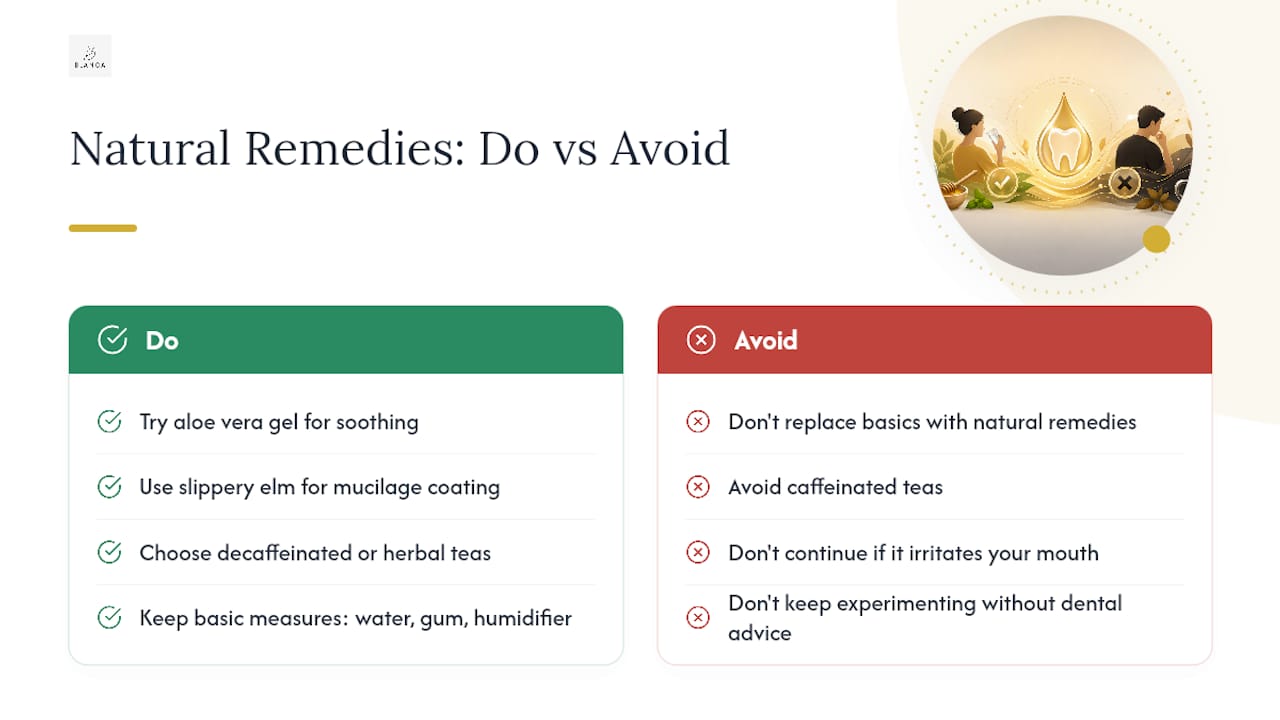
Aloe vera juice or gel, when formulated for oral use, has a soothing texture that some people find comforting against dry tissue. It won’t stimulate saliva production, but it can reduce the raw, irritated feeling that comes with chronic dryness. Slippery elm, traditionally used as a throat soother, works on a similar principle: it creates a mucilage-like coating that temporarily eases friction and discomfort rather than fixing the underlying saliva shortage.
Herbal teas, particularly chamomile or marshmallow root, offer warmth and hydration together, though caffeinated teas defeat the purpose since caffeine dries tissue further. If you’re reaching for tea as a comfort measure, decaffeinated or herbal varieties are the better choice.
Here’s the honest caveat: none of these natural approaches have the same weight of clinical evidence behind them as sipping water, chewing sugar-free gum, or using a humidifier. They’re reasonable additions to a home care routine, not replacements for the basics. If you notice a natural remedy irritates your mouth rather than soothing it, or if it doesn’t touch the underlying dryness after a couple of weeks, that’s useful information for your next dental visit rather than a reason to keep experimenting on your own.
Managing Dry Mouth From Sjögren’s Syndrome, Diabetes, and Other Conditions
Dry mouth linked to a medical condition behaves differently than dryness caused by dehydration or a single medication, and it usually needs a longer-term management plan rather than a quick fix.
Sjögren’s syndrome, an autoimmune condition that specifically targets moisture-producing glands, tends to cause more severe and persistent dryness than most other causes. People with Sjögren’s often need a combination approach: saliva substitutes used consistently throughout the day, prescription stimulants when appropriate, and closer dental monitoring since the decay risk climbs faster. A rheumatologist typically manages the underlying autoimmune piece while your dentist handles the oral protection side.
Diabetes contributes to dry mouth through a different mechanism, often tied to blood sugar levels that pull fluid from tissues and, in some cases, to medications used for blood sugar control. Getting glucose levels into a stable, well-managed range frequently improves dry mouth symptoms alongside the medical benefits, which makes this one case where treating the root condition and treating the oral symptom point in the exact same direction.
Radiation treatment for head and neck cancers deserves its own mention, since salivary gland damage from radiation can be long-lasting and often requires a combined approach: saliva substitutes, aggressive cavity prevention, and ongoing coordination between your oncology team and your dentist. If dry mouth followed a course of radiation, expect management to be a standing part of your care rather than a short-term fix.
When Chronic Dry Mouth Needs a Doctor’s Evaluation
Occasional dryness from a dehydrated afternoon or a stuffy nose isn’t a medical emergency. Dryness that sticks around week after week, despite consistent hydration and OTC products, is a different story and deserves a real evaluation.
Pay attention to dryness that arrives alongside other symptoms: joint pain and fatigue alongside dry eyes could point toward Sjögren’s syndrome. Unexplained thirst, frequent urination, or unintended weight loss alongside dry mouth could signal undiagnosed diabetes. A burning sensation on the tongue that doesn’t improve with basic care sometimes indicates a fungal infection that’s taken hold because saliva’s natural antimicrobial action is diminished.

Your dentist is often the right first stop, since dry mouth shows up in the mouth before it shows up anywhere else, and a dental exam can rule out or flag active decay quickly. From there, a referral to your primary care physician, an ENT, or a rheumatologist depends on what other symptoms are present. Don’t wait for the dryness to become unbearable before asking for help. Catching an underlying cause early usually means a simpler treatment path and less damage to your teeth in the meantime.
A Dental Professional’s Bottom Line on Managing Dry Mouth
Sip water often, lean on sugar-free gum, and run a humidifier at night. Those three habits solve most mild cases. But persistent dryness, trouble swallowing, or dryness that started with a new medication is your body asking for a second opinion. Loop in your dentist and physician together. They see different pieces of the same puzzle.
— Blanca
Protecting Your Smile While You Treat Dry Mouth
Dry mouth remedies handle the discomfort, but low saliva still leaves your teeth more exposed to plaque and decay than they’d otherwise be. That’s where the right daily tools make a measurable difference. Blancawhitening’s oral care essentials were built by dental professionals specifically to support the kind of consistent plaque control that dry mouths need most.
An electric toothbrush clears plaque more evenly than a manual brush, which matters when saliva isn’t doing its usual cleanup work. A water flosser reaches between teeth without the friction that string floss can cause on tender, dry gums, and it’s worth swapping out replacement tips regularly to keep it working properly. None of these products treat the underlying cause of your dry mouth. They’re an adjunct that protects your enamel and gums while you and your dentist work out the root issue. Browse the Blanca oral care collection and build a routine that keeps your smile protected while you get the dryness itself sorted out.
Where to Learn More About Dry Mouth
For deeper reading, see Mayo Clinic, Johns Hopkins Medicine, Cleveland Clinic, and MedlinePlus. Always confirm personal guidance with your dentist or physician.
This article is general information, not a substitute for advice from a qualified doctor. Consult a qualified healthcare professional about your own circumstances before acting on anything here.
Sources
- Dry mouth treatment: Tips for controlling dry mouth | Mayo Clinic
- Dry Mouth Remedies: 14 to Try | Johns Hopkins Medicine
- Dry mouth (xerostomia) — NCBI Bookshelf
- Dry Mouth (Xerostomia): Causes, Symptoms & Treatment | Cleveland Clinic