

See 100–240V? How Canadian Travelers Check Toothbrush Chargers
Most electric toothbrush chargers work worldwide with nothing more than a plug adapter, because many are rated for voltage ranges that cover most countries. Check the small print on your charger before you assume, though: single-voltage models and older corded devices are the exception, and they do need a converter. Battery carriage rules for flights are a separate matter entirely, governed by airline and safety guidance rather than local electricity.
TL;DR:
- Most electric toothbrush chargers are compatible worldwide with just plug adapters if they have an INPUT rating of 100-240V, but single-voltage models require a converter.
- Always verify the INPUT voltage on your charger before travel; if it just shows a single voltage like 120V, a converter is necessary to prevent damage.
- Travel plug types vary by country, so carrying an universal adapter with interchangeable pins simplifies fitting into different outlets.
- Frequency (50/60Hz) typically does not affect charging, but it’s wise to confirm if your charger lists only one frequency to avoid potential issues.
- Pack your charger in carry-on luggage, lock the power switch, and avoid spare batteries, following airline and safety regulations for lithium battery devices.
Table of Contents
- How Do I Check My Toothbrush Charger’s Voltage?
- Adapter or Converter: What’s the Real Difference?
- What Voltage and Plug Type Does My Destination Use?
- Does Frequency (Hz) Matter for Charging?
- What Are the Airline Rules for Traveling With a Battery Toothbrush?
- What Should You Pack for a Trip With an Electric Toothbrush?
- Why Reliable Charging Matters for Your Smile on the Road
- Travel-Ready Oral Care That Skips the Guesswork
- Sources
- FAQ
How Do I Check My Toothbrush Charger’s Voltage?
The answer is printed right on the charger itself, usually molded into the plastic on the base, the charging stand, or the barrel of the plug. Look for a line that starts with “INPUT” and flip the charger over if you don’t see it right away. Some travel cases print it on the inside lid instead of the charger body.
Here’s how to read what you find:
- “INPUT: 100–240V ~ 50/60Hz” means the charger is multi-voltage and works globally with just a plug adapter, according to guidance from DOACE on travel voltage compatibility.
- A single number, like “120V” or “230V,” means the charger is built for one region only, and you’ll need a voltage converter, not just an adapter, to use it safely elsewhere.
- No visible label, or text worn away from years of bathroom steam, means you should stop and check the manufacturer’s website or manual before plugging in anywhere unfamiliar.
If you genuinely can’t find or read the input rating, don’t gamble on it. Contact the manufacturer, or treat the charger as single-voltage until proven otherwise. A five-minute check at home beats a fried charger on day one of your trip.
Adapter or Converter: What’s the Real Difference?
A plug adapter changes the shape of the plug so it physically fits a foreign outlet. It does nothing to the electricity itself. A voltage converter changes the actual voltage coming through the outlet, stepping it up or down so a single-voltage device doesn’t receive more power than it’s built to handle.
Most electric toothbrush chargers only need the first one. Because they’re designed as multi-voltage, dual voltage electric toothbrush chargers already accept the full 100 to 240 volt range used across nearly every country, so all that’s missing is a compatible plug shape.
You’ll need an actual voltage converter for toothbrush use only in a few specific cases:
- Single-voltage chargers, typically older models sold before manufacturers standardized on wide-input designs.
- Corded countertop devices, such as some water flosses or hair clippers, which often run on 120V-only or 230V-only power rather than the flexible input built into cordless travel models.
- Very old accessories inherited or purchased secondhand, where the label may be faded or missing entirely.
Plugging a single-voltage charger into the wrong region without a converter can overheat the internal components, damage the battery, or in rare cases create a fire risk. If you’re not sure, assume the worst and use a converter until you can confirm the rating.
What Voltage and Plug Type Does My Destination Use?
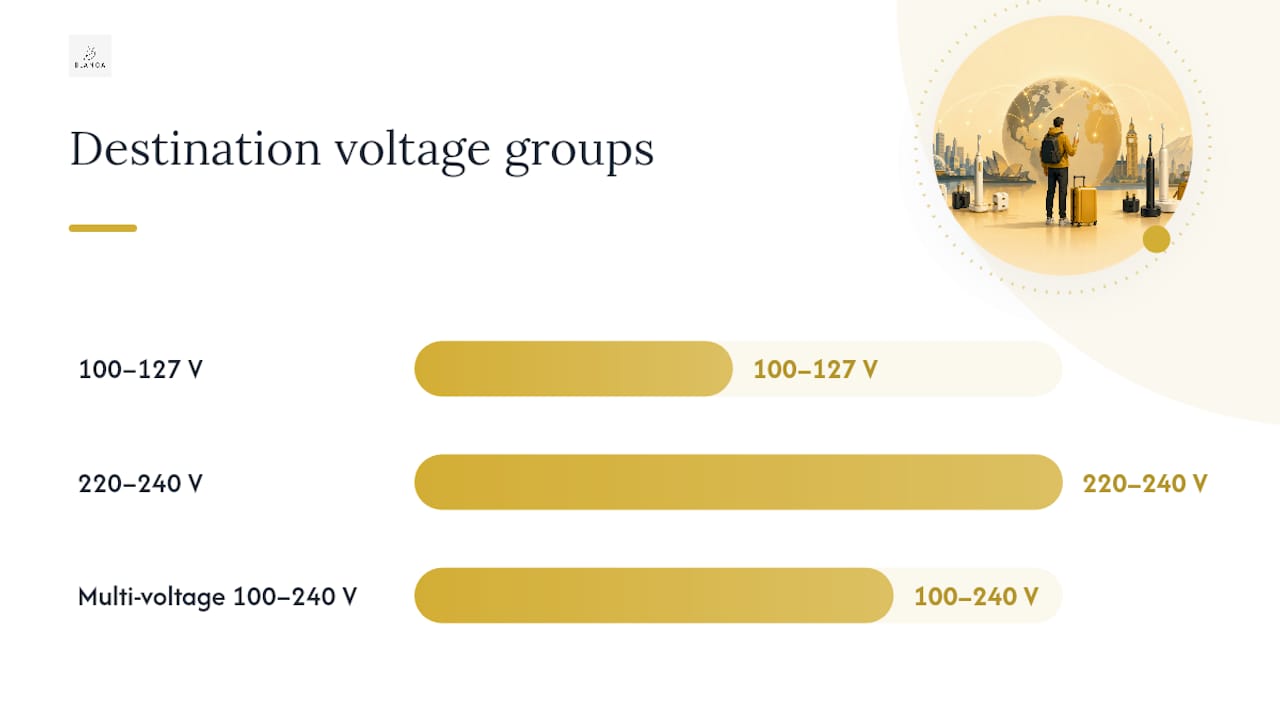
Countries generally fall into two voltage groups: 100 to 127V (North America, Japan, parts of the Caribbean) and 220 to 240V (most of Europe, Asia, Africa, and Australia). A multi-voltage charger doesn’t care which group you’re in, but a single-voltage one absolutely does.
Plug shape is the other variable, and it’s unrelated to voltage. A charger can be perfectly multi-voltage and still not physically fit the wall socket without an adapter for the local plug type.
A few things worth knowing before you pack:
- Some countries, notably Brazil, run mixed voltages depending on the region, so a national default isn’t always reliable.
- Hotel bathrooms sometimes have a dedicated “shaver socket” that’s wired differently from the rest of the room’s outlets, intended for low-wattage devices.
- The IEC’s world plug reference and the crowd-sourced country-by-country electricity guide are both solid places to confirm voltage and plug type before you leave.
- Don’t assume every outlet in a hotel room behaves the same way. Bathroom shaver sockets can have different isolation and current profiles than a bedside outlet.
A universal travel toothbrush adapter with interchangeable pins solves the plug-shape problem for nearly any country. Voltage is the part that still deserves a second look.
Does Frequency (Hz) Matter for Charging?
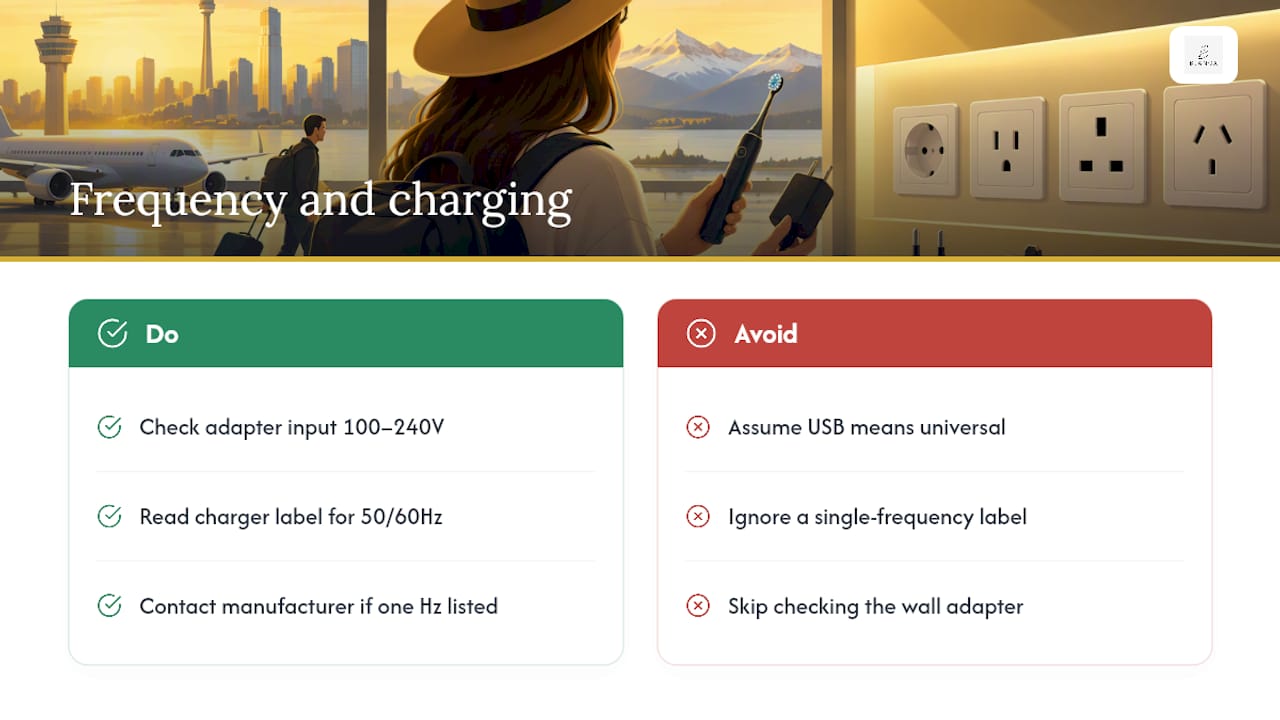
It rarely does, but it’s worth a glance. The “50/60Hz” on a charger label refers to the electrical frequency, and most modern electronics handle both without issue. If your charger’s label lists only one frequency, that’s a signal to double check with the manufacturer before assuming it will run safely elsewhere.
USB and USB-C charging adds a wrinkle travelers often miss. A USB-C cable itself doesn’t determine voltage compatibility. The wall adapter it plugs into does, and that block still needs its own INPUT rating printed on it. A universal toothbrush charger claim only holds if the actual wall brick states 100 to 240V. Don’t assume “it’s USB” means “it’s universal” without checking the block itself.
What Are the Airline Rules for Traveling With a Battery Toothbrush?
Voltage compatibility and battery carriage rules are two completely separate checks, and mixing them up is a common travel mistake. Transport Canada’s guidance on lithium batteries is clear that battery-powered devices belong in carry-on baggage, not checked luggage, and that damaged or recalled batteries shouldn’t fly at all. Airline-specific rules layer on top of that, and many carriers prohibit charging devices mid-flight.
Before you head to the airport:
- Pack your toothbrush in carry-on luggage, never checked bags.
- Lock or tape down the power button so it can’t accidentally activate inside your bag.
- Skip spare batteries. Pack a spare brush head instead, since most modern electric models use sealed, non-removable batteries anyway.
- Follow your specific airline’s device policy, since rules vary carrier to carrier even when Transport Canada’s baseline guidance stays the same.
Separately, Transport Canada’s advisory circular on battery incidents outlines how crews handle a battery thermal event in flight, which is a good reminder that lithium batteries deserve careful handling regardless of where you’re headed.
What Should You Pack for a Trip With an Electric Toothbrush?
A short checklist beats scrambling in an airport gift shop for an overpriced adapter. Before you zip the bag closed, confirm these:
- Charger INPUT confirmed as 100 to 240V, or a converter packed if it isn’t.
- The right plug adapter(s) for every country on your itinerary, since shapes vary even within the same voltage group.
- A spare USB-C cable or small power bank, useful backup if your charger is misplaced or a hotel outlet is occupied.
- A protective travel case to keep the brush head sanitary and the charger from getting crushed in a suitcase.
- The power switch taped or locked, preventing accidental activation in transit.
If your current charger turns out to be single-voltage, a converter is one fix, but buying a genuinely portable electric toothbrush built around USB charging is often the simpler long-term move, since it sidesteps the voltage question entirely on every future trip.
Pro Tip: Pack your charger in a padded pouch inside your carry-on rather than a checked bag. Airport baggage handling is rough on delicate charging contacts, and carry-on storage also satisfies the lithium battery guidance at the same time.
Why Reliable Charging Matters for Your Smile on the Road
Skipping your routine for a week of travel does more damage than most people expect, and a dead toothbrush is one of the easiest ways that happens. We built Blancawhitening around the idea that oral care shouldn’t get harder just because you’re away from home, which is why checking your charger before departure matters as much as packing the toothbrush itself. Confirm that INPUT line, pack smart, and your routine travels as easily as you do. For more on how consistent brushing habits affect long-term results, the oral hygiene research compiled by Lucilla Dental Clinic is worth a look.
— Blanca
Travel-Ready Oral Care That Skips the Guesswork
An electric toothbrush designed around USB charging helps travelers avoid concerns about converters, adapters, or fading voltage labels. USB-charged electric toothbrushes avoid the single-voltage issue by drawing power from various common USB sources like power banks, laptops, or wall adapters.

Instead of packing a bulky converter for a device that might not even need one, browse the BLANCA Electric Toothbrush and the full oral care collection for travel-friendly toothbrushes, replacement heads, and kits designed to survive a suitcase. If you’re shopping for your next trip, check the charger’s INPUT rating on whatever you pick, then add it to your cart with one less thing to worry about at security.
Sources
- Lithium batteries: What you didn’t know about travelling with them — Transport Canada
- Do I Need a Voltage Converter for My Electric Toothbrush, Shaver, or Beauty Device Abroad? — DOACE
FAQ
Do Electric Toothbrushes Use 110V or 240V?
Most modern electric toothbrush chargers accept both, listing an INPUT range of 100 to 240V so they work on either voltage group without a converter, according to DOACE’s travel voltage guidance. Always confirm the exact range printed on your own charger before traveling, since older or single-voltage models are the exception.
Can I Charge My Electric Toothbrush With 220V Power?
Yes, if the charger’s label shows a range like “100–240V,” it’s built to handle 220V power safely with only a plug adapter. If the label shows a single voltage number instead of a range, don’t plug it into a 220V outlet without a proper voltage converter.
Can I Bring My Electric Toothbrush on a Plane?
Yes, electric toothbrushes are allowed on flights, but Transport Canada advises packing lithium-battery devices in carry-on baggage rather than checked luggage. Don’t bring a device with a damaged or recalled battery, and check your specific airline’s rules on in-flight charging.
What Voltage Do Most Electric Toothbrushes Run On?
Many current chargers are rated for a wide INPUT voltage range at standard frequencies, making them suitable for international travel. Corded countertop devices and some older models are the main exceptions, and those may run on a single fixed voltage instead.
How Do I Know if My Charger Needs a Voltage Converter?
Check the INPUT label on the charger itself: a range like “100–240V” means no converter is needed, just a plug adapter for the local outlet shape. A single fixed number, such as “120V” only, means you’ll need a converter to use that charger safely outside its intended region.