

Carbamide vs Hydrogen Peroxide: Which Whitener Fits You?
If you need visible results fast and don’t mind a shorter chairside session, hydrogen peroxide is the faster-acting agent. If you’d rather whiten overnight with less fuss and lower odds of immediate sensitivity, carbamide peroxide is the better match. Both chemistries whiten teeth by releasing oxidizing power into enamel, but they get there on different timelines, which is the whole reason this decision matters.
A scoping review of 57 papers found no clear long-term winner between the two agents when total exposure is comparable, and a randomized controlled trial comparing 3.5% hydrogen peroxide against 10% carbamide peroxide backed that up with nearly identical shade improvement after four weeks. At Blancawhitening, we built our at-home systems around this evidence rather than around whichever chemical sounds more potent on a label.
Here’s a quick map of scenario to agent:
- In-office, need results today: hydrogen peroxide, typically 25 to 40 percent, applied in short bursts under professional supervision.
- Take-home trays worn overnight or for a few weeks: carbamide peroxide, usually 10 to 22 percent, prized for its slow, steady release.
- Whitening strips or short daily sessions: lower-concentration hydrogen peroxide, often 3 to 10 percent, for quick contact time without a tray.
Key Takeaways
Choosing between carbamide peroxide and hydrogen peroxide comes down to matching release speed and wear time to your schedule and sensitivity tolerance, not picking a “stronger” chemical.
| Point | Details |
|---|---|
| Speed determines the pick | Hydrogen peroxide suits fast, short sessions; carbamide peroxide suits slow, overnight wear. |
| Concentration isn’t 1:1 | Roughly 10% carbamide peroxide equals 3 to 3.5% active hydrogen peroxide. |
| Clinical outcomes are comparable | Matched total exposure produces similar shade improvement across both agents. |
| Sensitivity scales with dose and time | Higher concentration and longer contact raise risk regardless of which agent you use. |
| Blancawhitening fits the carbamide use case | Its at-home whitening kits are built for slow-release, overnight-style treatment with desensitizing guidance included. |
This article is general information, not a substitute for advice from a qualified doctor. Consult a qualified healthcare professional about your own circumstances before acting on anything here.
Table of Contents
- Carbamide Peroxide vs Hydrogen Peroxide: How the Chemistry Differs
- Does Carbamide Peroxide Whiten as Well as Hydrogen Peroxide?
- Which Whitening Formats Use Which Agent?
- Which Agent Causes More Sensitivity?
- Who Should Avoid Peroxide Whitening?
- How Do You Choose Between Carbamide and Hydrogen Peroxide?
- What Does the Clinical Research Actually Show?
- Sources
Carbamide Peroxide vs Hydrogen Peroxide: How the Chemistry Differs
Hydrogen peroxide whitens by breaking down directly into water and reactive oxygen species that penetrate enamel and oxidize the pigmented molecules causing stains. Carbamide peroxide takes a longer route to the same destination. It’s a compound of hydrogen peroxide bonded with urea, and once it contacts saliva or moisture, it slowly separates into hydrogen peroxide and urea, releasing its whitening power over a much longer window.
That difference in release speed is why concentration numbers on two different products aren’t directly comparable. As a rule of thumb, 10% carbamide peroxide breaks down to roughly 3 to 3.5% hydrogen peroxide in active strength, since carbamide peroxide is only about a third as concentrated in usable peroxide by weight. A 16% carbamide gel, then, behaves closer to a 5.3% hydrogen peroxide product in terms of oxidizing punch, just delivered on a slower schedule.
The urea released as a byproduct isn’t inert, either. It nudges the local pH slightly upward, which some researchers believe helps offset the acidity peroxide can generate and may play a role in the lower immediate sensitivity some users report with carbamide formulas, according to clinical guidance on tooth bleaching.
Release timing separates the two agents even more clearly:
- Hydrogen peroxide: most of its reactive activity happens in the first 30 to 60 minutes of contact, then tapers off quickly.
- Carbamide peroxide: releases roughly 50% of its whitening power in the first two hours, then keeps working for another six to eight hours.
| Factor | Hydrogen Peroxide | Carbamide Peroxide |
|---|---|---|
| Mechanism | Direct release of reactive oxygen | Breaks down into hydrogen peroxide + urea |
| Peak activity | First 30 to 60 minutes | Continues for several hours |
| Equivalent strength | Full concentration is active | ~1/3 of labeled % is active HP |
| Typical setting | In-office, short at-home sessions | Overnight trays, multi-week regimens |
Does Carbamide Peroxide Whiten as Well as Hydrogen Peroxide?
Yes, when the total peroxide exposure is roughly equal, clinical evidence shows the two agents land in the same place. Differences in outcome tend to trace back to how a product is used, not which molecule is doing the oxidizing.
The clearest data point here comes from a randomized trial that had participants apply either 3.5% hydrogen peroxide with potassium nitrate or 10% carbamide peroxide for three hours a day over four weeks. Both groups improved by close to 4.8 Vita shade tabs, and the difference between them wasn’t statistically significant.
A scoping review of 57 studies spanning 2017 to 2023 reached a similar conclusion: both agents are clinically effective, and the review recommended choosing based on patient preference rather than assuming one is superior.
Where studies do show a split, it’s usually about speed and comfort rather than final shade:
- Hydrogen peroxide tends to produce visible change faster, sometimes within a single in-office visit, because its full concentration acts immediately.
- Some trials note slightly lower short-term sensitivity with carbamide peroxide, likely tied to its slower release curve and the buffering effect of urea.
- In-office protocols concentrate a high dose into a short window; at-home carbamide protocols spread a lower dose across weeks. Total cumulative exposure, not the label percentage alone, drives the eventual result.
A methodological caveat matters here. Many of the enamel-level findings come from in vitro work, meaning extracted teeth or lab models rather than living patients, and sample sizes in some RCTs are small. That doesn’t undercut the parity finding, but it does mean you should read “equally effective” as “equally effective under matched protocols,” not as a guarantee that any two products labeled with different chemicals will behave identically on your smile.
Which Whitening Formats Use Which Agent?
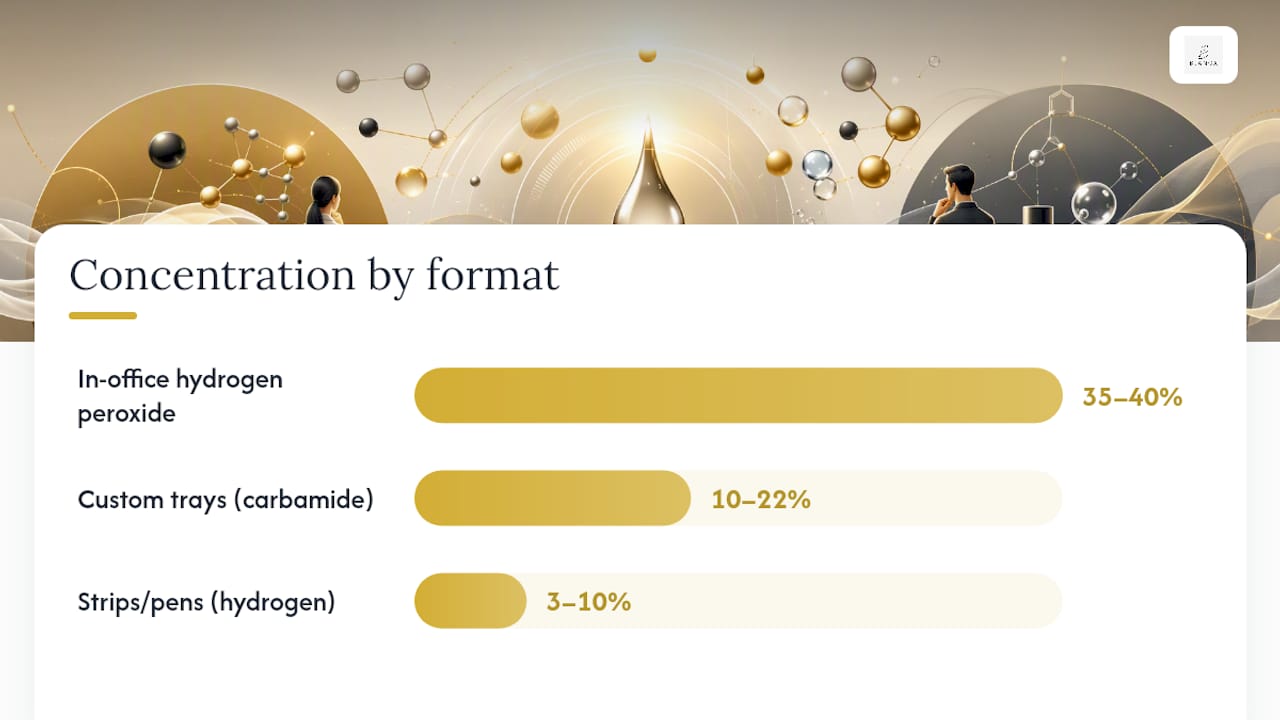
Hydrogen peroxide dominates fast formats: single in-office visits and short daily at-home sessions. Carbamide peroxide dominates slow formats: custom trays worn overnight or for a few hours nightly across several weeks.
Concentration and wear time move together by design:
- 35 to 40% hydrogen peroxide, in-office: applied in one or two 15 to 20 minute increments during a single dental visit, often with a curing light or heat source to accelerate the reaction.
- 10 to 22% carbamide peroxide, custom trays: worn 2 to 4 hours during the day or overnight, repeated nightly for 1 to 3 weeks depending on starting shade.
- 3 to 10% hydrogen peroxide, strips or pens: applied for 15 to 60 minutes once or twice daily, typically for 1 to 2 weeks.
Delivery hardware matters as much as the chemical inside it. Custom-fit trays, like those from ClearRetain’s bleaching tray line, hold gel evenly against enamel and limit gum contact, which is part of why carbamide formulas pair so naturally with tray-based systems. Prefilled disposable trays and strips skip the custom-fit step for convenience, usually at the cost of some coverage precision. Whitening pens tend to carry hydrogen peroxide gels meant for quick touch-ups rather than sustained wear.
What ties every format together is cumulative exposure. A patient doing three 20-minute in-office hydrogen peroxide sessions gets roughly an hour of high-concentration contact total. A patient wearing 16% carbamide trays for two hours nightly over two weeks accumulates around 28 hours of lower-concentration contact. Both can land on a similar final shade, but skipping nights or cutting sessions short in either protocol is the most common reason results fall short.
Which Agent Causes More Sensitivity?
Both agents can cause reversible tooth sensitivity and mild gum irritation, and risk climbs with higher concentration and longer exposure, not with one chemical name over the other.
The patterns differ somewhat in how sensitivity shows up:
- Hydrogen peroxide: acts fast and at higher concentrations in-office, and in vitro testing found 37.5% hydrogen peroxide produced the most pronounced enamel surface changes among the agents studied, including reductions in surface microhardness.
- Carbamide peroxide: its slower release generally produced intermediate enamel surface changes in the same lab comparison, and some clinical reports link it to lower immediate post-treatment sensitivity.
- Gingival irritation: tied more to tray fit, gel overflow, and contact time than to which peroxide is used, per the RCT comparing the two, which found irritation unrelated to product choice.
Pro Tip: Start with a desensitizing toothpaste containing potassium nitrate about two weeks before you begin whitening, and keep using it during treatment. Spacing sessions every other day instead of daily, or dropping to a lower concentration, often resolves sensitivity without abandoning the whitening plan entirely.
If sensitivity turns into sharp, lingering pain, or you notice white spots, gum blanching, or bleeding, stop treatment and check in with a dental professional before continuing. Our guide to safe hydrogen peroxide use walks through dosing and timing adjustments in more detail.
Who Should Avoid Peroxide Whitening?
Children under 14, pregnant or lactating people, and anyone with extensive untreated decay or active gum disease should hold off on peroxide whitening until a dentist clears it. The same caution applies after recent dental work like fillings or extractions, where manufacturer or dentist-specific guidance should override any general product instructions.
Storage and handling differences carry their own safety weight:
- Carbamide peroxide is chemically more stable in storage and typically holds its potency longer at room temperature.
- Hydrogen peroxide degrades faster and often benefits from refrigeration to preserve its strength between uses.
- Avoid mucosal contact with either agent, follow dilution instructions exactly, and never combine leftover gels from different products to “boost” concentration.
- Don’t substitute a higher-concentration product for a lower one just because you have it on hand. Wear time and formulation are calibrated together, not interchangeable.
High-concentration hydrogen peroxide products belong under professional supervision, not in an unsupervised DIY mix. Clinical guidance on tooth bleaching consistently flags dental oversight as a requirement for stronger in-office formulations, precisely because tissue contact risk rises sharply above consumer-grade concentrations.
Rules on peroxide concentration limits vary by region and by whether a product is dispensed through a dentist or sold over the counter, so check local dental guidelines if you’re unsure what’s permitted for at-home use where you live.
How Do You Choose Between Carbamide and Hydrogen Peroxide?
Pick your agent based on how fast you need results, how much sensitivity you can tolerate, and which delivery format actually fits your routine.
The decision breaks down into three questions:
- Need results in a day or two? Choose hydrogen peroxide, ideally an in-office session or a higher-concentration short at-home protocol.
- Prefer low-maintenance, overnight treatment? Choose carbamide peroxide in custom trays. It asks less of your schedule and spreads exposure out gently.
- Have a history of sensitive teeth? Start with a lower-concentration carbamide peroxide tray, or pair hydrogen peroxide with a desensitizing adjunct and professional oversight.
A few sample regimens make the trade-offs concrete.
If you have crowns, veneers, or visibly uneven staining between teeth, a consultation matters more than a product choice. Restorative materials don’t whiten the way natural enamel does, and a dentist can flag that mismatch before you spend weeks on a regimen that won’t touch it. Our comparison of professional versus at-home whitening breaks down cost and timeline trade-offs in more depth.
What Does the Clinical Research Actually Show?
Systematic reviews and randomized trials generally agree: carbamide peroxide and hydrogen peroxide produce comparable clinical whitening when total peroxide exposure is similar, with protocol design accounting for most of the variability between studies.
The strongest pieces of evidence line up as follows:
- The scoping review of 57 papers concluded neither agent holds a clear long-term advantage and recommended matching the agent to patient preference.
- The RCT comparing 10% carbamide peroxide to 3.5% hydrogen peroxide found statistically indistinguishable shade improvement after four weeks of daily use.
- In vitro enamel-morphology testing found high-concentration hydrogen peroxide (37.5%) caused the most surface change, carbamide peroxide (35%) an intermediate amount, and phthalimidoperoxycaproic acid the least, a finding worth knowing if enamel-friendliness weighs heavily in your decision.
The main limitation across this evidence base is heterogeneity. Studies vary in concentration, exposure time, outcome measurement (shade guides versus spectrophotometers), and follow-up length, which makes exact cross-study comparisons imprecise even when the general conclusion, that both agents work, holds steady.
A Dental-Led View on Choosing Between the Two
When I’m advising someone on which agent to use, I weigh three things: how fast they need to see change, how their teeth have handled sensitivity before, and how much daily effort they’re willing to put in. An athlete with a competition in five days is a hydrogen peroxide candidate almost by default. A parent juggling three kids’ schedules who can commit to wearing a tray while they sleep is a far better fit for carbamide peroxide’s slow, forgiving release. Neither choice is more “correct” than the other. If you have restorations, a history of severe sensitivity, or stains that look uneven rather than uniform, talk to a dental professional before starting either protocol.
A Slow-Release Option Built Around the Evidence
If the carbamide peroxide case sounds like your situation, the appeal is real: overnight wear, sustained release, and typically gentler sensitivity than a high-concentration in-office jolt. Blancawhitening’s at-home whitening collection is built around that slow-release logic, with formulations designed for consistent nightly use rather than a one-time high-dose hit.
Every kit ships with clear application timing and desensitizing guidance, so you’re not left guessing how long to wear a tray or what to do if your teeth feel tender on day three. If overnight, low-effort whitening fits how you actually live, start with the at-home collection and follow the wear schedule included with your kit.
Sources
- Efficacy of Carbamide and Hydrogen Peroxide Tooth Bleaching Techniques in Orthodontic and Restorative Dentistry Patients: A Scoping Review
- Comparison of the clinical efficacy and safety of carbamide peroxide and hydrogen peroxide in at-home bleaching gels
- Phthalimidoperoxycaproic Acid (PAP) Versus Peroxides and Impact on Dental Enamel After Whitening Treatment: An In Vitro Study
- Carbamide peroxide vs hydrogen peroxide: Which is best?
- Clinical guidance and safety notes for tooth bleaching