

Hydrogen Peroxide Teeth Whitening: Safe Use Guide
Hydrogen peroxide teeth whitening is the process of using hydrogen peroxide as a bleaching agent to lighten tooth discoloration through a chemical oxidation reaction. Dental professionals recognize it as one of the most studied whitening methods available, with clinical research supporting its safety and effectiveness at concentrations between 3% and 6% for home use. The American Dental Association acknowledges peroxide-based agents as the standard active ingredient in both at-home and professional whitening treatments. Understanding how this compound works, which concentrations are appropriate, and how to apply it correctly makes the difference between a brighter smile and unnecessary sensitivity.
How does hydrogen peroxide whiten teeth?
Hydrogen peroxide whitens teeth by penetrating the outer enamel layer and reaching the dentin beneath, where it breaks apart chromogenic molecules. These are the organic compounds responsible for the yellow and brown stains you see on your teeth. The process is called oxidation. Hydrogen peroxide releases reactive oxygen species that attack the chemical bonds holding stain molecules together, effectively decolorizing them.
Two types of stains respond differently to this process:
- Extrinsic stains sit on the enamel surface and come from coffee, tea, red wine, and tobacco. These respond quickly to peroxide treatment.
- Intrinsic stains are embedded deeper in the dentin, often caused by aging, certain medications, or fluorosis. These require longer treatment times and higher concentrations to address.
A randomized controlled trial found that low-concentration whitestrips using 3% hydrogen peroxide improved digital shade meter values from 72.86 to 78.73 across 70 adult participants over 14 days. That improvement represents a measurable, visible change in tooth color from a concentration available without a prescription.
Pro Tip: Hydrogen peroxide continues oxidizing stains after you remove the whitening product. Wait at least 30 minutes before brushing to let the reaction complete and protect your enamel from mechanical damage.
The oxidation reaction also explains why expired hydrogen peroxide loses its effectiveness. Once the solution stops bubbling when tested, it has broken down into water and oxygen and will no longer whiten. Always check your product’s freshness before starting a treatment cycle.
What concentrations of hydrogen peroxide are safe for home use?
The concentration of hydrogen peroxide in a whitening product determines both its speed and its risk profile. At-home products typically use concentrations between 3% and 6%, while professional in-office treatments use 25% to 40%.
| Concentration | Setting | Typical Duration | Sensitivity Risk |
|---|---|---|---|
| 3% | At-home (OTC) | 10–14 days | Low |
| 6% | At-home (prescribed or OTC) | 10 days | Moderate |
| 10% carbamide peroxide | At-home (dentist-dispensed) | 14 days | Low to moderate |
| 25–40% | In-office only | 60–90 minutes | High without protection |
A clinical study comparing home whitening agents found that a 10-day regimen with 6% hydrogen peroxide produced whitening results equivalent to a 14-day treatment with 10% carbamide peroxide. The 6% group reported higher tooth sensitivity, which confirms that concentration affects comfort more than it affects the final result.
Meta-analyses reinforce this point. Increasing concentration beyond 25–35% does not significantly improve whitening outcomes but does increase sensitivity. The primary effect of raising concentration is more discomfort, not a whiter smile.
Pro Tip: If you experience sensitivity during a whitening cycle, switch to a 3% product and extend the treatment duration rather than pushing through with a higher concentration. The end result will be nearly identical.
For most people seeking at-home whitening, a 3% to 6% product used consistently over 10 to 14 days delivers real results without the sensitivity risks that come with stronger formulations. Reviewing a whitening schedule guide before starting helps you plan treatment frequency and avoid overuse.
How to safely use hydrogen peroxide for teeth whitening at home
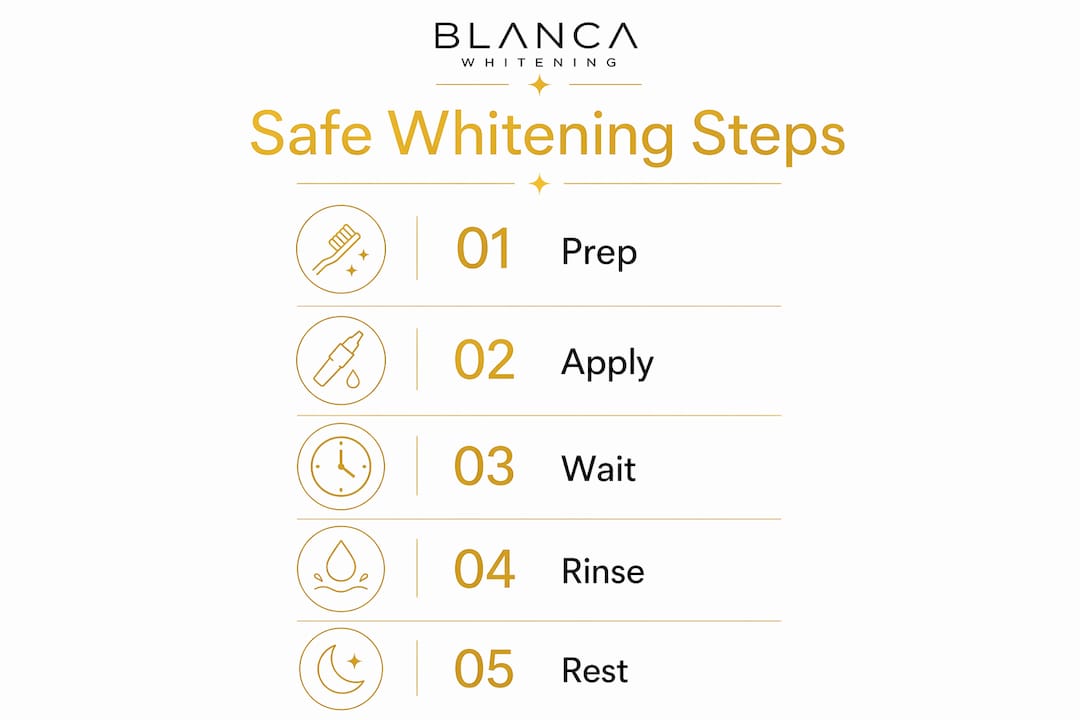
Safe application comes down to three factors: product format, frequency, and timing. Following these steps protects your enamel and gums while maximizing results.
- Choose a gel or strip format over a rinse. Effective whitening requires the peroxide to stay in contact with your teeth long enough to oxidize stains. Simple rinses with dilute peroxide lack the adhesive properties needed to maintain contact and wash away quickly in saliva. Gels and strips are formulated to cling to enamel.
- Follow the product’s recommended duration. Most at-home strips and gels specify 30 minutes per session. Do not extend sessions hoping for faster results. Longer contact time at low concentrations does not accelerate whitening but does increase irritation risk.
- Limit treatment cycles. Use whitening products for the full recommended cycle, then take a break of at least four to six weeks before repeating. Continuous use raises the risk of enamel erosion and pulpal inflammation.
- Wait 30 minutes before brushing. Hydrogen peroxide continues reacting after you remove the product. Brushing immediately afterward can damage softened enamel.
- Consult your dentist before starting. Dental professionals recommend evaluation to identify contraindications like cavities, enamel erosion, or existing restorations that could be harmed by peroxide exposure.
Avoid these common mistakes:
- Using undiluted 3% drugstore hydrogen peroxide as a daily rinse. It lacks the formulation to whiten effectively and can irritate oral tissue with repeated use.
- Whitening over cracked enamel or untreated cavities. Peroxide penetrates through damaged areas and causes sharp, lasting sensitivity.
- Combining multiple whitening products simultaneously. Stacking a whitening toothpaste, strips, and a rinse at the same time multiplies sensitivity risk without multiplying results.
Reading the safe whitening practices guide from Blancawhitening gives you a clear framework for building a safe routine around these principles.
At-home vs. professional hydrogen peroxide whitening: what’s the difference?
The core difference between at-home and professional whitening is concentration, speed, and supervision. Both methods use hydrogen peroxide as the active agent. The delivery system and the clinical environment separate them.
In-office treatments use 25–40% hydrogen peroxide and achieve rapid whitening in 60 to 90 minutes. Dentists apply protective barriers to your gums before treatment to prevent chemical burns from high-concentration gel. The speed is real, but so is the sensitivity risk without that professional protection.
At-home products work more gradually. A 3% to 6% product used over 10 to 14 days produces comparable final results for most people, just on a longer timeline. The trade-off is patience, not effectiveness. For people with existing sensitivity, the slower approach is often more comfortable and just as satisfying in the end.
Professional treatments also use custom-fitted trays that hold the gel precisely against tooth surfaces. This improves contact and reduces the chance of gel touching gum tissue. Over-the-counter strips and trays are designed to fit a range of mouth shapes, which means coverage is generally good but not perfectly tailored.
Cost and convenience favor at-home options significantly. Professional sessions require appointments and carry a higher price point. At-home kits from a brand like Blancawhitening let you whiten on your own schedule without the clinical overhead. For people with dental restorations like crowns or veneers, reviewing guidance on whitening after dental work is worth doing before choosing either method, since peroxide does not change the color of artificial materials.
If you want professional-level results with clinical supervision, expert whitening treatments that emphasize safety and consultation offer a supervised alternative to purely DIY approaches.
Key Takeaways
Low-concentration hydrogen peroxide used consistently over 10 to 14 days delivers measurable whitening results with manageable sensitivity, making it the most practical and safe choice for at-home use.
| Point | Details |
|---|---|
| Concentration drives sensitivity, not results | Raising concentration above 6% increases discomfort without significantly improving whitening outcomes. |
| Gel and strip formats outperform rinses | Adhesive formulations maintain tooth contact; dilute rinses wash away before oxidation can occur. |
| 30-minute post-application wait protects enamel | Brushing too soon after whitening damages softened enamel; always wait before brushing. |
| Dentist evaluation prevents harm | Cavities and enamel erosion are contraindications; a dental check before whitening avoids serious sensitivity. |
| At-home results match professional outcomes over time | A 14-day at-home cycle produces comparable shade improvement to in-office sessions, just more gradually. |
What I’ve learned about whitening patience and peroxide myths
The most persistent myth in teeth whitening is that stronger products work faster and better. The research does not support this. Concentration past a certain threshold adds sensitivity, not speed. I’ve seen people push through discomfort with high-concentration products and end up with more sensitivity and no better result than someone who used a 3% strip for two weeks.
The second myth is that daily use accelerates results. It does not. Enamel needs recovery time between sessions. Overuse causes pulpal inflammation, which is the kind of deep tooth sensitivity that can last weeks. Patience is not a limitation of at-home whitening. It is the mechanism.
My honest recommendation is to start with the lowest effective concentration, follow the cycle exactly, and give your teeth a break before repeating. If you have any doubt about your enamel health or existing dental work, read through the questions to ask before whitening and talk to your dentist first. The people who get the best long-term results are the ones who treat whitening as a consistent practice, not a quick fix.
— Blanca
Blancawhitening’s at-home whitening collection
Blancawhitening was founded by dental professionals who wanted to make clinically backed whitening accessible without a dentist’s chair. Every product in the at-home whitening collection is formulated with hydrogen peroxide concentrations designed for safe, gradual results at home.
The collection includes whitening strips and gels built to maintain proper tooth contact throughout each session, the key factor that separates effective products from ineffective rinses. If you want to see what’s currently available at a reduced price, the current sales page lists active offers across the full range. Every product comes with clear usage instructions and is designed to work within the safe concentration guidelines outlined in this article.
FAQ
Is hydrogen peroxide safe for daily teeth whitening?
Daily use is not recommended. Repeated exposure raises the risk of enamel erosion and pulpal inflammation. Most clinical protocols call for treatment cycles of 10 to 14 days followed by a break of at least four to six weeks.
What is the best hydrogen peroxide concentration for at-home whitening?
A concentration of 3% to 6% is the most effective and safest range for at-home use. Research shows that 3% whitestrips produce measurable shade improvement over 14 days, and 6% products match the results of stronger carbamide peroxide formulations with a shorter treatment window.
Can I use drugstore hydrogen peroxide to whiten my teeth?
Standard 3% drugstore hydrogen peroxide lacks the adhesive properties needed for effective whitening. It washes away in saliva before it can oxidize stains. Whitening gels and strips are specifically formulated to maintain contact with enamel long enough to work.
Does higher concentration hydrogen peroxide whiten teeth faster?
Not significantly. Meta-analyses show that concentrations above 25–35% do not improve whitening efficacy compared to lower concentrations. The main effect of higher concentration is increased tooth sensitivity, not a faster or better result.
Should I see a dentist before whitening at home?
Yes. Dental professionals recommend an evaluation before starting any whitening treatment to check for cavities, enamel erosion, or restorations that could be damaged by peroxide. Whitening over untreated dental issues causes sharp, lasting sensitivity that is avoidable with a simple checkup.