

Professional vs At-Home Whitening: 2026 Complete Guide
Both professional and at-home whitening methods effectively brighten teeth, but they differ significantly in speed, peroxide concentration, cost, and how much supervision you receive. In-office whitening uses hydrogen peroxide at professional-strength concentrations to deliver multiple shades of improvement in a single appointment. Dentist-supervised take-home kits use carbamide peroxide at moderate concentrations over weeks for several shades of improvement. Over-the-counter products contain lower concentrations and typically achieve modest shade improvements over several weeks. The right choice depends on your timeline, budget, sensitivity history, and how much flexibility you need.
| Dimension | In-office professional | Dentist take-home | OTC products |
|---|---|---|---|
| Speed of results | 60–90 minutes, one visit | 2–4 weeks | 4–8 weeks |
| Whitening agent strength | 35–40% hydrogen peroxide | 10–22% carbamide peroxide | 3–10% hydrogen peroxide |
| Typical shade improvement | 6–12 shades | 4–8 shades | 1–3 shades |
| Cost | Highest | Moderate | Lowest |
| Safety and sensitivity risk | Managed by dentist | Customizable, lower risk | Variable, no supervision |
| Convenience | Single clinic visit | At home, flexible schedule | Pharmacy, no appointment |
| Duration of results | 1–3 years | 1–3 years | Weeks to months |
Why do teeth discolor in the first place?
Understanding what causes staining helps you choose the whitening method most likely to work for your specific situation.
Extrinsic stains form on the outer enamel surface and are the most common type. They come from:
- Coffee, tea, and red wine, which deposit tannins and chromogens onto enamel
- Tobacco use, which leaves tar and nicotine residue that penetrates surface layers
- Certain foods like berries, tomato sauce, and soy sauce
- Poor oral hygiene that allows plaque and tartar to accumulate
Intrinsic stains originate inside the tooth structure itself and are harder to treat:
- Aging, which thins enamel and exposes the naturally yellow dentin beneath
- Trauma to a tooth, which can cause internal bleeding and gray discoloration
- Tetracycline antibiotics taken during childhood, which bind to dentin and cause deep banding
- Fluorosis from excessive fluoride exposure during tooth development
Extrinsic stains respond well to both professional and at-home whitening. Intrinsic stains, particularly those from tetracycline or trauma, often require professional-strength treatment or, in severe cases, restorative options like veneers.
How does teeth whitening actually work?
All teeth whitening, whether in a dental office or at home, relies on the same fundamental chemistry: oxidation.
Bleaching agents penetrate enamel prism structures and oxidize pigmented molecules by breaking double bonds in chromophores, the molecules responsible for tooth color. This chemical reaction renders those pigments lighter or colorless, producing a visibly whiter tooth. Hydrogen peroxide is the active bleaching radical in both systems; carbamide peroxide simply decomposes into hydrogen peroxide and urea before the same reaction occurs.
The key variable between methods is concentration and contact time. In-office techniques deliver a strong dose in a short time, while at-home techniques use a weaker dose over an extended period to achieve a comparable effect. Think of it as the difference between a sprint and a long run: both cover the same ground, just at different paces.
Carbamide peroxide breaks down more slowly than hydrogen peroxide, which is why it suits overnight or extended-wear trays. The slower release also tends to be gentler on enamel and surrounding gum tissue, a real advantage for people with sensitivity concerns.
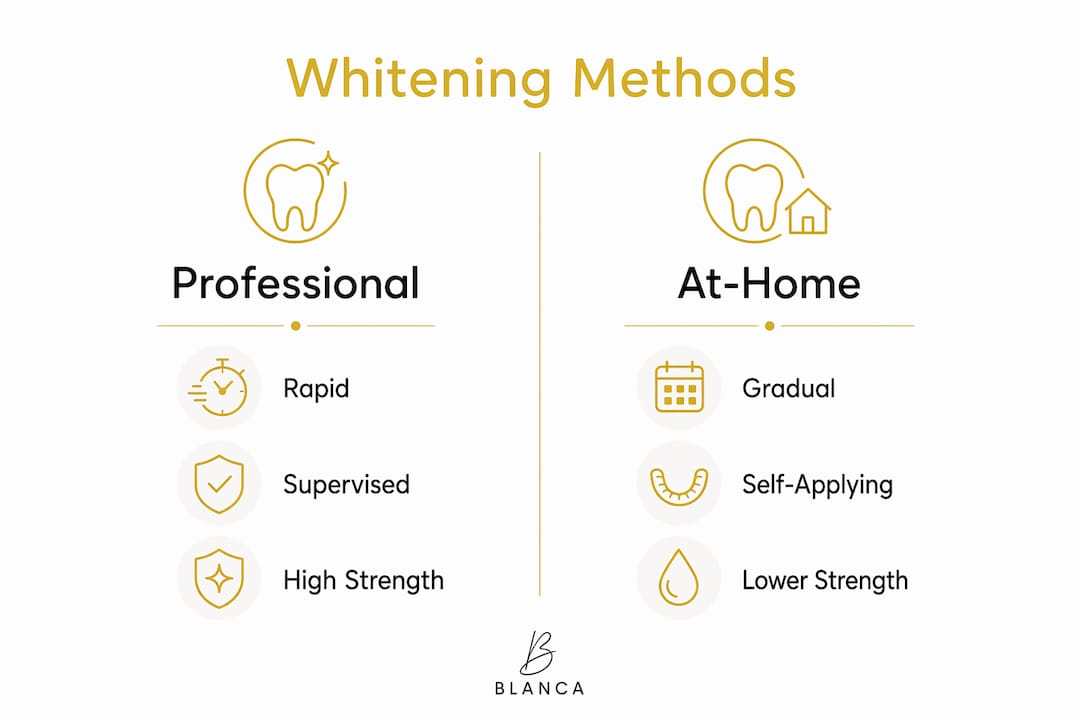
What whitening options are available to you?
Three main categories cover the full spectrum of teeth whitening methods available in the United States today.
Professional in-office whitening uses high-concentration hydrogen peroxide gel applied directly to teeth by a trained dental professional. Gum tissue is protected with a barrier throughout the procedure. Some systems use LED or laser light to accelerate the reaction. The entire process takes 60–90 minutes and produces visible results immediately.
Dentist-supervised take-home kits involve custom trays fabricated from impressions of your teeth, filled with professional-grade carbamide peroxide gel. You wear them for a prescribed period each day, typically 30–60 minutes or overnight, over 2–4 weeks. The custom fit keeps gel evenly distributed across tooth surfaces while minimizing contact with gums.
Over-the-counter products include whitening strips, paint-on gels, generic boil-and-bite trays, and whitening toothpastes. These are available without a prescription and require no dental visit.
| Method | Active agent | Typical shade change | Treatment duration |
|---|---|---|---|
| In-office professional | 35–40% hydrogen peroxide | 6–12 shades | 60–90 minutes |
| Dentist take-home trays | 10–22% carbamide peroxide | 4–8 shades | 2–4 weeks |
| OTC strips and gels | 3–10% hydrogen peroxide | 1–3 shades | 4–8 weeks |
| Whitening toothpaste | Mild abrasives, low peroxide | Surface stain removal only | Daily use, ongoing |
Key differences between professional and at-home whitening
The professional vs at-home whitening comparison comes down to five practical dimensions that affect your daily life and your final result.
Speed. In-office treatment delivers noticeable whitening in a single appointment. At-home methods, even dentist-supervised ones, require consistent daily use over weeks. If you have a wedding, job interview, or event in the next few days, in-office is the only realistic option.
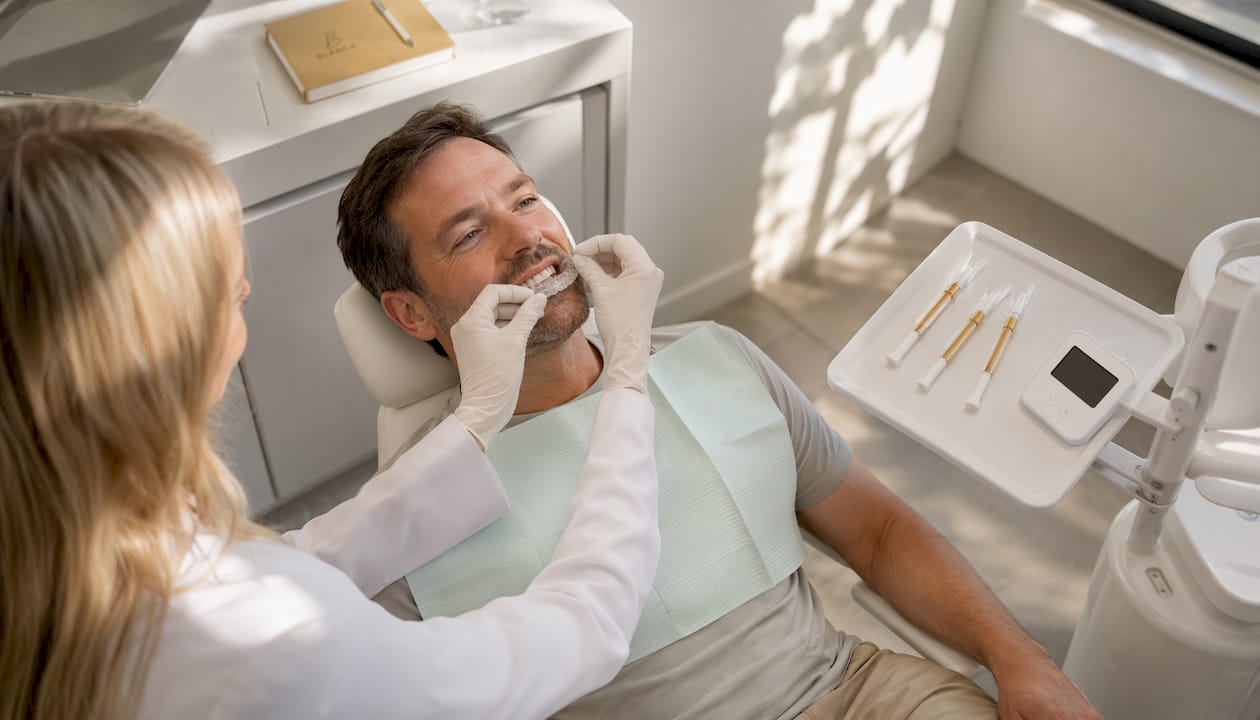
Whitening agent strength and supervision. Professional oversight minimizes gum irritation and sensitivity risks by customizing gel concentration and tray fit through comprehensive Flat-Rate Injectables Menu services at a professional clinic like Continuum Bio-Beauty Austin. OTC products offer no such customization. A dentist can also screen for cavities or gum disease before treatment, conditions that can turn whitening into a painful experience if left undetected.
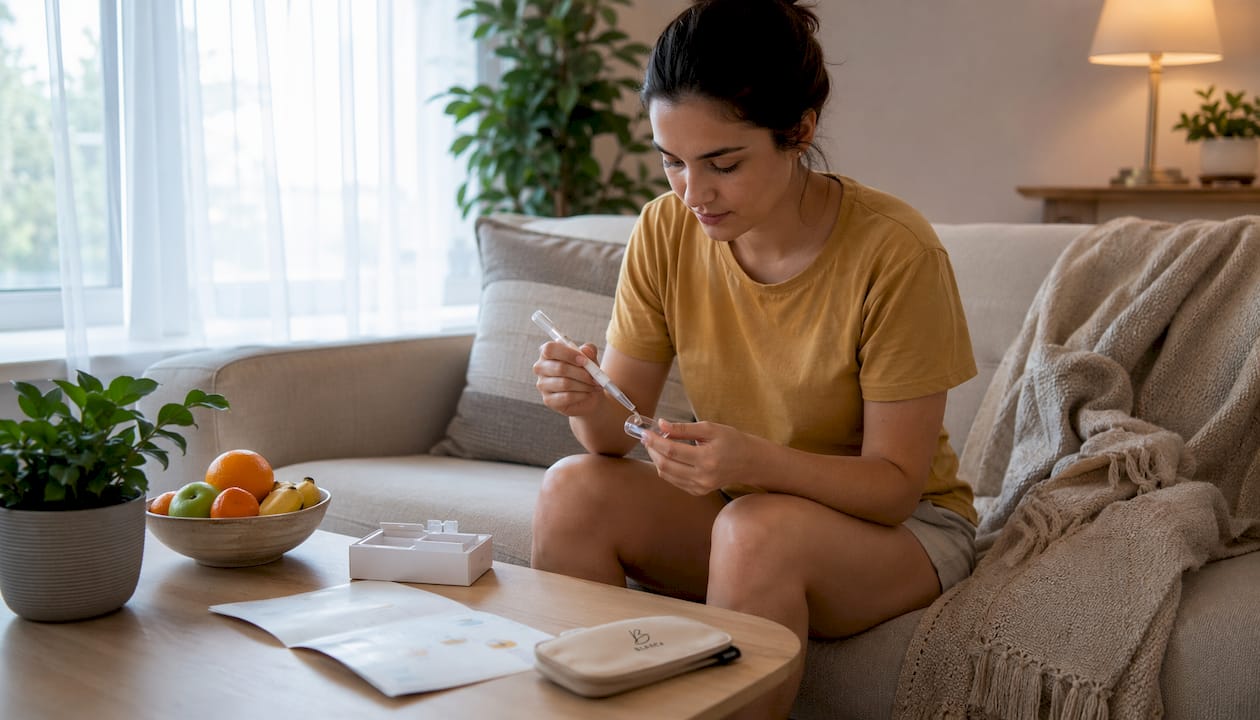
Effectiveness over time. Research shows that at-home whitening can achieve equal or greater whitening than in-office treatment when used consistently, though in-office offers faster, more controlled results. Neither method has a clear superiority in final shade outcome when protocols are properly followed.
Cost and convenience. In-office treatment carries the highest upfront cost but requires only one or two visits. At-home kits cost less and fit around your schedule, though they demand daily commitment. OTC products are the most affordable but deliver the most modest results.
Longevity. Whitening results typically last 1–3 years depending on diet, oral hygiene, and smoking habits. At-home treatments may have a slight edge in maintaining color over time because touch-ups are easier to perform with existing trays.
How much does whitening cost, and how long does it take?
Cost and time commitment vary widely across the three whitening categories, and both factors deserve honest consideration before you commit.
- In-office professional whitening: Typically ranges from $300 to $1,000 per session in the United States, depending on the system used and the dental practice’s location. Results appear within a single 60–90 minute appointment.
- Dentist-supervised take-home kits: Generally cost $150 to $400, which includes the custom tray fabrication and the initial gel supply. Treatment takes 2–4 weeks of daily use, but the trays are reusable for future touch-ups, lowering the long-term cost.
- OTC whitening strips and gels: Available for $20 to $60 at most pharmacies. Results take 4–8 weeks of consistent use and are more modest. Replacing products regularly to maintain even a subtle difference adds up over time.
Scheduling also plays a role. In-office treatment requires one or two dental appointments, which may not suit people with tight schedules or dental anxiety. At-home options fit into your routine at whatever time works for you, whether that is during a morning routine or overnight. If you are weighing affordability and flexibility comparisons, dentist-supervised take-home kits often represent the best balance of professional-grade results and manageable cost.
Safety, sensitivity, and what to watch for
Tooth sensitivity is the most common side effect of any whitening method, but the experience differs meaningfully between professional and at-home approaches.
In-office whitening may cause higher-intensity sensitivity immediately after treatment, while at-home treatments tend to produce milder but more prolonged sensitivity throughout the treatment period. The overall likelihood of experiencing some sensitivity is similar for both. No permanent enamel damage has been documented with either method when used as directed.
Key safety considerations by method:
- In-office: Gum tissue is protected with a physical barrier during application. A dentist monitors the entire process and can stop or adjust treatment if sensitivity becomes uncomfortable.
- Dentist take-home: Custom trays ensure even gel distribution and reduce gum irritation. Gel concentration can be adjusted based on your sensitivity history.
- OTC products: Generic strips and trays are not custom-fitted, which means gel can leak onto gum tissue and cause irritation. There is no dental screening beforehand, so existing cavities or gum disease may go undetected.
People with receding gums, existing dental restorations, or a history of sensitivity should consult a dentist before starting any whitening treatment. Veneers, crowns, and fillings do not respond to peroxide-based agents, so a dentist can plan treatment to ensure your natural teeth match your existing restorations.
Pro Tip: Use a desensitizing toothpaste containing potassium nitrate for two weeks before starting whitening. This helps calm nerve endings in the dentin and reduces the likelihood of post-treatment discomfort. For minimizing whitening sensitivity, pre-treatment preparation makes a measurable difference.
How long do whitening results last, and how do you maintain them?
The most durable whitening outcomes come from combining methods, not relying on a single treatment.
Combining in-office whitening with at-home maintenance trays can maintain color stability for up to two years. Without any maintenance, stains typically return within 12 months. A combined in-office and at-home protocol leverages the rapid initial whitening of in-office treatment with the long-term stability that regular at-home touch-ups provide.
Recommended maintenance strategies:
- Use a whitening toothpaste daily to slow surface stain accumulation
- Perform a brief touch-up with take-home trays every 6–12 months
- Limit coffee, tea, red wine, and tobacco in the days immediately after whitening, when enamel pores are most open
- Rinse with water after consuming staining foods or drinks
- Keep your custom trays stored properly so they remain usable for future touch-ups
Statistic callout: Clinical evidence shows that color stability lasts up to two years with combined in-office and at-home protocols, compared to relapse within 12 months when no maintenance is performed.
For practical guidance on extending whitening results, the maintenance phase matters as much as the initial treatment.
Key Takeaways
Both professional and at-home whitening produce comparable shade improvements when protocols are followed correctly. The deciding factors are speed, budget, sensitivity tolerance, and how committed you are to ongoing maintenance.
| Point | Details |
|---|---|
| In-office speed advantage | In-office whitening delivers 6–12 shades of improvement in a single 60–90 minute appointment using 35–40% hydrogen peroxide. |
| At-home long-term value | Dentist-supervised take-home kits using 10–22% carbamide peroxide achieve 4–8 shades over 2–4 weeks at a lower cost than in-office treatment. |
| Combined protocol durability | Combining in-office and at-home maintenance can maintain color stability for up to two years. |
| Sensitivity management | Professional supervision allows gel concentration and tray fit to be customized, reducing sensitivity risk. |
| Blancawhitening option | Blancawhitening offers clinically backed at-home whitening kits developed by dental professionals for safe, effective results. |
The case for knowing what you actually want before you whiten
Most people approach the professional vs at-home whitening decision backwards. They start by asking which method is “better” when the more useful question is: what does your life actually look like for the next four weeks?
If you have a specific event coming up, in-office treatment is the only method that delivers a visible result before you walk out the door. But if your schedule is unpredictable, your sensitivity runs high, or your budget is limited, a dentist-supervised take-home kit often produces results that are just as impressive over time. Research supports this: at-home bleaching appears to provide effective long-term results, with color stability lasting up to 2.5 years in cases without severe initial discoloration.
What gets underestimated is the maintenance phase. People invest in a professional treatment, see great results, and then do nothing for two years. The color fades, they repeat the full treatment, and the cycle continues at full cost. A brief touch-up with take-home trays every six months is far more cost-effective than repeated in-office sessions.
The other thing worth saying plainly: OTC strips are not a substitute for either professional method if your staining is moderate to deep. They work for mild surface staining, and they are a reasonable maintenance tool between professional treatments. But expecting them to match a custom-tray protocol is setting yourself up for disappointment.
Pro Tip: Before committing to any whitening method, ask your dentist to assess your stain type. Extrinsic stains from coffee or wine respond quickly to peroxide-based agents. Intrinsic stains from aging or medication require higher concentrations and more time, and some may not respond to bleaching at all.
Blancawhitening: professional-grade whitening designed for real life
Brighter teeth should not require choosing between results and safety. Blancawhitening was founded by dental professionals who understood that gap, and every product in the line reflects that starting point.
The at-home whitening collection includes clinically backed whitening kits formulated with dentist-approved peroxide concentrations, designed to deliver professional-grade results without requiring a clinic visit. For daily care that supports and extends your whitening results, the best-selling oral care range covers electric toothbrushes, water flossers, and maintenance essentials, all developed with long-term enamel health in mind. Whether you are starting your first whitening treatment or maintaining results from an in-office session, Blancawhitening gives you the tools to do it safely, consistently, and on your own schedule. You can also explore current promotions and deals to find the right kit at the right price.
Recommended
- Types of Professional Whitening Systems: 2026 Guide – Blanca Whitening
- At-Home Whitening Best Practices: Your Safe Results Guide – Blanca Whitening
- At-Home vs. Professional Teeth Whitening: Which Is Right for You? – Blanca Whitening
- Canadian Dental Guidelines for Whitening: 2026 Guide – Blanca Whitening