

Is Teeth Whitening Safe During Pregnancy? A Clear Guide
Peroxide-based teeth whitening should be deferred until after pregnancy and, for those who breastfeed, until after breastfeeding ends. That is the consistent position of U.S. dental and medical organizations, and it is grounded in a straightforward clinical reality: no controlled safety studies have been conducted on pregnant participants, so no one can guarantee these products are safe for a developing baby. The good news is that you have real options right now. Whitening toothpastes that rely on mild abrasives rather than peroxide, professional cleanings, and a few smart daily habits can keep your smile looking its best while you wait.
- Defer peroxide-based whitening (strips, trays, in-office bleaching) until after delivery and, if breastfeeding, until after weaning.
- Use abrasive-only whitening toothpaste (no hydrogen peroxide or carbamide peroxide listed in the ingredients) for surface stain removal.
- Schedule a professional cleaning — it is safe, recommended, and removes built-up stain better than any at-home product.
- Avoid staining drinks like coffee, tea, and dark juices, or rinse with water immediately after.
Table of Contents
- Why is teeth whitening safe pregnancy guidance so cautious?
- How do common whitening methods compare for pregnancy safety?
- What do U.S. dental and medical organizations recommend?
- Practical, pregnancy-safe ways to keep your smile bright today
- When can you reasonably consider whitening again after pregnancy?
- Which dental treatments are safe and necessary during pregnancy?
- Why the evidence gap exists and what that means for clinical advice
- Key Takeaways
- Blancawhitening’s daily oral-care tools for pregnancy and beyond
- Useful sources for further reading
Why is teeth whitening safe pregnancy guidance so cautious?
The short answer: dentists cannot prove these products are safe during pregnancy, and because whitening is elective, the ethical calculus is simple. When there is no medical need and no safety data, the precautionary principle applies.
The deeper reason involves how research works. Enrolling pregnant people in trials that expose them to chemicals for cosmetic purposes is ethically restricted. That restriction is not a technicality — it reflects a genuine commitment to protecting vulnerable participants. The result is a structural evidence gap: no controlled studies confirm that peroxide-based whitening is safe during pregnancy, but the absence of documented harm does not equal proof of safety.
“No definitive clinical evidence proves teeth whitening is harmful during pregnancy, but the lack of controlled studies means safety cannot be guaranteed; therefore dentists follow a precautionary approach and advise postponing elective whitening.” — American Dental Association
The theoretical concern centers on how peroxide interacts with oral tissue. Whitening agents can be absorbed through the oral mucosa, the soft tissue lining the inside of your mouth, and enter the bloodstream at low levels. Pregnancy-specific pharmacokinetic studies that would tell us exactly how much crosses into fetal circulation simply do not exist.
Pregnancy itself also changes your mouth in ways that raise the local risk. Hormonal shifts increase gingival blood flow and inflammation, making gum tissue more permeable and more reactive to chemical irritants. Peroxide-based products are more likely to cause gingival irritation or amplify tooth sensitivity in pregnant tissue than in non-pregnant tissue. That is a concrete, documented risk on top of the theoretical systemic one.
How do common whitening methods compare for pregnancy safety?
Not all whitening products work the same way, and the differences matter when you are pregnant.
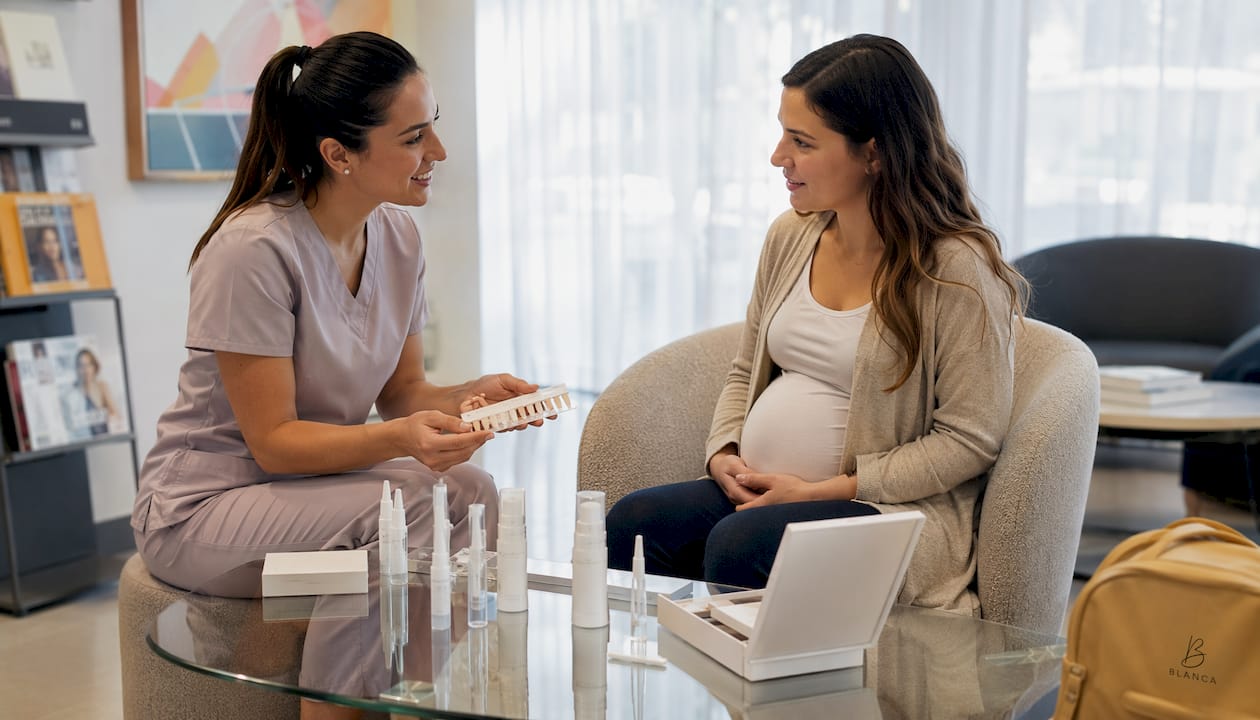
Abrasive polishing vs. peroxide bleaching are two fundamentally different mechanisms. Whitening toothpastes typically use mild abrasives, such as hydrated silica or calcium carbonate, to physically scrub surface stains off enamel. Contact time is brief — you brush and rinse. Peroxide-based products, by contrast, penetrate the enamel and chemically oxidize pigment molecules inside the tooth structure. That process requires sustained contact with soft tissue, which is exactly what raises concern during pregnancy.
| Method | Typical peroxide concentration | Contact time | Pregnancy guidance |
|---|---|---|---|
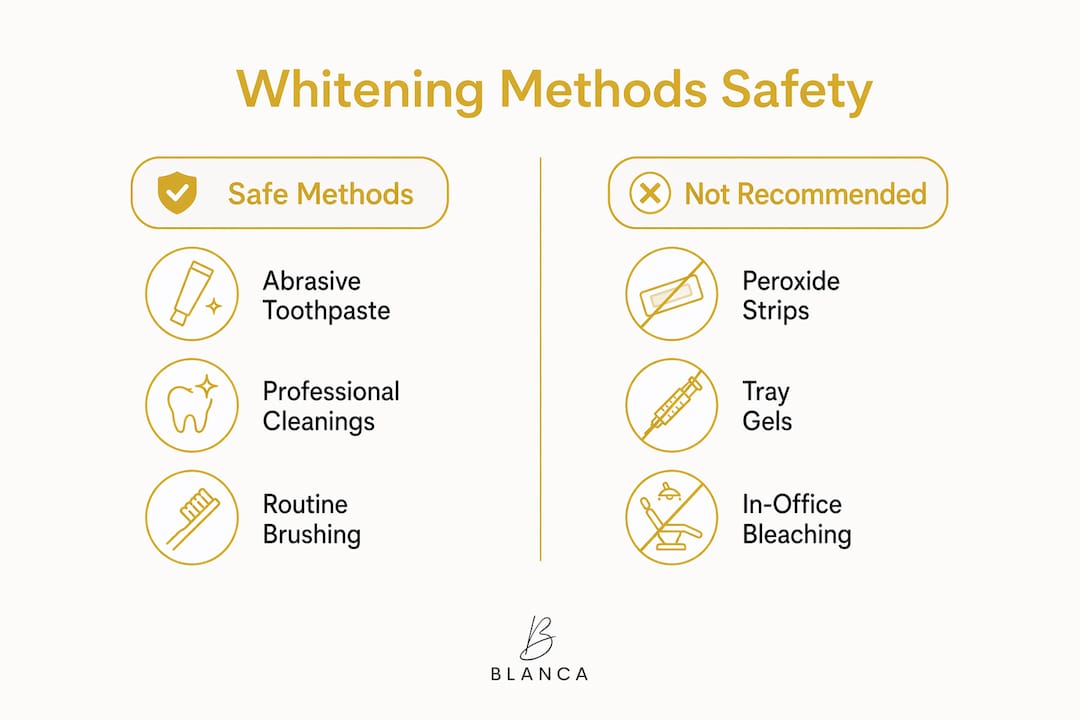
| Whitening toothpaste (abrasive-only) | — | Seconds (rinse out) | Generally considered acceptable |
| OTC whitening strips | Moderate-concentration hydrogen peroxide | 10–30+ minutes | Clinicians advise avoiding |
| Take-home tray gels | Variable-concentration carbamide peroxide | Extended contact time | Clinicians advise avoiding |
| In-office bleaching | High-concentration hydrogen peroxide | — | Clinicians advise avoiding |
In-office concentrations can reach up to approximately 35–40%, while many OTC strips fall in the 6–14% range. The higher the concentration and the longer the contact time, the greater the potential for mucosal absorption.
Whitening strips and tray gels are specifically discouraged because they involve prolonged mucosal contact, which increases both local irritation and the potential for systemic absorption compared with a toothpaste that is rinsed away in seconds.
What to look for on a label: Check the active ingredients list. If you see hydrogen peroxide or carbamide peroxide, set the product aside for now. An abrasive-only toothpaste will list ingredients like hydrated silica, calcium carbonate, or baking soda without any peroxide compound.
What do U.S. dental and medical organizations recommend?
The American Dental Association (ADA) and the American College of Obstetricians and Gynecologists (ACOG) draw a clear line between elective cosmetic care and necessary dental treatment.
“Elective treatments, such as teeth whitening and other cosmetic procedures, should be postponed until after the birth. It is best to avoid this dental work while pregnant and avoid exposing the developing baby to any risks, even if they are minimal.” — American Pregnancy Association
The ADA’s formal position is that preventive, diagnostic, and restorative dental treatment is safe throughout pregnancy. Whitening is classified as elective cosmetic care, not treatment, and therefore falls under the deferral guidance. ACOG aligns with this framing: oral conditions requiring immediate treatment can be managed at any point during pregnancy, but procedures that are not medically necessary should wait.
The FDA regulates whitening products as cosmetics or drugs depending on their formulation, but has not issued a pregnancy-specific safety clearance for peroxide-based whitening products. That regulatory silence reinforces the clinical default: when in doubt about a nonessential exposure, defer.
One practical step that makes a real difference: tell both your dentist and your OB-GYN that you are pregnant. Coordinating care between these two providers means your oral health is monitored in the context of your full prenatal picture, and neither provider is making decisions without the other’s awareness.
Practical, pregnancy-safe ways to keep your smile bright today
You do not have to accept a dull smile for nine months. Several approaches keep your teeth looking their best without any peroxide exposure.
- Brush twice daily with fluoride toothpaste using a soft-bristled brush for two minutes. The ADA recommends this as the foundation of oral health during pregnancy, and it removes the surface film that makes teeth look yellow.
- Floss once a day. Pregnancy hormones cause gums to swell and trap food more easily; daily flossing prevents the buildup that contributes to both staining and gingival disease.
- Choose an abrasive-only whitening toothpaste. Look for products that list hydrated silica or baking soda as the active polishing agent, with no peroxide in the ingredient list. These gently buff surface stains without chemical bleaching.
- Schedule a professional cleaning. A hygienist can remove calculus and extrinsic stain that no toothpaste touches. Cleanings are safe at any stage of pregnancy and are actively recommended.
- Reduce staining exposures. Coffee, black tea, red wine, and dark juices are the primary dietary stain sources. Drinking through a straw or rinsing with water immediately after reduces contact time with enamel. For more on preventing tooth stains through diet and habits, that guide covers the mechanism in detail.
| Approach | Stain removal mechanism | Safe during pregnancy? |
|---|---|---|
| Abrasive whitening toothpaste | Physical polishing of surface stains | Yes |
| Professional cleaning | Mechanical scaling and polishing | Yes |
| Dietary stain reduction | Limits new stain formation | Yes |
| OTC whitening strips | Peroxide bleaching | No — defer |
| In-office bleaching | High-concentration peroxide | No — defer |
Pro Tip: After vomiting from morning sickness, do not brush your teeth immediately. Stomach acid softens enamel temporarily, and brushing within 30 minutes can accelerate erosion. Instead, rinse with a solution of one teaspoon of baking soda dissolved in one cup of water to neutralize the acid, then wait at least 30 minutes before brushing.
Maintaining good overall pregnancy health habits — staying hydrated, eating a balanced diet, and keeping prenatal appointments — also supports oral health indirectly by reducing dry mouth and nutritional deficiencies that can affect enamel.
When can you reasonably consider whitening again after pregnancy?
Most clinicians advise waiting until after delivery before reintroducing peroxide-based products. If you are breastfeeding, the typical guidance extends that wait until after weaning. The reasoning is precautionary: breast milk is the infant’s primary nutrient source, and while the measured transfer of whitening agents into milk is likely minimal, the goal is to avoid nonessential chemical exposures during the period of infant dependence.
The postpartum dental visit is the right moment to revisit whitening. Before starting any peroxide-based product, a dentist should evaluate your gum health and enamel condition. Pregnancy can leave gums temporarily more inflamed and enamel more vulnerable, particularly if morning sickness was significant. Starting whitening before those tissues have recovered can increase sensitivity and irritation.
Questions worth raising at that visit:
- Has my gum inflammation from pregnancy resolved?
- Is my enamel in good condition for peroxide exposure?
- Which method and concentration would you recommend given my sensitivity history?
- How long after weaning should I wait before starting?
For a broader checklist of safety questions to bring to your dentist before any whitening treatment, that guide covers the full pre-treatment conversation.
Which dental treatments are safe and necessary during pregnancy?
Pregnancy is not a reason to avoid the dentist. Skipping necessary care creates risks that are far more concrete than the theoretical concerns around elective whitening.
Safe and recommended during pregnancy:
- Routine professional cleanings and periodontal exams (safe at any trimester; actively recommended because gum disease has been linked to preterm birth)
- Cavity fillings and crowns (ideally scheduled in the second trimester when lying back is still comfortable)
- Tooth extractions when clinically indicated
- Root canals and periodontal treatment when needed
- Local anesthetics, including those with epinephrine (lidocaine, bupivacaine, mepivacaine are considered safe)
- Dental X-rays when clinically necessary (the ADA confirms radiographs are safe at any stage of pregnancy; shielding is no longer routinely required but may still be offered)
What to defer:
- Elective whitening and other cosmetic procedures
- Elective restorations that can safely wait until after delivery
- Nitrous oxide (classified as a pregnancy risk Category C medication; both patients and dental staff who are pregnant should avoid exposure)
“The ADA and ACOG agree that emergency treatments, such as extractions, root canals, or restorations, can be safely performed during pregnancy and that delaying treatment may result in more complex problems.” — American Dental Association
Seek prompt dental attention if you notice: severe tooth pain, signs of abscess (swelling, fever, pus), bleeding that does not resolve with improved brushing, or a loose tooth. These are not situations to defer. Untreated infection during pregnancy carries real risks to both you and the baby.
Why the evidence gap exists and what that means for clinical advice
The conservative stance on whitening during pregnancy is not arbitrary caution. It reflects a structural reality in how medical research works.
Enrolling pregnant participants in trials that expose them to chemicals for cosmetic purposes is ethically restricted. Institutional review boards will not approve such studies because the potential benefit (a whiter smile) does not justify exposing a fetus to an unknown risk. That ethical restriction is appropriate and protective, but it means the evidence gap is unlikely to close anytime soon.
Professional organizations apply the precautionary principle specifically to elective cosmetic care: when a procedure is not medically necessary and safety data for a vulnerable population is absent, the recommendation is to defer. This is not the same as saying the product is proven harmful. No documented link exists between whitening product use and miscarriage or fetal harm. The honest clinical position is that we simply do not know, and “we do not know” is sufficient reason to wait when the procedure is optional.
Key research takeaways:
- Absence of documented harm is not the same as confirmed safety.
- The ethical restriction on enrolling pregnant participants in elective exposure trials is the primary reason the evidence gap persists.
- Both the ADA and ACOG classify whitening as elective, placing it outside the scope of necessary care that is explicitly endorsed during pregnancy.
- Gingival changes during pregnancy increase local tissue permeability, adding a concrete physiological reason to avoid prolonged peroxide contact.
Key Takeaways
Peroxide-based whitening should be deferred throughout pregnancy and, for those who breastfeed, until after weaning; abrasive-only toothpaste and professional cleanings are the safe, effective alternatives available right now.
| Point | Details |
|---|---|
| Defer peroxide-based whitening | Strips, trays, and in-office bleaching should wait until after delivery and, if breastfeeding, until after weaning. |
| Evidence gap is structural | No controlled trials exist on whitening during pregnancy; absence of harm data does not equal confirmed safety. |
| Safe alternatives exist now | Abrasive-only whitening toothpaste and professional cleanings remove surface stains without peroxide exposure. |
| Essential dental care is safe | Cleanings, fillings, extractions, local anesthesia, and necessary X-rays are all safe at any stage of pregnancy. |
| Blancawhitening for postpartum planning | Blancawhitening’s daily oral-care tools support safe pregnancy maintenance; at-home whitening options are available for postpartum use. |
A note from Blanca on why we take the conservative position
The precautionary approach to whitening during pregnancy is the right one, and not just because professional organizations say so. The reasoning holds up on its own terms: whitening is elective, the evidence base for pregnant populations is structurally absent, and the potential downside of being wrong is not a minor inconvenience. That asymmetry, where the cost of unnecessary caution is a delayed cosmetic result and the cost of unnecessary exposure is unknown fetal risk, makes the conservative recommendation straightforward.
What concerns me more than the whitening question itself is the broader pattern of pregnant people feeling pressured to maintain cosmetic routines at the expense of clinical prudence. A bright smile is worth having. It is not worth a risk we cannot quantify. Please consult both your dentist and your prenatal provider for guidance specific to your situation; this article is general information, not a substitute for personalized clinical advice.
Blancawhitening’s daily oral-care tools for pregnancy and beyond
Blancawhitening was founded by dental professionals who believe that safe oral care and a confident smile are not mutually exclusive, even during pregnancy. Right now, the safest path to a brighter smile is consistent daily care: a quality electric toothbrush, a water flosser for gentle interdental cleaning, and fluoride toothpaste used twice daily. These tools support the gum health and plaque control that matter most during pregnancy, without any peroxide exposure.
When you are ready to explore whitening after delivery and weaning, Blancawhitening’s at-home whitening collection offers clinically backed options designed for safe, effective use. Browse the full range and plan your postpartum whitening routine when the time is right for you.
Useful sources for further reading
- American Dental Association — Pregnancy oral health: The primary U.S. dental authority’s guidance on safe treatments, recommended care, and the classification of whitening as elective during pregnancy.
- American Pregnancy Association — Dental work and pregnancy: Practical guidance on which procedures to proceed with and which to defer, including the explicit recommendation to postpone cosmetic whitening.
- Centers for Disease Control and Prevention — Pregnancy oral health: Background on hormonal changes that increase gingival inflammation and sensitivity during pregnancy.
- Children’s Dayton — Tooth whitening during pregnancy: Plain-language overview of the evidence gap and the distinction between abrasive toothpastes and peroxide bleaching.
- NIH/PubMed — Oral health in pregnancy: Peer-reviewed research on pregnancy-related oral changes and clinical management considerations.