

Can Mouthwash Stain Your Teeth? What Causes It and How to Fix It
Yes, some mouthwashes can stain teeth, and how much depends heavily on the ingredient and how you use it. The two biggest culprits are chlorhexidine, a prescription-strength antiseptic rinse, and colored dyes found in cosmetic mouthwashes.
Most mouthwash discoloration is extrinsic, meaning it sits on the tooth surface rather than inside it, and it usually responds to a professional cleaning or a break from the product. Restorations are a different story: composite fillings and crowns can pick up stains that don’t polish out as easily as natural enamel does.
A few quick signals to watch for:
- Yellow, brown, or grayish film appearing within weeks of starting a new rinse
- Discoloration concentrated on front teeth or near existing fillings
- Staining that worsens even after you brush and floss consistently
If you notice sudden or worsening color changes, stop the rinse and check in with your dentist before assuming it’s permanent.
Key Takeaways
Mouthwash staining is real, usually reversible on natural enamel, and driven mainly by chlorhexidine’s chemical binding to chromogens over a predictable 30 to 90 day window.
| Point | Details |
|---|---|
| Chlorhexidine is the main culprit | Its cationic charge binds oral surfaces and reacts with dietary chromogens to form visible stains. |
| Staining peaks and stabilizes | Discoloration increases through day 60 of use, then levels off by day 90 in clinical data. |
| Restorations are the exception | Composite fillings and crowns can absorb stains that resist polishing and sometimes need replacement. |
| ADS formulas reduce risk | Anti-discoloration system chlorhexidine cuts staining without lowering plaque control. |
| BLANCA supports maintenance | Powered brushing, water flossing, and whitening strips help manage and reverse surface stains at home. |
This article is general information, not a substitute for advice from a qualified doctor. Consult a qualified healthcare professional about your own circumstances before acting on anything here.
Table of Contents
- Which Mouthwash Ingredients Actually Cause Teeth Stains
- How Fast Does Mouthwash Staining Show Up?
- How to Prevent Mouthwash From Staining Your Teeth
- Removing Mouthwash Stains: What Works and What Doesn’t
- When to See a Dentist About Mouthwash Stains
- What the Research Actually Shows
- A Clinical Perspective on Mouthwash Staining
- Keeping Your Smile Bright While You Manage Staining
- Sources
Which Mouthwash Ingredients Actually Cause Teeth Stains
Chlorhexidine gluconate is the ingredient dentists most associate with tooth staining, and the mechanism is well understood. It’s a cationic molecule, meaning it carries a positive charge that binds readily to negatively charged surfaces in your mouth, including tooth enamel, dental plaque, and restoration materials. Once bound, chlorhexidine reacts with chromogens (the pigmented compounds in coffee, tea, red wine, and certain foods) and precipitates into visible brown or yellow deposits. This isn’t a flaw in your hygiene routine. It’s a direct chemical byproduct of how the antiseptic works.
Colored mouthwashes, particularly the blue and green cosmetic rinses sold over the counter, work differently. These dyes can temporarily tint plaque or soft tissue, making buildup easier to spot, but they rarely bond to enamel the way chlorhexidine does. The discoloration they cause tends to be cosmetic and short-lived.
Essential-oil and alcohol-based mouthwashes introduce a separate concern, especially if you have composite fillings or bonding. Lab research on resin composites found that certain rinses roughen the composite surface, which then traps more pigment from future beverages, creating a compounding cycle of stain susceptibility. Some newer formulations containing nanoparticles showed measurable color shifts, or ΔE values, in spectrophotometer testing, even though brushing barely lifted the stain in lab conditions.
Here’s the general risk hierarchy, from most to least likely to stain:
- Chlorhexidine and other cationic antiseptic rinses
- Nanoparticle or antiseptic-enhanced formulations tested in vitro
- Alcohol and essential-oil rinses (mainly a concern for existing restorations)
- Colored cosmetic rinses (temporary, low risk to enamel)
Plaque and tartar make everything worse because they act like a sponge, absorbing pigment far more readily than clean enamel does. If your hygiene routine has slipped even slightly, the same rinse will stain you faster than it would someone with pristine tooth surfaces.
Pro Tip: If you have visible plaque buildup, get a professional cleaning before starting any chlorhexidine regimen. Clean enamel resists staining far better than plaque-coated enamel.
How Fast Does Mouthwash Staining Show Up?
Staining from chlorhexidine follows a fairly predictable curve, and the data on this is more specific than most people expect. A systematic review and meta-analysis of orthodontic patients using various mouthwashes found statistically significant tooth discoloration by day 30, with the effect growing stronger by day 60, then leveling off by day 90. In other words, the damage doesn’t accelerate indefinitely. It builds for about two months and then plateaus.
Meta-analysis data showed a significant increase in staining by day 30 and a stronger effect by day 60, which then stabilized by day 90.
Laboratory studies back this up from a different angle. In vitro testing on resin composites exposed to various mouthwashes recorded measurable ΔE color shifts, particularly with antiseptic and nanoparticle-containing formulas, and found that brushing removed relatively little of the induced stain once it had set.
Certain groups face higher risk than the average user:
- Orthodontic patients, since brackets and wires create more surface area for pigment to collect
- Anyone with exposed dentin from gum recession or enamel wear, since dentin stains more readily than enamel
- Heavy coffee, tea, or red wine drinkers, whose chromogen exposure compounds the chemical binding effect
- Smokers, who add another layer of pigment on top of existing rinse residue
It’s worth noting a real gap between lab and life: immersion studies soak samples continuously in a rinse solution, which exaggerates staining compared to a 30 second daily swish. Real-world results tend to be milder, but the direction of the effect, more staining with more exposure, holds up consistently.
How to Prevent Mouthwash From Staining Your Teeth
Prevention starts with the basics you already know, but a few adjustments matter more than people realize once a staining-prone rinse enters the picture.
Daily habits that make the biggest difference:
- Brush with a tartar-control or whitening toothpaste, ideally with a powered toothbrush for more consistent plaque removal
- Floss daily to keep pigment from settling in spaces a toothbrush can’t reach
- Book a professional cleaning every six months, or sooner if you’re on a staining-prone rinse
- Rinse with water after coffee or tea to reduce the chromogen load your mouthwash has to interact with
If your dentist has prescribed chlorhexidine, a few technique choices can meaningfully reduce how much it stains. Ask about formulations with an anti-discoloration system, often labeled ADS, since clinical trials show these versions produce significantly less brownish discoloration while maintaining the same plaque-control benefit. Use the shortest effective course rather than extending it out of habit, and avoid coffee, tea, or red wine for the window your dentist recommends after rinsing.
Pro Tip: A controlled lab study found that chlorhexidine rinses kept at cooler temperatures caused more dentin darkening than rinses warmed toward body temperature. If your dentist approves, letting the rinse sit at room temperature rather than straight from the fridge may reduce staining risk, though this evidence comes from a laboratory model rather than a large clinical trial.
For patients who need a long-term antimicrobial rinse, alternatives like cetylpyridinium chloride, aloe vera, or plant-based formulations have shown lower staining potential in some studies, though efficacy varies by clinical situation. Bring this up with your dentist rather than switching on your own.
Removing Mouthwash Stains: What Works and What Doesn’t
Most extrinsic mouthwash stains respond well to a structured approach, but the order matters.
- Pause or switch the rinse under your dentist’s guidance, since stopping cold turkey isn’t always appropriate if you’re using chlorhexidine therapeutically.
- Tighten your home routine for two to four weeks. Consistent brushing with a tartar-control paste and daily flossing often lifts a meaningful amount of surface pigment on its own.
- Try a whitening toothpaste or whitening strips for stains confined to natural enamel. These work by lifting surface pigment rather than altering the tooth’s internal structure, so they’re best suited to extrinsic staining rather than deeper discoloration.
- Schedule a professional cleaning if home care isn’t fully resolving it. Scaling and polishing (often called a prophy) removes tartar and surface stain far more effectively than any home product, and ultrasonic cleaning can address more stubborn buildup.
- Ask about in-office whitening if natural tooth color hasn’t returned to baseline after cleaning.
Expect gradual improvement over several weeks to a few months rather than an overnight fix. That said, restorations complicate the picture. Composite fillings and resin-based crowns have a more porous surface than natural enamel, and stains that penetrate that surface may not respond to polishing. In some cases, a stained restoration needs to be replaced rather than cleaned, particularly if the surface has become rough. This is why persistent staining near a filling or crown deserves a dental evaluation rather than another round of whitening strips.
When to See a Dentist About Mouthwash Stains
Certain patterns should send you to a dental chair rather than a drugstore aisle. Staining that appears within days, worsens despite stopping the rinse, or concentrates on a filling or crown all point to something a home routine won’t fix. So does new tartar buildup, tooth sensitivity, or discoloration that’s simply bothering you cosmetically.
Bring the following to your appointment:
- The mouthwash’s name and ingredient list
- When you started using it and how often
- Photos tracking the discoloration over time, if you have them
- Your current brushing and flossing routine
- Coffee, tea, and tobacco habits
Your dentist will likely examine the affected teeth, perform a polish or scaling if warranted, check any restorations for surface damage, and recommend an alternative rinse or an ADS-formulated chlorhexidine if you need to continue antimicrobial treatment.
What the Research Actually Shows
The clinical picture on mouthwash staining is more consistent than the anecdotal advice floating around online. Chlorhexidine is genuinely effective against plaque and gingivitis, but the Mayo Clinic’s drug guidance lists tooth and restoration staining as a known side effect, alongside increased tartar formation, and recommends brushing with tartar-control toothpaste and keeping up with professional cleanings.
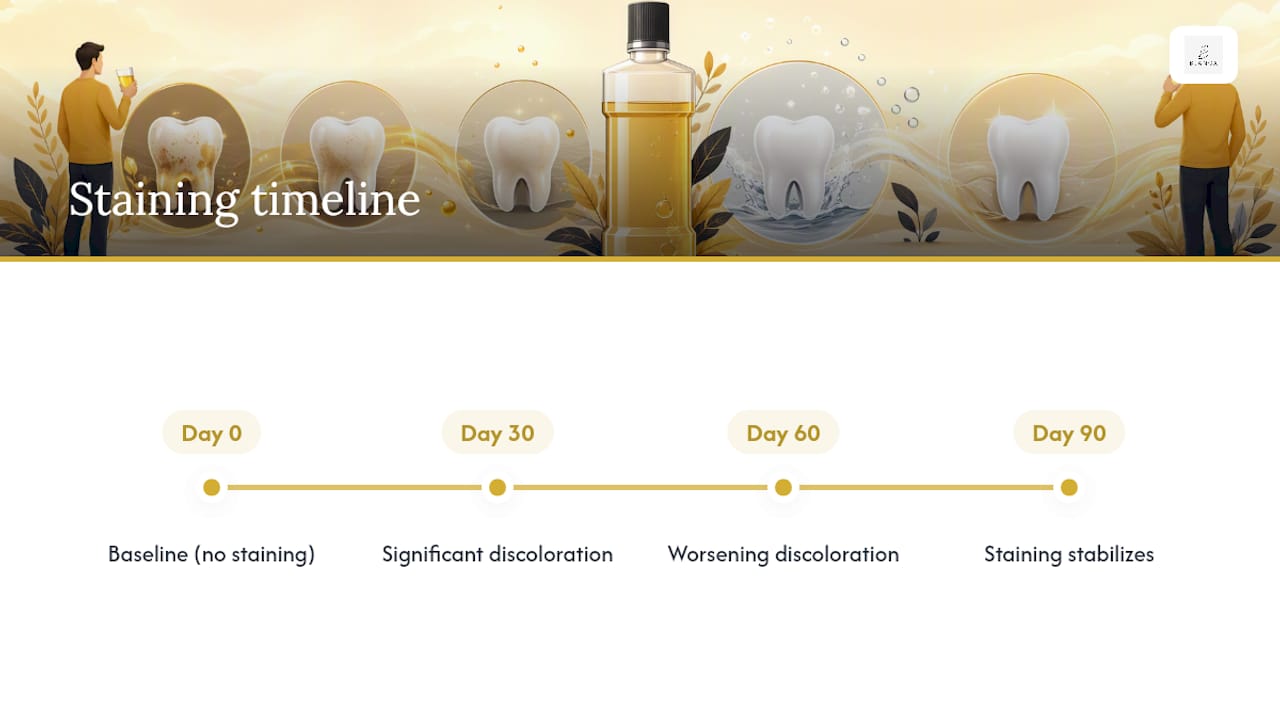
The staining timeline backs this up with real numbers: significant discoloration by day 30, worsening through day 60, then stabilizing by day 90, according to the meta-analysis of mouthwash effects on tooth color. In vitro work on nanoparticle-containing rinses shows measurable enamel and composite color change under lab conditions, though how noticeable that is in everyday life depends on your diet and hygiene habits.
The practical takeaway dentists have settled on: short-term chlorhexidine use is often worth the staining tradeoff for patients who need serious plaque control, particularly after periodontal treatment. The goal isn’t avoiding the rinse entirely. It’s managing the course length, formulation, and home care around it so staining stays temporary and cosmetic rather than permanent.
A Clinical Perspective on Mouthwash Staining
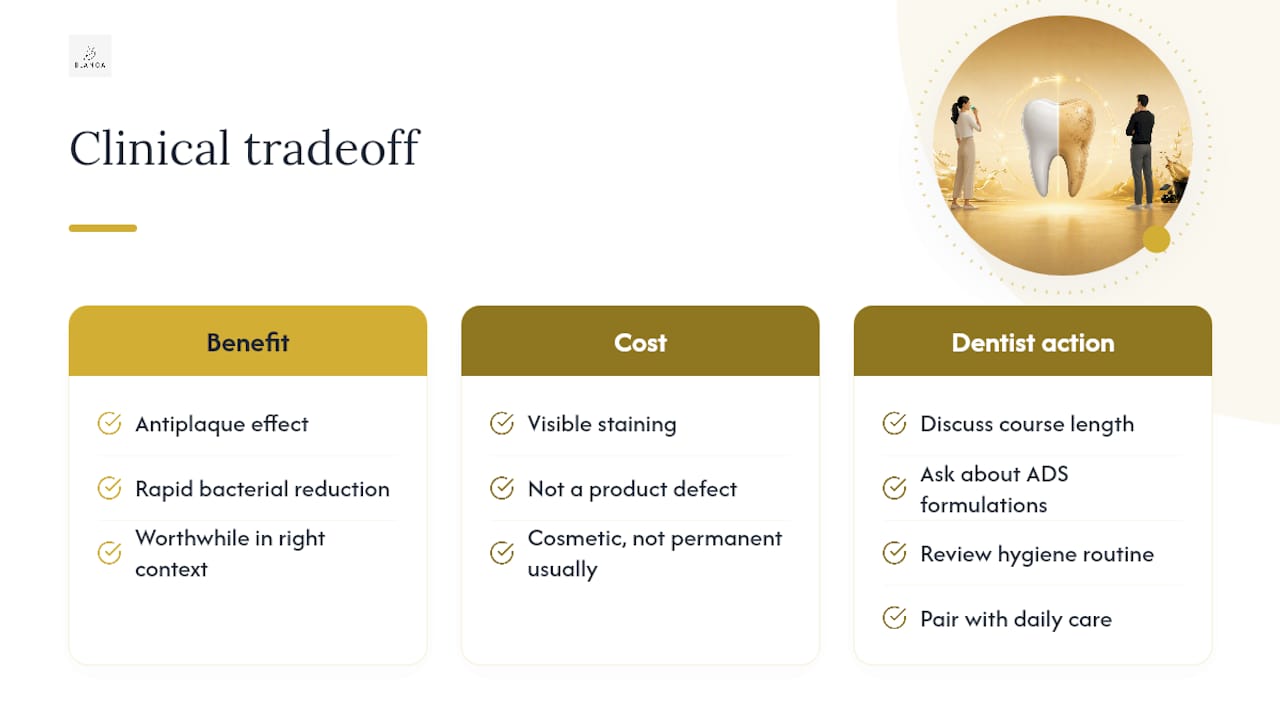
Mouthwash staining gets treated like a design flaw, but it’s really a tradeoff dentists have accepted for decades because the antiplaque benefit is worth it in the right context. Chlorhexidine wasn’t built to keep your smile picture perfect. It was built to knock down bacterial load fast, and staining is the visible cost of that chemistry doing its job.
What frustrates us is when patients either panic and quit a rinse they genuinely need, or ignore staining that’s actually signaling a restoration problem. Both reactions skip the step that matters most: a conversation with your dentist about course length, ADS formulations, and whether your current hygiene routine is keeping pace. Pair that with consistent daily care and the cosmetic damage rarely becomes permanent.
— Blanca
Keeping Your Smile Bright While You Manage Staining
Prevention and touch-up care go hand in hand once you’ve dealt with mouthwash-related discoloration, and that’s where the right daily tools make a measurable difference. A powered toothbrush removes plaque more thoroughly than manual brushing alone, which matters directly, since staining clings harder to plaque-coated surfaces than clean enamel. Pair it with a water flosser to clear pigment from between teeth where a brush can’t reach.
For surface stains that have already set in, BLANCA’s at-home whitening strips target extrinsic discoloration without requiring an office visit, making them a practical next step after you’ve tightened your hygiene routine or finished a course of chlorhexidine. They won’t reverse staining that has penetrated a composite restoration, and that distinction matters: if a filling or crown is discolored, a dental evaluation comes first. For everyday enamel staining from rinses, dyes, or dietary chromogens, they’re built exactly for that job.
If you’re ready to get your smile back to its baseline shade, start with the BLANCA whitening collection and pick the strip or kit that matches how much discoloration you’re dealing with.
Sources
- The Effect of Different Mouthwashes on Tooth Enamel Color in Fixed Orthodontic Patients: A Systematic Review and Meta-analysis
- Chlorhexidine (oral route) - Side effects & dosage - Mayo Clinic
- Effect of Different Mouthwashes on Stain Susceptibility of Resin Composite in Contact with Beverages
- Effect of Temperature on Tooth Staining by 0.12% Chlorhexidine Gluconate