

Tetracycline Teeth Whitening: What Actually Works
Tetracycline-stained teeth can be improved in many cases, but the degree of change depends heavily on how severe the discoloration is. For mild to moderate staining, dentist-supervised bleaching with carbamide or hydrogen peroxide often produces meaningful results over several months. For deep gray or banded staining, restorative options like veneers or crowns are frequently needed to achieve a uniform, natural-looking smile. Complete normalization through bleaching alone is uncommon for the most severe cases.
Here is what you can realistically expect:
- Conservative improvement with dentist-supervised bleaching: Most patients with mild to moderate staining see measurable lightening after weeks to months of tray-based bleaching. Results continue to develop slowly, sometimes over 6–12 months.
- Partial improvement followed by reassessment: Some patients achieve enough improvement through bleaching that they are satisfied; others use it as a first step before minimal-prep veneers, which then require less tooth reduction.
- Restorative work for severe staining: Deep gray or heavily banded teeth that do not respond adequately to extended bleaching are usually best addressed with ceramic veneers, crowns, or composite bonding.
Your clearest next step is to book a consult with a dentist experienced in tetracycline cases. Bring any childhood medication records you have, including the antibiotic name, dosage, and approximate age when you took it. That history helps your dentist estimate stain depth and set realistic expectations before any treatment begins.
Key Takeaways
Tetracycline-stained teeth can be meaningfully improved with dentist-supervised bleaching in many cases, but severe gray or banded staining often requires restorative work to achieve a satisfactory result.
| Point | Details |
|---|---|
| Bleaching works, but takes time | Extended protocols of 3–12 months under dentist supervision produce the most reliable improvement for tetracycline staining. |
| Concentration affects comfort, not just speed | 10% carbamide peroxide showed fewer sensitivity problems than higher concentrations while still producing measurable results over time. |
| Satisfaction rates are high with realistic expectations | In a 59-subject study, 91% of patients reported satisfaction at three months and 85% at nine months across all concentrations tested. |
| Bleaching before restorations is the evidence-based sequence | Whitening first reduces the tooth preparation required for veneers or crowns, preserving more natural tooth structure. |
| Blancawhitening supports the maintenance phase | Clinician-recommended at-home kits from Blancawhitening can be integrated into a staged treatment plan under dentist supervision. |
Table of Contents
- What tetracycline staining is and why it behaves differently from other discoloration
- Who benefits from bleaching and who should consider restorations
- Detailed treatment options dentists use for tetracycline-stained teeth
- What improvement to expect and realistic timelines
- Risks, side effects, and contraindications to know before you start
- When veneers, crowns, or composite bonding make more sense than continued bleaching
- What to expect in Canada: appointments, timeline, and cost factors
- How to choose the right dentist and what to ask at your consult
- What the clinical evidence actually shows
- A perspective worth considering before you commit to any treatment
- Blancawhitening professional and at-home whitening options for tetracycline cases
- Sources
What tetracycline staining is and why it behaves differently from other discoloration
Tetracycline staining is an intrinsic discoloration, meaning the pigment is embedded inside the tooth structure itself, not sitting on the surface. When tetracycline antibiotics are taken during the period of tooth development (generally from the second trimester of pregnancy through age eight), the drug binds to calcium in the dentin, the layer beneath the enamel. Once the teeth mineralize, that pigment is locked in permanently. Unlike coffee or wine stains, which sit on the enamel surface and respond quickly to standard whitening, tetracycline discoloration does not fade on its own over time.
The color and pattern of the staining reflect when and how much of the antibiotic was taken. A single short course tends to produce a diffuse yellow or light brown tint. Repeated or prolonged courses during different developmental stages create the characteristic horizontal banding, alternating lighter and darker zones across the tooth. The color spectrum runs from yellow and light brown at the milder end through dark brown and gray-blue at the severe end.
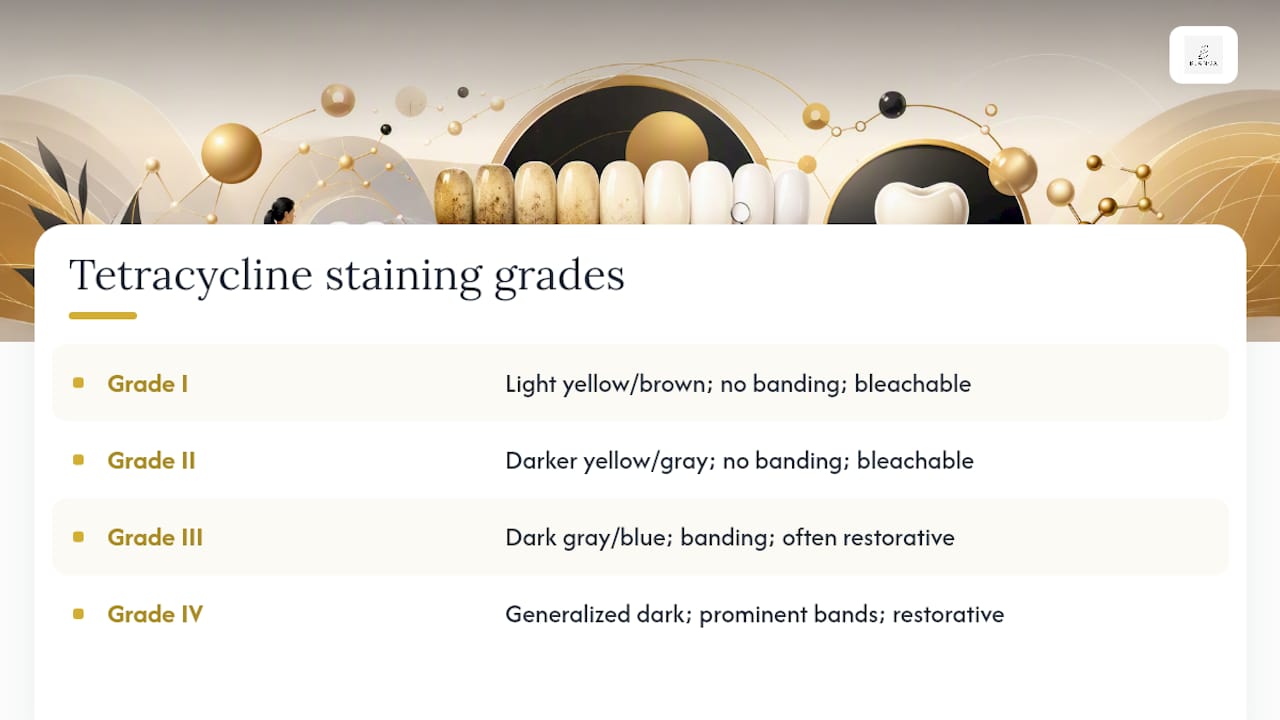
Clinicians typically grade tetracycline staining on a four-point scale. Grade I is a uniform, light yellow or brown tint without banding. Grade II is a darker yellow or gray, still without banding. Grade III involves dark gray or blue staining with visible banding. Grade IV is the most severe, with generalized dark staining and prominent bands. This grading matters because it directly predicts how much bleaching can realistically achieve: Grade I and II cases are the best candidates for bleaching alone, while Grade III and IV cases often need restorative work.
Pro Tip: Bring a childhood medication history to your first dental consult, including the antibiotic name, the age you were when you took it, and how long the course lasted. Clinicians use that information alongside clinical photos and shade mapping to estimate stain depth and give you a more accurate prognosis before any treatment starts.
Who benefits from bleaching and who should consider restorations
Not every patient with tetracycline discoloration is a good candidate for bleaching alone. Dentists evaluate several factors before recommending a treatment path.
Typical bleaching candidates share these characteristics:
- Vital teeth (teeth with a living pulp) that can tolerate peroxide-based agents
- Mild to moderate staining (Grade I or II), with yellow or light brown tones rather than deep gray
- Intact enamel without significant cracks or erosion that could allow peroxide to penetrate too deeply
- No large existing restorations on the affected teeth that would not respond to bleaching
- Realistic expectations: partial improvement over months, not a dramatic overnight change
Restorations are more likely when:
- Teeth are non-vital (root-canal-treated) with internal staining that bleaching trays cannot reach
- Staining is Grade III or IV, with dark gray or blue banding that has shown little response after a full course of supervised bleaching
- The patient’s cosmetic goal is a very uniform, very-white result that bleaching cannot reliably deliver
- Structural defects (chips, cracks, or worn edges) are present alongside the discoloration
A practical triage approach: if your staining is minor to moderate, start with a dentist-supervised bleaching trial before committing to any restorative work. If your staining is severe or heavily banded gray, discuss conservative restoration options with your dentist after attempting whitening, since bleaching first can still reduce how much tooth structure needs to be removed for veneers later. Understanding whether at-home or professional whitening fits your situation is a useful starting point before your consult.
Detailed treatment options dentists use for tetracycline-stained teeth
Home tray bleaching with carbamide peroxide
Dentist-supervised tray bleaching is the most widely studied and commonly recommended first-line treatment for tetracycline discoloration. Custom-fitted trays hold a carbamide peroxide gel against the teeth, typically worn for several hours each night or overnight. Research comparing 10%, 15%, and 20% carbamide peroxide found that all three concentrations produced measurable whitening in tetracycline-stained teeth, with the 10% concentration showing fewer sensitivity problems while higher concentrations acted faster. The most rapid change occurs in the first month, but improvement continues to accumulate over 3–9 months with consistent use.
The tradeoff between concentration and comfort is real. Lower concentrations are gentler on the pulp and gingival tissues, which matters for prolonged protocols. Higher concentrations can accelerate early results but increase the risk of transient sensitivity, especially in teeth that already have some enamel wear.
In-office bleaching and light-assisted methods
In-office bleaching uses higher-concentration hydrogen peroxide gels applied by a dentist, sometimes activated with a light or laser source to accelerate the reaction. A single in-office session can produce a noticeable initial shift in shade, but for tetracycline staining, multiple sessions are typically needed, and in-office treatment is often combined with an extended at-home tray protocol rather than used as a standalone solution.
KTP laser-assisted vital bleaching has shown promising results in case reports. One published case demonstrated rapid shade improvement after a single session, though the authors emphasized careful soft-tissue protection and noted that larger studies are needed before the technique can be broadly recommended. Thermal effects on the pulp are a consideration with any light-assisted method, and dentists should monitor for post-treatment sensitivity.
Internal (intracoronal) bleaching for non-vital teeth
When a tooth has had a root canal and the discoloration is coming from inside the pulp chamber, external tray bleaching cannot reach the source. Internal bleaching involves placing a bleaching agent directly inside the pulp chamber through an access opening, then sealing it temporarily while the agent works over several days. This approach can lighten a single dark non-vital tooth significantly, but it carries a risk of cervical root resorption if the bleaching agent contacts the root surface, so careful technique and follow-up are required.
Restorative options: veneers, crowns, and composite bonding
When bleaching reaches its limit, restorative dentistry offers predictable aesthetic outcomes. Porcelain veneers cover the front surface of the tooth with a thin ceramic shell, masking discoloration while preserving most of the natural tooth structure. Crowns encase the entire tooth and are typically reserved for teeth that also have structural damage. Composite bonding is a more conservative and reversible option that applies tooth-colored resin directly to the surface, though it is less durable than ceramic over the long term.
The British Dental Journal recommends attempting tray bleaching before prosthodontic restorations because whitening first can reduce the amount of tooth reduction required for veneers or crowns, preserving more of your natural tooth structure.
Concentration and timeline reference
| Treatment | Concentration | Typical timeline | Sensitivity risk |
|---|---|---|---|
| Home tray (low) | 10% carbamide peroxide | 6–12 months nightly | Lower |
| Home tray (mid) | 15% carbamide peroxide | 3–6 months nightly | Moderate |
| Home tray (high) | 20% carbamide peroxide | 3–6 months nightly | Moderate to higher |
| Strips (home) | 6% hydrogen peroxide | 3 months daily | Low to moderate |
| In-office | Higher-concentration HP | Multiple sessions | Variable |
Clinical finding: In a 59-subject extended bleaching study, 91% of patients reported being at least “a little pleased” at three months and 85% remained satisfied at nine months, across all three carbamide peroxide concentrations tested.
Pro Tip: For tetracycline staining specifically, slower and longer bleaching protocols tend to produce better outcomes than aggressive short-term approaches. Lower concentrations used consistently over many months often deliver a more comfortable experience and more even results than high-concentration protocols rushed over a few weeks.
What improvement to expect and realistic timelines
The most rapid shade change typically happens in the first month of consistent tray use. After that, improvement continues more gradually, with measurable gains through three months and sometimes extending to six or twelve months with prolonged at-home protocols. Patience is genuinely required here: tetracycline whitening is not a quick process, and stopping early is one of the most common reasons patients underestimate what bleaching can achieve.
Yellow and light brown staining responds more reliably to bleaching than deep gray or blue-gray banding. Gray tooth discoloration from medication or trauma involves different chromogens embedded deeper in the dentin, making it harder to lighten with peroxide-based agents alone. Patients with Grade III or IV gray staining should expect more modest bleaching results and should discuss restorative options as a realistic part of their plan from the start.
The randomized controlled trial comparing 15% carbamide peroxide trays and 6.5% hydrogen peroxide strips found that both produced significant color improvement over three months with no significant adverse reactions in the study sample. That finding is meaningful: it shows that even a lower-concentration strip format can move the needle on tetracycline staining when used consistently over months, not just days.
Complete normalization, meaning teeth that look indistinguishable from unstained teeth, is uncommon with bleaching alone for moderate to severe cases. The realistic goal for most patients is meaningful improvement in shade and a reduction in the visual contrast of banding, which can make a significant difference in confidence and appearance even when the staining is not fully eliminated.
Risks, side effects, and contraindications to know before you start
Bleaching tetracycline-stained teeth is generally safe under dentist supervision, but the extended protocols required for intrinsic staining do carry a specific risk profile that is worth understanding before you begin.
Common side effects:
- Transient tooth sensitivity, particularly during the first few weeks of tray use. This usually resolves within a day or two of pausing treatment and is manageable by reducing wear time or switching to a lower concentration.
- Gingival irritation or mild chemical burns, most often caused by ill-fitting trays that allow gel to contact the gum tissue. Custom-fitted professional trays reduce this risk significantly compared to generic over-the-counter trays.
Less common but important risks:
- Pulpal irritation from prolonged exposure to higher-concentration peroxide, particularly in teeth with thin enamel or existing sensitivity
- Uneven results that create a visible contrast between treated and untreated areas, or between the bleached natural teeth and any existing crowns, veneers, or composite restorations that do not respond to bleaching
Contraindications and red flags:
- Active gum disease or untreated decay should be resolved before any bleaching begins
- Bleaching is not appropriate for pregnant or breastfeeding patients
- Any provider promising a complete fix in a single session or through an over-the-counter product alone should be viewed with skepticism; intrinsic staining like tetracycline discoloration does not respond to surface-only whitening products
- Prolonged bleaching without professional monitoring increases the risk of undetected sensitivity progression or gingival damage
The safest approach is dentist-prescribed concentrations, professional custom trays, and scheduled follow-up visits to monitor sensitivity and shade progress throughout the protocol.
When veneers, crowns, or composite bonding make more sense than continued bleaching
Some cases simply reach the limit of what bleaching can do. Persistent deep discoloration after a full supervised bleaching course, structural defects alongside the staining, a single dark non-vital tooth after trauma, or a patient’s desire for a very-white uniform result are all situations where restorative work becomes the more practical path.
The key principle in modern cosmetic dentistry is conservation: remove as little natural tooth structure as possible. Minimal-prep or no-prep porcelain veneers, which require little to no enamel reduction before placement, are a good option for patients whose teeth are structurally sound but cosmetically unsatisfactory after bleaching. Thin ceramic laminates can mask even dark tetracycline staining effectively. Composite bonding is a reversible, lower-cost alternative that works well for patients who want to improve their appearance without committing to irreversible ceramic work, though it typically needs replacement or touch-up over time.
Timing matters here. The British Dental Journal review makes a clinically important point: attempting bleaching before restorations can reduce the amount of tooth preparation required, because a lighter baseline shade means the veneer or crown needs less masking opacity and can be made thinner. Bleaching first is not wasted effort even when restorations are the eventual destination.
Pro Tip: Before agreeing to any irreversible restorative treatment, ask your dentist for a digital shade simulation or a temporary mock-up of the proposed veneers. Seeing the result before the preparation begins helps you make a confident, informed decision and gives you a chance to adjust the shade or shape.
What to expect in Canada: appointments, timeline, and cost factors
A typical treatment pathway in a Canadian dental clinic starts with a consultation and clinical photography, followed by shade mapping and a discussion of realistic outcomes based on your staining grade. If you are a bleaching candidate, your dentist will take impressions for custom trays and prescribe a carbamide or hydrogen peroxide gel. The at-home phase runs for 3–12 months depending on your response, with follow-up appointments every 4–8 weeks to monitor sensitivity and shade progress. After the bleaching phase, you and your dentist reassess together and decide whether the result is satisfactory or whether a restorative phase is warranted.
Cost in Canada varies considerably based on several factors. The complexity of your case (how many teeth are affected, how severe the staining), the number of in-office sessions required, your geographic location, and the clinic’s fee schedule all influence the final number. In-office bleaching sessions add to the cost compared to a purely at-home protocol. Restorative work, particularly ceramic veneers or crowns, represents a substantially higher investment than extended bleaching alone. Dental insurance in Canada typically covers little to nothing for cosmetic procedures, so most of the cost for tetracycline treatment falls to the patient directly.
A practical step before committing: ask your dentist for a written treatment plan with itemized costs for each phase. That document lets you compare quotes across clinics, understand what is included in each phase, and plan your budget without surprises. Comparing professional and at-home whitening options can also help you understand where costs differ between clinic-based and supervised home protocols.
How to choose the right dentist and what to ask at your consult
Tetracycline staining is not a routine whitening case. The extended timelines, the need for careful concentration selection, and the decision point around restorations all require a dentist who has handled these cases before. Choosing the right provider makes a meaningful difference in both your outcome and your experience.
Selection criteria to prioritize:
- Documented experience with tetracycline cases, not just general cosmetic whitening
- A photographic before-and-after portfolio showing tetracycline cases specifically
- Willingness to attempt conservative bleaching before recommending restorations
- Familiarity with extended home-bleaching protocols and, when relevant, internal bleaching for non-vital teeth
- A clear monitoring plan for sensitivity throughout the protocol
Questions to bring to your first consult:
- Have you treated tetracycline staining before, and can I see clinical photos of similar cases?
- What bleaching concentration and schedule do you recommend for my specific staining grade?
- How will you monitor my sensitivity and progress during the protocol?
- At what point would you recommend moving from bleaching to restorative options?
- If I need veneers, would you attempt minimal-prep or no-prep options first?
- Can you provide a written treatment plan with itemized costs for each phase?
- What happens if my existing restorations don’t match the shade of my bleached teeth?
Red flags to watch for:
- Promises of complete stain removal in a single session or with an over-the-counter product
- Reluctance to show clinical photos of tetracycline cases they have treated
- Refusal to put a treatment plan and cost estimate in writing
- Skipping a clinical assessment and jumping straight to a treatment recommendation
- No mention of a monitoring plan for sensitivity during extended bleaching
A dentist who offers a staged, conservative approach, starting with bleaching and reassessing before any irreversible work, is following the evidence-based standard of care. Exploring professional whitening systems before your consult can help you ask more informed questions about what your dentist is recommending and why. You can also ask a clinic like Clayton Dental Studio about their approach to cosmetically complex staining cases as a reference point for what a thorough assessment looks like.
What the clinical evidence actually shows
The evidence base for tetracycline teeth whitening is more substantial than many patients realize, though it is still smaller than the literature on routine whitening.
Key finding: The 59-subject extended bleaching study found that 91% of patients reported satisfaction at three months and 85% remained satisfied at nine months, across all three carbamide peroxide concentrations tested. The 10% concentration produced fewer sensitivity problems, while 15% and 20% acted faster.
The RCT comparing 15% carbamide peroxide trays and 6.5% hydrogen peroxide strips found measurable Lab* color improvement in both groups over three months, with no significant adverse reactions recorded. That trial is notable because it confirms that even a strip-based format can produce real results for intrinsic tetracycline staining when used consistently over months, not just a few days.
KTP laser-assisted bleaching represents a promising but still limited-evidence approach. The published case report showed dramatic shade change after a single session, but the authors noted gingival burns when soft-tissue isolation was incomplete and called for larger controlled studies before the technique is broadly adopted. It is a tool with real potential, not yet a standard protocol.
The British Dental Journal review synthesizes the clinical picture well: tray bleaching is the reasonable first-line treatment for most tetracycline cases, and it can improve the outcome of any subsequent restorations by reducing the preparation depth required. That sequencing, bleaching first, then reassessing for restorations only if needed, is the approach most consistent with the available evidence.
Narrative reviews of current approaches confirm that bleaching remains the least invasive starting point for most tetracycline cases, with restorative work reserved for cases where bleaching has been genuinely exhausted or where structural needs make it necessary.
Practical takeaways from the evidence:
- Extended protocols (3–12 months) consistently outperform short-term bleaching for tetracycline staining
- Lower concentrations are not less effective over time; they are often better tolerated, which supports adherence
- Laser-assisted methods show promise but should be considered only by experienced clinicians with proper isolation protocols
- Satisfaction rates in published series are high when patients have realistic expectations set before treatment begins
A perspective worth considering before you commit to any treatment
Most people with tetracycline staining arrive at a dental consult having already tried an over-the-counter whitening strip or two, felt disappointed, and concluded that whitening simply does not work for them. That conclusion is understandable but premature. The strips failed not because bleaching is ineffective for tetracycline staining, but because the protocol was too short and the product was designed for surface stains, not intrinsic dentin discoloration.
The more useful reframe is this: tetracycline whitening is a long-term clinical project, not a cosmetic shortcut. The evidence supports meaningful improvement for a significant proportion of patients, but only when the protocol is long enough, the concentration is appropriate, and a dentist is monitoring the process. Rushing it with higher concentrations or abandoning it after a few weeks are the two most common ways patients underestimate what is actually achievable.
There is also a tendency in cosmetic dentistry to move too quickly toward veneers for tetracycline cases, partly because the result is more predictable and partly because the timeline is shorter. That is not always the wrong call, but it should not be the first call. Bleaching first, even when veneers are the likely eventual destination, preserves more of your natural tooth structure and gives you a clearer picture of what restorations actually need to accomplish. A dentist who skips that step is not necessarily wrong, but you should ask why.
The patients who tend to be most satisfied with their outcomes are those who entered treatment with a clear, honest picture of what bleaching can and cannot do for their specific staining grade, committed to a full protocol under supervision, and made the decision about restorations from a position of informed choice rather than impatience.
Blancawhitening professional and at-home whitening options for tetracycline cases
For patients who want a clinically supported at-home maintenance option alongside their dentist’s treatment plan, Blancawhitening offers professional-grade whitening kits and at-home products designed for use under dental supervision. These are not replacements for a dentist-led bleaching protocol for tetracycline staining, but they are a practical way to maintain results between in-office sessions or extend the gains from a supervised tray program.
Blancawhitening’s professional kits are used by dental providers across Canada and are built around clinically backed peroxide concentrations. For patients in the maintenance phase after completing an extended bleaching protocol, the at-home whitening collection includes options your dentist can recommend as part of an ongoing care plan. If you are ready to explore what Blancawhitening offers for your situation, visit the product pages or ask a dentist certified to use Blancawhitening professional kits about integrating them into your staged treatment plan.
Sources
The clinical evidence cited throughout this article comes from the following peer-reviewed studies and authoritative overviews. They were used to set realistic expectations, report outcome data, and support the safety and sequencing guidance described above.
- Tetracycline Teeth: Why Are My Teeth Stained?
- Extended at-home bleaching of tetracycline-stained teeth with different concentrations of carbamide peroxide
- A randomized controlled trial of home bleaching of tetracycline-stained teeth
- Vital bleaching of tetracycline-stained teeth by using KTP laser: A case report
- Bleaching: the initial treatment consideration for tetracycline-stained teeth | British Dental Journal
- Tooth discoloration
This article is general information, not a substitute for advice from a qualified doctor. Consult a qualified healthcare professional about your own circumstances before acting on anything here.