

Does Whitening Toothpaste Work? A Science-Backed Answer
Whitening toothpaste does work, but only for surface stains. It removes extrinsic discoloration caused by coffee, tea, wine, and tobacco through mild abrasion and low-level chemical action. It does not bleach the internal color of your teeth, which is determined by the dentin layer beneath the enamel.
Here is what the evidence shows at a glance:
- Surface stains respond well. A 2025 meta-analysis of 14 RCTs found whitening dentifrices usually effective at reducing stain area and stain intensity compared to regular toothpaste.
- Shade change is modest. Most formulas produce roughly 1–2 shades of improvement over 2–6 weeks of consistent twice-daily use.
- Intrinsic stains do not respond. Yellowing from aging, tetracycline antibiotics, or dental trauma requires professional bleaching, not toothpaste.
- Safety matters. Some formulas increase enamel surface roughness with repeated use; choosing the right abrasivity level protects your enamel long-term.
- Best role: maintenance. Dental professionals consistently position whitening toothpaste as a tool for preserving results from stronger treatments, not replacing them.
The sections below explain the mechanisms, review the clinical evidence, and give you a practical guide to using these products safely.
Table of Contents
- How whitening toothpaste actually removes stains
- What the clinical research actually shows
- What whitening toothpaste can and cannot do for your teeth
- Which ingredients help and which ones deserve caution
- Safety, enamel wear, and how to protect yourself
- How to use whitening toothpaste for the best results
- How whitening toothpaste compares to strips and professional bleaching
- When you should see a dentist about tooth discoloration
- A closer look at the 2025 systematic review and what it means for you
- Key Takeaways
- The case for realistic expectations over marketing promises
- Clinically backed at-home whitening from Blancawhitening
- Useful sources and further reading
How whitening toothpaste actually removes stains
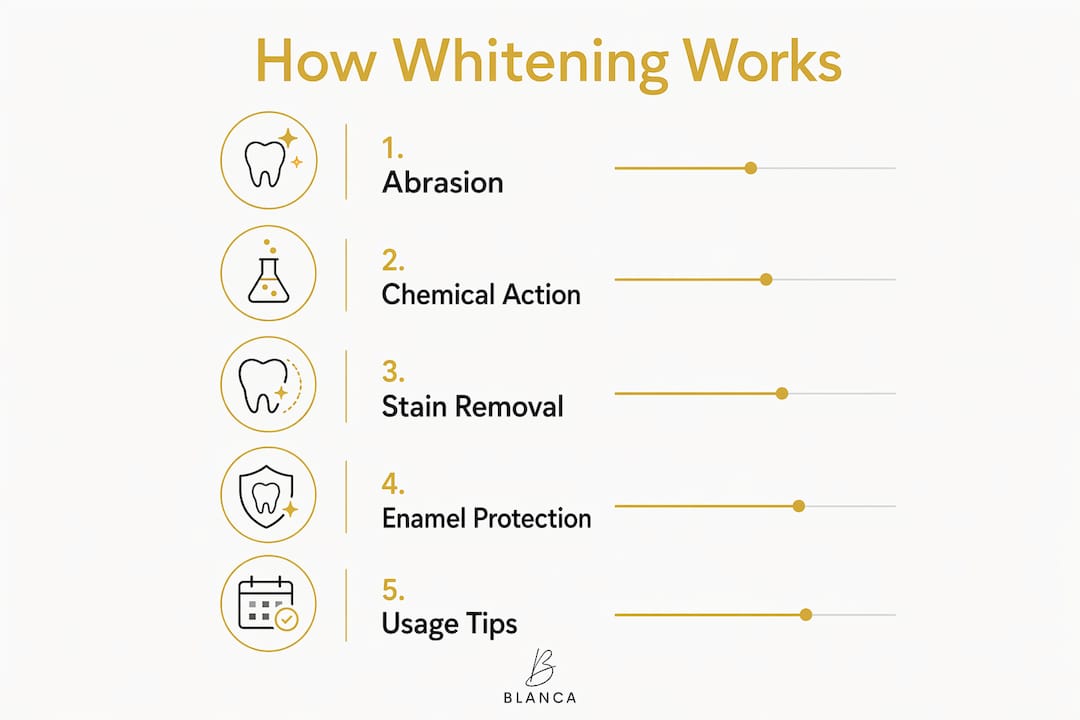
Two distinct mechanisms are at work in most whitening toothpastes: physical abrasion and mild chemical action. Understanding which one is doing the heavy lifting helps you choose a product that works without causing harm.
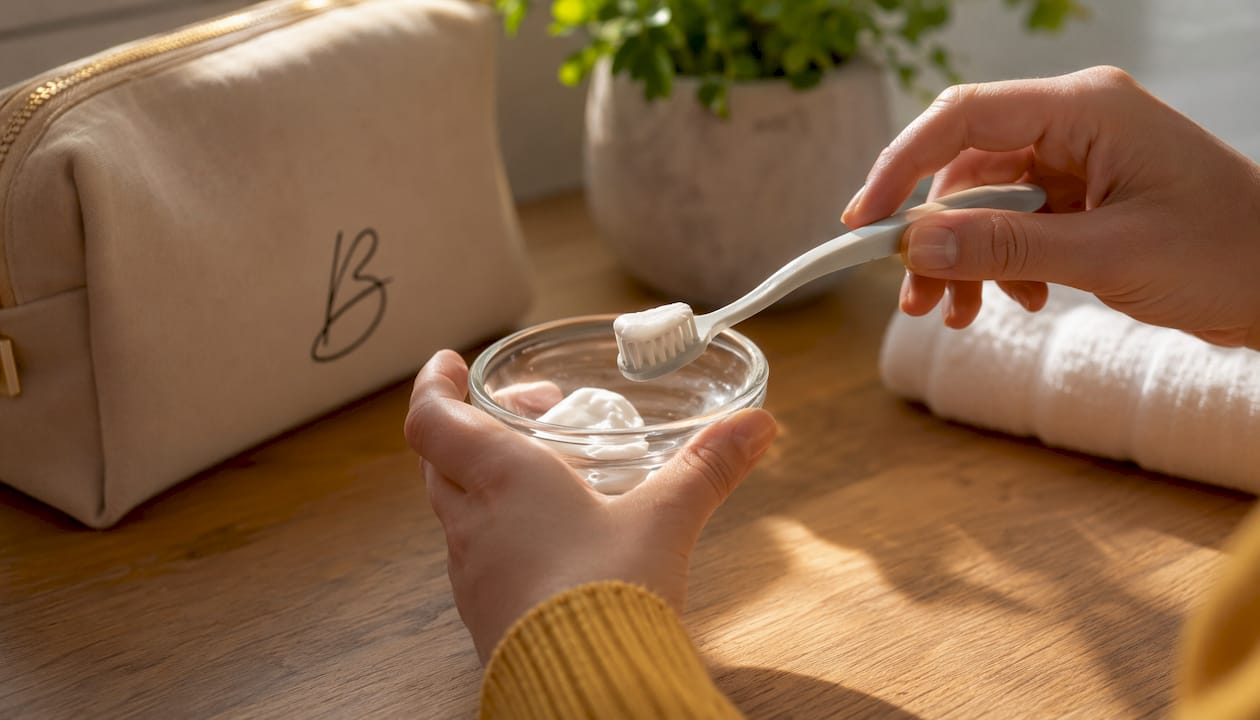
Abrasive polishing is the primary driver. Ingredients like hydrated silica and calcium carbonate act as microscopic polishing agents, physically scrubbing pigment-laden pellicle (the thin protein film on your enamel) away from the tooth surface. This is effective for the kind of staining that builds up from daily coffee or tea consumption. The catch is that abrasion only reaches the outermost enamel layer. Pigments that have penetrated into the dentin, the softer, yellowish layer beneath enamel, are completely out of reach.
Mild chemical agents add a secondary layer of action. Low-concentration hydrogen peroxide (typically around 1–2% when present) can oxidize some surface chromogens, producing a modest lightening effect at the enamel surface. Enzymes in some formulas break down the protein matrix that holds stain particles in place, making them easier to brush away. Blue covarine, found in certain products, works differently still: it deposits a thin blue-tinted optical film on the tooth surface that makes teeth appear whiter immediately, though this effect is purely cosmetic and temporary. None of these agents reach the dentin in meaningful concentrations, which is why whitening toothpastes cannot change intrinsic tooth color the way peroxide strips or professional bleaching can.
Pro Tip: Use a soft-bristled brush and gentle circular strokes rather than scrubbing back and forth. Aggressive horizontal brushing amplifies abrasive damage to enamel and gum margins without improving stain removal.
What the clinical research actually shows
The evidence base for whitening toothpaste has grown substantially, and the headline finding is clear: these products do outperform regular toothpaste for extrinsic stain removal. The nuances, though, matter just as much as the headline.
Statistic spotlight: A 2025 systematic review and meta-analysis pooling 14 randomized controlled trials found whitening dentifrices typically achieved substantial reductions in stain area and stain intensity compared to non-whitening toothpaste.
An earlier systematic review and meta-analysis of whitening dentifrices confirmed statistically significant reductions in stain indices and modest shade changes, but also flagged an increased risk of adverse effects in some trials. A separate systematic review found that most included studies showed significant color change after 5 days to 8 weeks of use, with twice-daily brushing producing the most consistent results.
| Outcome Measure | Finding vs. Regular Toothpaste | Study Type |
|---|---|---|
| Stain area reduction | Statistically significant improvement | Meta-analysis, 14 RCTs (2025) |
| Stain intensity reduction | Statistically significant improvement | Meta-analysis, 14 RCTs (2025) |
| Shade change | Statistically significant; modest clinically | Multiple RCTs and systematic reviews |
| Adverse effects | Increased risk noted in some trials | Systematic review and meta-analysis |
| Enamel surface roughness | Increased with some formulas | In vitro and clinical studies |
One important limitation runs through nearly all of this research: heterogeneity. Products tested across studies differ widely in abrasive particle size, RDA (Relative Dentin Abrasivity) values, peroxide concentration, and additional active ingredients. Short follow-up periods (most studies run 4–8 weeks) also mean long-term enamel effects are harder to quantify from trials alone. In vitro findings on surface roughness are consistent, but translating them to real-world clinical risk requires caution. The bottom line is that the efficacy signal is real and reproducible; the magnitude of whitening is modest; and safety depends heavily on which formula you choose.
What whitening toothpaste can and cannot do for your teeth
Setting the right expectation before you buy is the single most useful thing you can do. Whitening toothpaste effectiveness depends entirely on the cause of your discoloration.
Extrinsic stains sit on or just beneath the pellicle layer. They come from:
- Coffee, tea, red wine, and dark-colored foods
- Tobacco (smoked or chewed)
- Plaque and tartar buildup
- Poor brushing consistency over time
For these stains, whitening toothpaste can produce roughly 1–2 shades of improvement over 2–6 weeks of consistent twice-daily use. A professional cleaning first makes toothpaste even more effective by removing calculus that toothpaste cannot touch.
Intrinsic stains originate inside the tooth structure itself. Common causes include:
- Aging (dentin naturally darkens and enamel thins, revealing it)
- Tetracycline antibiotic exposure during tooth development
- Dental fluorosis (excess fluoride during development)
- Trauma causing internal bleeding or pulp death
- Restorations: crowns, veneers, and composite fillings
Whitening toothpaste will not help with any of these. Dental restorations do not respond to bleaching agents at all, which means whitening the surrounding natural teeth can actually create a visible color mismatch. A Frontiers review reinforces this point directly: OTC whitening products are effective largely for extrinsic stains, and misusing them on the wrong type of discoloration can cause tissue damage without producing any whitening benefit.
A practical self-check: If your teeth look yellow in photographs but feel fine and the color has developed gradually over years, that is likely extrinsic staining that toothpaste can address. If the discoloration appeared suddenly, affects only one tooth, or has been present since childhood, see a dentist before reaching for any OTC product.
Which ingredients help and which ones deserve caution
Reading a toothpaste label is more useful than most people realize. A few specific ingredients predict both effectiveness and safety.
Ingredients that support whitening:
- Hydrated silica: The most common abrasive in whitening toothpastes; effective at polishing surface stains when kept at a moderate RDA level.
- Low-level hydrogen peroxide (approximately 1–2%): Clinical trials show that peroxide-containing formulas produce measurable color change beyond abrasion alone; the combination of peroxide and high-performance silica shows the strongest results in head-to-head studies.
- Baking soda (sodium bicarbonate): Mild abrasive with a low RDA; well-tolerated by most people, including those with sensitivity.
- Blue covarine: Provides an immediate optical brightening effect; useful for a quick cosmetic boost, though the effect fades.
- Potassium nitrate: Not a whitening agent, but its presence in a whitening formula signals that the manufacturer has considered sensitivity management.
Ingredients to use with caution:
- Activated charcoal: Marketed aggressively but lacks strong clinical evidence for whitening; its abrasivity can be high and inconsistent across products, and it may interfere with fluoride uptake.
- High-RDA abrasives: The ADA-recommended RDA range for daily use caps safe daily toothpaste at 250 RDA, with most dentists preferring products under 150 for regular use. Products without a stated RDA are harder to evaluate.
- Sodium lauryl sulfate (SLS): A foaming agent that can irritate gum tissue and worsen sensitivity in some people; look for SLS-free formulas if you experience recurring gum soreness.
Pro Tip: Always choose a whitening toothpaste that also contains fluoride. Fluoride remineralizes enamel and protects against cavities — two things no whitening agent does on its own. A formula without fluoride trades one benefit for another.
For readers managing sensitivity alongside whitening goals, science-backed options for sensitive teeth are worth reviewing before committing to a formula.
Safety, enamel wear, and how to protect yourself
Whitening toothpaste is safe for most adults when used correctly. The risks are real but manageable, and they are almost always linked to overuse or choosing a formula with excessive abrasivity.

The most documented physical risk is increased enamel surface roughness. In vitro and clinical studies consistently show that whitening toothpastes can raise surface roughness and reduce enamel microhardness compared to regular toothpaste. Clinically, rougher enamel is more susceptible to future staining and, over time, may be less resistant to acid erosion. A related paradox: aggressive abrasion can increase surface roughness to the point where stain particles adhere more easily, meaning overuse of a harsh formula can make staining worse, not better.
Common side effects include:
- Tooth sensitivity: Especially with peroxide-containing formulas; usually mild and temporary, but persistent sensitivity warrants a dentist visit.
- Gum irritation: More common with SLS-containing products or when brushing technique is too aggressive; guidance on preventing gum irritation during whitening can help you adjust your routine before symptoms worsen.
- Enamel wear over time: Most significant with high-RDA products used multiple times daily.
A note on frequency: Using a whitening toothpaste twice daily is appropriate for most adults with healthy enamel. If you have exposed dentin, gum recession, or existing sensitivity, alternating your whitening toothpaste with a low-abrasion fluoride toothpaste every other brushing session reduces cumulative abrasive load without sacrificing stain control.
Practical safety steps:
- Check the RDA value before buying; stay under 150 for daily use if you have any sensitivity.
- Use a soft-bristled brush, not medium or hard.
- Stop using the product and consult a dentist if sensitivity does not improve within two weeks.
- Do not use whitening toothpaste more than twice daily.
How to use whitening toothpaste for the best results
Consistency and technique matter more than the specific product you choose. A well-formulated toothpaste used carelessly will underperform a modest one used correctly.
A practical daily routine:
- Brush twice daily, morning and evening, for a full two minutes each session.
- Use a pea-sized amount of toothpaste; more does not improve results and increases the risk of swallowing peroxide.
- Apply gentle circular or small back-and-forth strokes; avoid scrubbing pressure.
- Spit and rinse thoroughly after brushing.
Timeline expectations:
- Most people notice a visible difference within 2–4 weeks of consistent twice-daily use.
- Most formulas produce roughly 1–2 shades of improvement over 2–6 weeks of consistent twice-daily use; maximum results usually plateau around 6–8 weeks.
- Results are not permanent; staining resumes if dietary habits do not change.
When to alternate toothpastes:
- If you have sensitivity, use your whitening toothpaste in the morning and a low-abrasion fluoride toothpaste at night.
- Alternating on a weekly basis (whitening one week, low-abrasion the next) is a reasonable approach for people with mild enamel concerns.
For a structured schedule that accounts for both whitening and maintenance phases, a recommended whitening schedule can help you plan around your specific goals.
Pro Tip: Schedule a professional cleaning before starting a whitening toothpaste routine. Removing calculus and surface debris first gives the toothpaste direct access to enamel, which meaningfully improves results from the first week.
Clinic-backed guidance on safe at-home whitening methods provides additional context on technique and product selection if you want a deeper reference.
How whitening toothpaste compares to strips and professional bleaching
Toothpaste, whitening strips, and professional in-office bleaching all work on the same principle (oxidizing or polishing away stain pigments) but differ dramatically in concentration, contact time, and the depth of whitening they can achieve.
| Method | Active Agent | Typical Concentration | Contact Time | Shade Change | Approximate Cost |
|---|---|---|---|---|---|
| Whitening toothpaste | Abrasives + low peroxide | 1–2% peroxide | 2 min, twice daily | 1–2 shades over 2–6 weeks | $5 |
| Whitening strips | Hydrogen peroxide | 6–14% | — | 1–2 shades over several weeks | $30 |
| Professional in-office | Hydrogen peroxide | — | — | 4–8+ shades per session | — |
The core difference is penetration. Strips and professional treatments use peroxide at concentrations high enough to diffuse through enamel and reach the dentin, which is where most of the tooth’s color originates. Toothpaste does not. Higher-concentration peroxide products are required for meaningful intrinsic shade change, and no amount of brushing with whitening toothpaste will replicate that effect.
When strips or professional treatment make more sense:
- You want a noticeable shade change in weeks, not months.
- Your discoloration is intrinsic (aging, dentin darkening).
- You have already tried whitening toothpaste for 6–8 weeks without satisfying results.
- You are preparing for an event and need faster results.
Tradeoffs to weigh: strips and professional bleaching carry a higher risk of temporary sensitivity and cost significantly more. For a detailed breakdown of what each approach involves, the professional vs. at-home whitening comparison covers the full spectrum of options.
Whitening toothpaste remains the most practical choice for everyday stain maintenance and for preserving results after a professional treatment. Dental experts consistently describe it as a maintenance tool rather than a primary whitening intervention.
When you should see a dentist about tooth discoloration
Not every case of tooth discoloration is appropriate for OTC management. Some situations call for professional evaluation before you try any whitening product.
See a dentist if you notice any of the following:
- A sudden color change in one or more teeth, especially without an obvious dietary cause.
- Tooth sensitivity or pain that does not resolve within two weeks of stopping a whitening product.
- Discoloration that has been present since childhood or adolescence (possible fluorosis or tetracycline staining).
- You have crowns, veneers, bridges, or composite fillings in visible areas. Whitening the surrounding teeth can create a noticeable color mismatch.
- Staining that does not respond at all after 6–8 weeks of consistent whitening toothpaste use.
- Gum recession or exposed root surfaces, which are more sensitive to abrasive formulas.
A professional cleaning before starting any whitening routine is worth scheduling regardless of which product you plan to use. Calculus and heavy surface deposits block toothpaste from reaching enamel directly, and no OTC product can remove them. A dentist can also identify whether your discoloration is extrinsic or intrinsic, which determines whether toothpaste is even the right tool. Bringing photos of your teeth taken in natural light to the appointment helps the dentist assess the degree and pattern of staining accurately.
For readers with existing dental work, guidance on whitening teeth safely after dental work outlines what is and is not safe to attempt at home.
A closer look at the 2025 systematic review and what it means for you
The 2025 meta-analysis is the most comprehensive synthesis of whitening dentifrice evidence published to date, and its numbers deserve careful interpretation rather than a simple headline.
Key finding: Across 14 randomized controlled trials, whitening dentifrices showed 94.45% efficacy for stain-area reduction and 77.78% efficacy for stain-intensity reduction. Both figures represent statistically significant improvements over regular toothpaste.
What do those percentages actually mean in practice? They describe the proportion of trials in which whitening toothpaste outperformed a control dentifrice on the measured stain indices, not the percentage of stain removed from any individual tooth. The clinical magnitude of improvement, meaning how much whiter your teeth will actually look, is modest. Most trials measure changes in stain indices or spectrophotometric color coordinates, and the differences, while statistically significant, often fall near the threshold of what the human eye can perceive without a reference shade guide.
The limitations are worth naming plainly. Products tested across these trials vary widely in RDA values, peroxide concentration, and additional active ingredients, making it difficult to draw conclusions about any single formula. Follow-up periods are short (typically 4–8 weeks), so long-term effects on enamel integrity remain an open question. In vitro findings on surface roughness and microhardness reduction are consistent across multiple studies, but whether that translates to clinically meaningful enamel damage in healthy adults using a well-formulated product twice daily is still debated.
How to apply this evidence practically: the research supports using whitening toothpaste for extrinsic stain control and maintenance, particularly when you choose a formula with a moderate RDA, fluoride, and a mild peroxide or baking soda base. If you are expecting the kind of shade change that shows up clearly in photos, strips or professional treatment are a more evidence-supported path.
Pro Tip: When comparing products, look for the ADA Seal of Acceptance on the packaging. It confirms the product has been independently tested for both safety and the efficacy claims on the label, which is a meaningful filter in a crowded market.
Key Takeaways
Whitening toothpaste effectively reduces extrinsic surface stains through abrasion and mild chemical action, but it cannot change intrinsic tooth color or match the shade improvement of strips or professional bleaching.
| Point | Details |
|---|---|
| Surface stains only | Whitening toothpaste removes extrinsic stains from coffee, tea, and tobacco; intrinsic discoloration requires professional treatment. |
| Modest shade change | Most formulas produce roughly 1–2 shades of improvement over 2–6 weeks of consistent twice-daily use. |
| Safety depends on formula | Choose a product with a moderate RDA (under 150 for daily use), fluoride, and avoid charcoal or high-abrasion formulas if you have sensitivity. |
| Restorations do not respond | Crowns, veneers, and fillings are unaffected by whitening agents; whitening surrounding teeth can create a color mismatch. |
| Blancawhitening’s approach | Blancawhitening’s at-home whitening collection is formulated by dental professionals to balance effective stain removal with long-term enamel safety. |
The case for realistic expectations over marketing promises
There is a gap between what whitening toothpaste packaging implies and what the clinical evidence actually supports, and that gap is worth naming directly.
Most whitening toothpaste marketing leans on before-and-after imagery and shade-guide comparisons that suggest dramatic transformation. The research tells a more measured story: these products reliably reduce surface staining, produce modest shade improvement, and work best as a maintenance tool after professional whitening or as a daily defense against new staining from coffee and tea. That is genuinely useful, but it is a different value proposition than the one most labels suggest.
What concerns me more is the proliferation of high-abrasion formulas, particularly charcoal-based products, that are marketed as “natural” or “deep-cleaning” without adequate RDA disclosure. The evidence on charcoal toothpaste is thin at best, and the abrasivity risk is real. Choosing a product with a stated RDA, a fluoride base, and ideally an independent safety certification is not overcautious; it is the minimum standard for something you use twice a day for years.
The most underappreciated use case for whitening toothpaste is post-professional-whitening maintenance. After a professional bleaching session, the enamel surface is temporarily more porous and more susceptible to restaining. Using a whitening toothpaste consistently in the weeks and months following treatment extends results significantly, which is a far better return on investment than expecting the toothpaste to do the heavy lifting on its own.
Clinically backed at-home whitening from Blancawhitening
If whitening toothpaste has taken you as far as it can and you are ready for a more meaningful shade change, Blancawhitening’s at-home whitening collection offers professional-grade formulations designed by dental professionals for safe, effective use at home. Every product in the range is built around clinically supported ingredients, with sensitivity and enamel safety as non-negotiable design criteria, not afterthoughts.
For readers managing sensitivity or existing dental work, product selection matters. Blancawhitening recommends reviewing your restoration status and sensitivity history before choosing a whitening system, and consulting your dentist when either factor is present. The questions to ask before whitening guide is a practical starting point for that conversation. Browse the full collection or check current offers at Blancawhitening to find the option that fits your goals and your enamel.
Useful sources and further reading
- 2025 Meta-analysis: Whitening dentifrices effectiveness (PubMed) — The most current systematic review and meta-analysis of 14 RCTs on whitening dentifrice efficacy for extrinsic stain reduction.
- Over-the-counter whitening products review (PMC) — Comprehensive review distinguishing surface stain removal from intrinsic bleaching; covers strips and professional options.
- Efficacy and adverse effects of whitening dentifrices: systematic review and meta-analysis (PubMed) — Earlier meta-analysis confirming both efficacy signals and adverse-effect risk in clinical trials.
- Effect of whitening toothpaste on surface roughness and microhardness (PMC) — Key study on mechanical risks from abrasive whitening formulas.
- Abrasive effects of whitening toothpastes on enamel (PMC) — In vitro evidence on the paradoxical staining risk from over-abrasion.
- Effectiveness and adverse effects of OTC whitening products (Frontiers, 2021) — Frontiers review emphasizing diagnosis-first approach and tissue damage risk from misuse.
- In vivo RCT: whitening toothpaste efficiency and patient satisfaction (PubMed) — 161-participant RCT comparing eight whitening toothpastes; enzyme-peroxide combination showed strongest results.
- Efficacy of dental bleaching with whitening dentifrices: systematic review — Systematic review of nine RCTs; confirms significant color change with twice-daily use over 5 days to 8 weeks.
- Can you whiten teeth with a crown or bridge? (Mill Plain Dental Center) — Clinical explanation of why restorations do not respond to whitening agents.
Recommended
- Does Teeth Whitening Damage Enamel? What the Science Really Says – Blanca Whitening
- Best Teeth Whitening Options for Sensitive Teeth (Science-Backed Guide – Blanca Whitening
- Tooth Porosity Whitening Results: What You Need to Know – Blanca Whitening
- Questions to Ask Before Whitening Teeth: Safety Guide – Blanca Whitening