

What to Do About Remineralizing After Whitening
The single most important step is to start remineralizing your enamel within hours of finishing your whitening treatment, using a fluoride or calcium-phosphate product while avoiding acidic and staining foods for the first 48 hours. Your enamel is at its most porous right after bleaching, which is exactly the window when remineralizing agents work hardest to restore microhardness and lock in your results.
Here is the timeline that matters: the first few minutes set the tone, the next 24 to 48 hours are the danger zone for staining and sensitivity, and the following week determines how well your enamel actually rebuilds.
- Right after treatment: Rinse with plain water, apply a desensitizing or remineralizing gel if provided, and hold off on eating anything colored for at least 30 minutes.
- First 24 to 48 hours: Stick to a “white diet,” avoid coffee, wine, and tomato sauce, and skip mouthwashes with alcohol or strong pigments.
- First week: Switch to a gentle, fluoride-based or nano-hydroxyapatite toothpaste instead of anything abrasive.
- Ongoing: Keep up daily remineralizing habits for at least two weeks to support full recovery.
Research on bleached enamel backs up why this timing matters so much. In-vitro testing found that remineralizing agents applied after bleaching measurably restored enamel microhardness and partially recovered phosphorus and fluoride levels lost during treatment. Skip this step, and you’re leaving your enamel in its weakest state for longer than it needs to be.
Key Takeaways
Remineralizing after whitening works because it restores mineral density and occludes the microscopic pores bleaching opens, which cuts sensitivity and helps your results last longer.
| Point | Details |
|---|---|
| Act within hours | Start a remineralizing gel or fluoride toothpaste routine the same day you finish whitening, not days later. |
| Follow the 48 hour rule | Stick to a white diet and skip acidic drinks for the first two days to avoid new staining. |
| Choose the right ingredient | Fluoride, CPP-ACP, and nano-hydroxyapatite all show restored microhardness in lab studies; pick based on sensitivity and any dairy allergy. |
| Give it two weeks | Full remineralizing benefit builds over 7 to 30 days, not overnight. |
| Know when to call a dentist | Sharp pain lasting beyond a week or visible enamel changes need a professional look, not more toothpaste. |
| Support the routine with the right products | Blancawhitening’s oral care collection and whitening strips are designed to pair whitening with gentle, remineralizing-friendly aftercare. |
Table of Contents
- How Do You Remineralize Teeth After Whitening?
- Immediate Post-Whitening Care: What to Do in the First 72 Hours
- Building Your At-Home Remineralizing Regimen
- Which Ingredients Actually Remineralize Enamel After Bleaching?
- When Should You See a Dentist for Professional Remineralizing Treatment?
- What Does the Research Actually Show About Enamel Recovery?
- Your Two-Week Remineralizing Checklist
- When to Worry: Signs You Need a Dentist, Not Just More Toothpaste
- Why We Think Remineralization Should Never Be an Afterthought
- Pair Your Whitening Kit With the Right Aftercare Products
- Frequently Asked Questions
- Sources
How Do You Remineralize Teeth After Whitening?
Remineralizing teeth after whitening means replenishing the calcium, phosphate, and fluoride ions that bleaching agents pull out of your enamel, using products designed to rebuild that mineral structure rather than just mask sensitivity. This is different from “whitening maintenance,” which focuses on keeping stains away. Remineralization is about structural repair.
Whitening gels, whether over-the-counter or professional strength, work by breaking down stain molecules with peroxide. That chemical process temporarily softens the outer layer of enamel and increases its porosity. It’s a bit like opening tiny doors on your tooth’s surface: helpful for letting whitening agents in, but risky if left open too long, since stains and sensitivity triggers can slip right back through.
The fix is straightforward in concept: give your enamel the raw materials it needs to close those doors back up. That means fluoride, calcium phosphate compounds like CPP-ACP, or nano-hydroxyapatite, depending on what your dentist recommends or what’s in your at-home routine. The dental research on this is consistent. A study on different remineralizing regimens found that applying 2% sodium fluoride before, during, or after bleaching brought microhardness back to levels close to unbleached enamel, without undermining the whitening itself in most protocols tested.
Immediate Post-Whitening Care: What to Do in the First 72 Hours
The first three days after whitening are when your enamel is doing the most work to recover, and also when it’s most vulnerable to picking up new stains or triggering sharp sensitivity. Treat this window seriously and the payoff shows up weeks later in how long your results last.
Day zero: right after your session
Don’t brush immediately. Give your mouth at least 30 minutes before eating or drinking anything, and longer if you can manage it. If your whitening kit or your dentist provided a desensitizing gel or remineralizing paste, apply it now, while the enamel is most receptive. Skip mouthwash with alcohol for the rest of the day; it can aggravate already-sensitive tissue.
The first 24 to 48 hours
This is the window dental professionals often call the danger zone for staining, because your enamel’s temporarily increased porosity means chromogens (the pigment molecules in dark foods and drinks) can settle in more easily. Clinical guidance generally recommends a white diet for 24 to 48 hours after any bleaching treatment.
- Stick to light-colored foods: chicken, rice, plain yogurt, white fish.
- Skip coffee, red wine, berries, soy sauce, and tomato-based dishes.
- If you do drink something dark, use a straw and rinse with water right after.
- Avoid extremely hot or cold foods and drinks if you’re feeling sensitivity; lukewarm is your friend.
72 hours in: easing back to normal
By day three, most people can return to a fairly normal diet, though it’s smart to keep avoiding heavy staining foods for another day or two if your teeth still feel sensitive. This is also when you should reconsider your toothpaste. Don’t reach for a whitening toothpaste yet. Freshly bleached enamel is still more porous than usual, and the mild abrasives in whitening formulas can do more harm than good this early. Give it at least a week before introducing anything abrasive back into your routine.
Pro Tip: If you have a dinner or work event with coffee or wine on the calendar during this window, drink water alongside it and swish gently after each sip. It won’t eliminate the staining risk entirely, but it cuts down how long pigments sit against your enamel.
Building Your At-Home Remineralizing Regimen
Getting through the first 72 hours is only half the job. Real remineralization, the kind that measurably rebuilds enamel hardness, takes a sustained routine over the following one to two weeks and ideally becomes a permanent habit.
What to use, and in what order
- Morning: Brush gently with a fluoride or nano-hydroxyapatite toothpaste using a soft-bristle brush. Avoid pressing hard.
- After meals: Rinse with water rather than brushing immediately, especially after anything acidic like citrus or soda. Brushing too soon after acid exposure can abrade enamel that’s already softened.
- Evening: Apply a remineralizing gel or desensitizing toothpaste if sensitivity is bothering you, then avoid eating or drinking for 30 minutes.
- Ongoing: Use a fluoride or alcohol-free mouthwash rather than one built around whitening claims, at least for the first couple of weeks.
Diet habits that actually help
Cutting back on acidic foods, sodas, and citrus for a week or two gives your enamel a break from anything that could re-soften what’s trying to harden back up. Add in more water throughout the day, and lean toward calcium and phosphate-rich foods like dairy, leafy greens, and almonds, which supply some of the same minerals your remineralizing products are working to restore.
What not to do in the first week
- Skip whitening toothpaste or charcoal powders; save these for later.
- Don’t use hard-bristle brushes or aggressive brushing technique.
- Avoid extremely acidic drinks like soda, sports drinks, or straight lemon water.
- Don’t ignore ongoing sharp pain; that’s different from the dull sensitivity that’s expected.
Our oral care habits guide walks through daily habits that protect enamel long after this initial window closes, and it’s worth a look if you want the fuller routine.
Pro Tip: Set a phone reminder for your remineralizing gel each night for the first two weeks. This step gets skipped more than any other simply because people forget once the initial sensitivity fades.
Which Ingredients Actually Remineralize Enamel After Bleaching?
Not every ingredient marketed as “remineralizing” works the same way, and picking the wrong one immediately after whitening can undo some of what you just paid for. Here’s what the evidence actually supports.
Fluoride works by incorporating into the enamel crystal structure, forming fluorapatite that’s more resistant to acid than the original mineral. It’s the most studied option, and the data is reassuring: applying sodium fluoride before, during, or after bleaching improved microhardness to levels comparable to unbleached enamel without meaningfully reducing whitening results.
CPP-ACP (casein phosphopeptide-amorphous calcium phosphate, the compound behind products like MI Paste) delivers bioavailable calcium and phosphate directly to the tooth surface. One caution here that gets overlooked: CPP-ACP is derived from milk protein, so it’s not appropriate for anyone with a dairy allergy.
Nano-hydroxyapatite and carbonated hydroxyapatite mimic the natural mineral structure of enamel almost directly. A study on carbonated hydroxyapatite after at-home bleaching found significant mineral deposition on enamel surfaces within seven days of treatment, alongside similar results for CPP-ACP.
Calcium silicate-sodium phosphate-fluoride formulations, along with newer boosting serums, showed stronger hardness recovery than NovaMin bioactive glass in head-to-head lab testing, making this category one to watch if it shows up in your dentist’s recommendations.
One safety note that applies across the board: some remineralizing products carry their own staining risk if used at the wrong time. Research comparing several agents found that certain sodium fluoride mouthwashes had a higher discoloration potential right after bleaching than a purpose-built remineralizing paste, so read labels and follow the timing your dentist recommends rather than grabbing whatever mouthwash is in the cabinet.
| Ingredient | Mechanism | Evidence strength | Practical notes |
|---|---|---|---|
| Fluoride (NaF) | Forms acid-resistant fluorapatite in enamel | Strong, multiple in-vitro trials | Safe before, during, or after bleaching; widely available in toothpaste |
| CPP-ACP | Delivers bioavailable calcium and phosphate to enamel surface | Moderate to strong, in-vitro data | Avoid if allergic to milk protein; apply nightly for best results |
| Nano-hydroxyapatite / carbonated hydroxyapatite | Deposits mineral that mimics natural enamel structure | Growing, promising early data | Good for daily toothpaste use; effects measurable within about a week |
| Calcium silicate-sodium phosphate-fluoride | Combines mineral deposition with fluoride uptake | Emerging, outperformed bioactive glass in lab tests | Often found in newer remineralizing serums and pastes |
Pro Tip: If you’re sensitive to dairy, skip anything labeled CPP-ACP or “MI Paste” and reach for a nano-hydroxyapatite or straight fluoride formula instead. They deliver comparable benefits without the allergy risk.
When Should You See a Dentist for Professional Remineralizing Treatment?
At-home care handles most post-whitening sensitivity, but professional options exist for a reason, and knowing when they’re worth pursuing saves you weeks of unnecessary discomfort.
Fluoride varnish is the most common in-office treatment. Your dentist paints a concentrated fluoride layer directly onto teeth, and it typically delivers a much higher dose than anything available over the counter. This is often recommended right after an in-office bleaching session, particularly for patients who already deal with sensitive teeth.
Professionally applied desensitizing agents, often containing potassium nitrate or oxalate compounds, work by blocking the microscopic tubules in dentin that transmit pain signals. These get applied directly to sensitive spots and can offer relief within a single visit.
Prescription-strength remineralizing gels go beyond what’s sold in stores, usually with higher fluoride or calcium-phosphate concentrations. Dentists tend to recommend these for patients who whiten frequently, have naturally thin enamel, or experienced unusually intense sensitivity during treatment.
- Fluoride varnish: best for patients heading into high-concentration in-office whitening.
- In-office desensitizing agents: fastest route to relief for acute post-treatment pain.
- Prescription gels: for ongoing at-home use when OTC products aren’t cutting it.
- Follow-up exam: worth scheduling if sensitivity lasts beyond two weeks.
How soon does fluoride varnish work? Most patients notice reduced sensitivity within 24 to 48 hours of application, though full benefit can take a few days to settle in.
Does everyone need professional treatment after whitening? No. Most people do fine with at-home fluoride or CPP-ACP products; professional options matter most for those with a history of sensitive teeth or higher-concentration bleaching.
What Does the Research Actually Show About Enamel Recovery?
Lab data on bleaching and remineralization is more extensive than most whitening marketing lets on, and it’s worth understanding what’s actually been tested rather than taking claims at face value.
Bleaching agents measurably reduce enamel microhardness and mineral content, with some studies reporting reductions in the range of 13 to 25 percent depending on peroxide concentration. Post-treatment remineralizing agents restore a meaningful share of that lost hardness, though not every product fully reverses surface roughness changes.
That gap between “restores hardness” and “fully reverses roughness” matters. It’s the difference between marketing language and what a microscope actually shows. Several remineralizing agents perform well on hardness testing but leave some surface texture changes behind, which is one more reason consistent daily care matters more than a single application.
- In-vitro testing consistently shows nano-hydroxyapatite, CPP-ACP, and fluoride all contribute to measurable hardness recovery.
- Sodium fluoride applied at the right stage of the bleaching process shows some of the most reliable results across studies.
- A 2026 evaluation of remineralizing agents found that both the specific agent used and how long it was in contact with enamel significantly affected phosphorus and fluoride recovery over a 30-day period.
- Occluding the microscopic pores that bleaching opens up is a major mechanism by which these agents reduce stain reuptake, which is part of why remineralizing care protects your results rather than just your comfort.
The limitation worth flagging honestly: nearly all of this data comes from in-vitro testing on extracted teeth, not long-term clinical trials on live patients. That doesn’t make the findings unreliable, but it does mean real-world results can vary based on saliva composition, diet, and how consistently someone actually follows through on a routine.
Your Two-Week Remineralizing Checklist
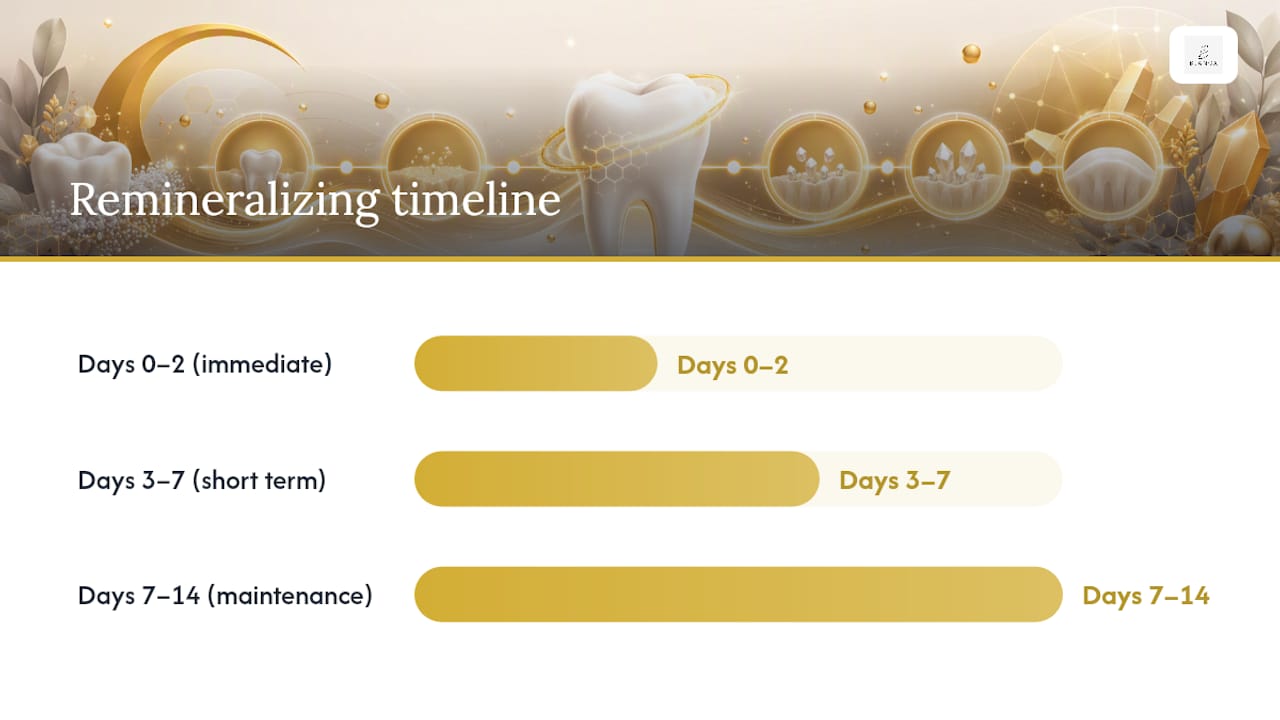
Turning all of this into a routine you’ll actually stick to matters more than memorizing the science behind it. Here’s the practical version.
Days 0 to 2 (immediate):
- Wait 30+ minutes before eating or drinking after treatment.
- Follow the white diet strictly.
- Apply desensitizing or remineralizing gel as directed.
- Skip alcohol-based mouthwash.
Days 3 to 7 (short term):
- Switch to fluoride or nano-hydroxyapatite toothpaste.
- Reintroduce a wider diet, but keep avoiding heavy staining foods.
- Continue nightly remineralizing gel if sensitivity persists.
- Hold off on whitening toothpaste and hard-bristle brushing.
Days 7 to 14 (maintenance):
- Optional: apply CPP-ACP paste nightly if sensitivity is still noticeable.
- Reintroduce whitening toothpaste gradually if enamel feels comfortable.
- Keep up water intake and calcium-rich foods.
- Schedule a dental check if sensitivity hasn’t eased by day 14.
Lab research on hardness recovery suggests early gains show up within 24 to 72 hours of starting remineralizing treatment, with further improvement continuing over the following weeks as minerals continue depositing into the enamel surface.
When to Worry: Signs You Need a Dentist, Not Just More Toothpaste
Most post-whitening sensitivity fades within a week or two with consistent care. When it doesn’t, or when something feels off beyond typical tingling, that’s a signal to stop self-treating and get evaluated.
- Sharp, lingering pain that over-the-counter desensitizing products don’t touch after a week of consistent use.
- Visible chips, rough edges, or translucent spots on your teeth that weren’t there before whitening.
- Sensitivity that gets worse rather than better after the first few days.
- Discoloration or uneven color that persists beyond two to three weeks.
- Gum irritation or receding gum lines around specific teeth.
A dentist evaluating you for this will typically check whether what you’re feeling is transient dentin sensitivity (common, temporary, and expected) versus actual enamel loss (less common, but requires a different treatment plan entirely). When you call, mention how long ago you whitened, what concentration or product you used, how the sensitivity has changed day to day, and whether it’s isolated to specific teeth or general across your mouth. That detail helps them figure out what’s going on faster. If you’ve whitened repeatedly over a short period, our guide on overuse whitening risks covers signs that your enamel may need a longer break than usual.
Why We Think Remineralization Should Never Be an Afterthought
Too many whitening guides treat remineralization as an optional add-on for people with naturally sensitive teeth, something you reach for only if things go wrong. We think that framing gets it backward.
Every bleaching treatment, whether it’s a professional in-office session or an at-home strip, opens up enamel porosity to some degree. That’s simply how peroxide chemistry works; there’s no whitening method that skips this step entirely. Which means remineralizing care isn’t a fix for a problem some people have. It’s the second half of a whitening treatment that most people never finish. Skipping it doesn’t make your teeth look worse right away, but it does mean your enamel stays in a weaker, more porous state longer than necessary, which is exactly the state that lets stains creep back in faster and sensitivity linger longer than it should.
The evidence on this is fairly consistent across the studies we’ve looked at: agents like fluoride, CPP-ACP, and nano-hydroxyapatite don’t undo whitening results. They protect them, by closing the same microscopic channels the peroxide had to open in order to work. As a dental-led brand, we built our approach to whitening around that full picture rather than around the bleaching step alone. Whitening gets you the color. Remineralizing is what makes that color, and your comfort, actually last.
Pair Your Whitening Kit With the Right Aftercare Products
You don’t need a cabinet full of specialty products to remineralize properly. You need the right few, used consistently, and that’s exactly what Blancawhitening built its post-whitening lineup around.
Our oral care collection includes gentle toothbrushes and water flossing tools designed to work alongside sensitive, freshly whitened enamel, so you’re not choosing between a clean mouth and a comfortable one. If you’re due for your next whitening round, our at-home whitening strips come in several flavors and pair naturally with the remineralizing routine outlined above, since a shorter, well-managed treatment window means less enamel stress to recover from in the first place. For the daily maintenance side, an electric toothbrush with a soft-bristle head helps you clean thoroughly without the aggressive scrubbing that freshly whitened teeth don’t need. Browse our best-selling products to see which combination fits your routine, and start your next whitening treatment already knowing exactly how you’ll take care of what comes after.
Frequently Asked Questions
How long does it take to remineralize teeth after whitening? Early hardness recovery shows up within 24 to 72 hours of consistent care, with continued mineral gains over the following two to four weeks.
Can remineralizing products make my teeth whiter? No. Remineralization restores mineral density and seals porous enamel; it preserves the color you already achieved rather than adding to it.
Is it safe to use CPP-ACP products if I’m allergic to dairy? No. CPP-ACP is derived from milk protein, so anyone with a dairy allergy should use a fluoride or nano-hydroxyapatite alternative instead.
Do I need professional fluoride varnish after every whitening session? Not usually. It’s most useful after high-concentration in-office bleaching or for people with a history of significant sensitivity.
This article is general information, not a substitute for advice from a qualified doctor. Consult a qualified healthcare professional about your own circumstances before acting on anything here.
Sources
The clinical picture behind this guide comes primarily from in-vitro enamel studies, which give the clearest available data on how bleaching affects mineral content and how various agents respond.
- Evaluation of the effects of different remineralizing agents on the microhardness and mineral content of bleached enamel | BMC Oral Health
- Evaluation of the effects of different remineralizing agents on the microhardness and mineral content of bleached enamel | SpringerLink