

Protect Enamel: RDA vs REA and Toothpaste Abrasivity for Adults
Toothpaste abrasivity is how much a toothpaste physically wears down tooth structure through brushing, measured clinically as RDA (Relative Dentin Abrasivity) and sometimes REA (Relative Enamel Abrasivity). Products in the 0 to 70 low and 71 to 100 medium range are considered safe for daily use. If you have thin enamel, gum recession, or sensitivity, stick to low or medium RDA formulas and save anything higher for short-term, dentist-guided stain removal.
TL;DR:
- Toothpastes with an RDA of 0 to 70 are generally safe for daily use, especially for those with thin enamel or sensitive gums, while higher RDA formulas are better for short-term stain removal under dentist supervision.
- Laboratory testing of RDA varies due to differences in substrate, brushing simulation, and testing methods, so the number should be treated as a directional guide rather than an exact measure.
- Diamond powder and other hard abrasive ingredients can result in low RDA scores but cause significant enamel wear, highlighting the importance of considering REA alongside RDA for true safety assessment.
- Mechanical stain removal depends on formulation type and particle shape, with some mid-range RDA formulas providing similar cleaning performance to high-RDA pastes over longer brushing times.
- Pair low or medium RDA toothpastes with soft-bristle brushes and avoid high-RDA formulas unless short-term, dentist-guided treatment, to better protect enamel and minimize undue wear.
Table of Contents
- What Do RDA and REA Actually Measure?
- How Do Abrasive Ingredients Physically Wear Down Teeth?
- Why Do Published Abrasivity Numbers Vary So Much?
- Does a Low RDA Always Mean Your Enamel Is Safe?
- Does Higher Abrasivity Actually Clean Teeth Better?
- How Should You Choose a Toothpaste Based on Abrasivity?
- Why Safety-First Formulation Matters More Than Marketing Claims
- Ready to Build a Safer Daily Routine?
- Where This Article’s Research Comes From
- Sources
- FAQ
What Do RDA and REA Actually Measure?
RDA testing works by brushing a dentin sample against a standardized abrasive reference under controlled pressure and stroke count, then measuring how much tooth substance wears away compared to that reference standard. The scale is relative, not absolute. A toothpaste with an RDA around 70 removes roughly that proportion of dentin as the calibration material during the test cycle.
REA measures the same kind of wear but on enamel instead of dentin. It gets reported far less often because enamel is so much harder than dentin that most toothpaste formulas barely scratch it under lab conditions, making REA differences harder to detect and less commercially urgent for manufacturers to publish.
Here is where the numbers matter for your bathroom cabinet. The commonly cited RDA categories break down like this:
- 0 to 70: Low abrasivity, generally suitable for everyday long-term use
- 71 to 100: Medium abrasivity, still appropriate for daily brushing for most people
- 101 to 150: High abrasivity, better suited to occasional or short-term use
- 151 to 250: Approaching or exceeding what many dental researchers regard as a harmful limit for daily use
These bands are useful guardrails, not laws of physics. RDA figures are calculated in a lab, and no two labs run identical brush pressure, bristle stiffness, or stroke counts. Two toothpastes with the same active ingredients can post different RDA scores depending on where and how they were tested. Treat the number as a directional signal, not a guarantee.
How Do Abrasive Ingredients Physically Wear Down Teeth?
Every abrasive toothpaste relies on tiny hard particles suspended in the paste that scrub away plaque, food debris, and surface stain when the bristles drag them across your teeth. The ingredient list on the tube tells you which particles are doing that work, and each one behaves differently on tooth structure.
- Hydrated silica: The most common abrasive in modern toothpaste, prized because manufacturers can control its particle size closely to dial abrasivity up or down.
- Calcium carbonate: A traditional, relatively coarse abrasive still used in some whitening formulas, generally more aggressive than fine silica at equivalent concentrations.
- Phosphates (like dicalcium phosphate): Common in formulations paired with fluoride, offering moderate cleaning with generally gentler wear profiles.
- Polymer abrasives: Softer synthetic particles used in sensitivity-focused pastes to reduce mechanical wear while still lifting some surface stain.
- Diamond powder: An emerging ingredient in some whitening pastes, extremely hard, with a wear profile that behaves unpredictably across different tooth tissues (more on that below).
Particle size, shape, hardness, and concentration all interact to determine final abrasivity, which is why formulation matters more than any single ingredient name on a label. A profilometry study using model toothpastes found RDA climbed from 33 to 66 as hydrated silica concentration rose from 2.5% to 10% by weight, though the increase wasn’t strictly linear. Sharp, angular particles cut more aggressively than rounded ones, and higher concentrations simply mean more grinding contacts per brushstroke.
Not every stain-fighting strategy relies on mechanical wear. Enzymatic and chemical stain-removal agents, along with peroxide-based whitening compounds, lift discoloration through chemistry rather than friction. That is one reason some whitening approaches can brighten teeth without pushing RDA into risky territory.
Why Do Published Abrasivity Numbers Vary So Much?
RDA testing traces back to a standardized method using radioactively labeled dentin samples brushed against a reference abrasive under fixed pressure and stroke count, a technique that became the de facto industry benchmark long before ADA and ISO frameworks formalized acceptance criteria around fluoride content and safety testing for ADA Seal products.
Newer labs increasingly use laser-scan profilometry instead of or alongside radioactive methods. This approach measures physical wear directly, tracking scratch depth and volume loss on a sample surface after simulated brushing. Profilometric measurements have been shown to correlate closely with RDA scores, and the method offers a mechanistic advantage: it captures individual scratch patterns and particle-surface interactions that an aggregate RDA number simply cannot show.
Even with better instruments, published values still drift for practical reasons:
- Substrate differences: Bovine dentin, human dentin, and synthetic substrates don’t wear identically.
- Brushing simulator variation: Bristle stiffness, applied load, and stroke count differ between labs.
- Manufacturer reporting gaps: Many brands never publish traceable RDA or REA values at all, and batch-to-batch testing differences are common even within a single product line.
Pro Tip: If a toothpaste’s packaging or website doesn’t list an RDA number, that silence is itself useful information. Assume moderate to unknown abrasivity and lean on other cues, like whether it’s marketed for sensitivity or daily use, rather than assuming it’s automatically gentle.
Does a Low RDA Always Mean Your Enamel Is Safe?
Not necessarily, and this is the single most misunderstood part of toothpaste abrasivity. Enamel is the hardest substance in the human body, but dentin underneath it is far softer, and abrasives interact with each tissue differently. When enamel wears thin from erosion, aging, or aggressive brushing, exposed dentin wears faster, producing the sensitivity, notching near the gumline, and visible yellowing that dentists associate with abrasive damage.
This is where the diamond powder paradox comes in. Diamond particles are hard enough to scratch enamel effectively, but on soft dentin they can behave differently. Research measuring both scales directly found diamond-containing toothpastes with low RDA scores but REA values reaching up to 244 (plus or minus 76) in some tested products. In practical terms, the particles sink into dentin rather than grinding it away, producing a deceptively low RDA reading, while the same hard edges cut into enamel with far more force. A toothpaste can look gentle on paper and still be aggressive on the enamel surface you actually see when you smile.
A toothpaste’s RDA number describes what it does to dentin. It says almost nothing on its own about what it does to enamel, which is why pairing RDA with REA data matters more for whitening-focused formulas than for standard fluoride toothpaste.
Certain factors stack the risk higher regardless of which toothpaste you use:
- Acid erosion from soda, citrus, wine, or reflux softens enamel before the toothbrush ever touches it.
- Overbrushing, meaning excessive pressure, hard bristles, or brushing immediately after acidic food, compounds mechanical wear.
- Aging enamel thins naturally over decades, narrowing your safety margin even with a moderate-RDA paste.
Watch for wedge-shaped notches at the gumline, new or worsening cold sensitivity, and a duller or more translucent look near the biting edges of your front teeth. Those are signs worth raising with your dentist before your next cleaning, and it’s worth reading more about how whitening overuse can affect enamel if you’re combining abrasive pastes with a whitening routine.
Does Higher Abrasivity Actually Clean Teeth Better?
Up to a point, yes, but the returns shrink fast. An in vitro study on bovine dentin found the highest-RDA toothpaste tested, at 143 plus or minus 6, cleaned stains fastest among the group. But several mid-range RDA formulas achieved nearly complete stain removal too, they just took longer brushing time to get there. That gap matters: a moderate-RDA paste used consistently over a longer brushing session can rival a high-RDA paste used briefly.
RDA alone also doesn’t fully predict how well a toothpaste cleans. Particle type and formulation shape performance just as much as the raw abrasivity number. A silica-based paste and a calcium carbonate paste with similar RDA scores can produce noticeably different stain removal, because particle shape and how the abrasive is suspended in the formula both affect how efficiently it contacts the tooth surface during brushing. Research on RDA and hard tissue impact confirms there’s no single consensus threshold where cleaning stops improving and damage risk takes over. It depends on the person, the formula, and how the toothpaste gets used.
That nuance opens the door to reasonable exceptions. Someone with heavy coffee or tobacco staining might use a higher-RDA whitening toothpaste for a defined stretch, say a few weeks, under a dentist’s recommendation, then rotate back to a gentler daily formula. That approach treats high abrasivity like a short-term tool rather than a permanent habit, which lines up with how most dental researchers frame stronger-abrasivity products: appropriate for stubborn extrinsic stains, not routine daily brushing.
- Higher RDA generally speeds stain removal, but with diminishing returns past a certain point.
- Formulation and particle type shift cleaning performance independent of the RDA number itself.
- Short-term high-abrasivity use under dental guidance is different from making it your everyday paste.
How Should You Choose a Toothpaste Based on Abrasivity?
Picking the right toothpaste comes down to matching the formula to your actual risk profile, not just grabbing whatever promises the whitest smile on the shelf. Work through these steps:
- Identify your risk factors first. Do you have thin enamel, receding gums, existing sensitivity, or a history of acid reflux or frequent acidic drinks? Any of these should push you toward the low end of the RDA scale.
- Define your actual goal. Are you managing sensitivity, maintaining a healthy baseline, or targeting stubborn surface stains? Each goal points to a different abrasivity band.
- Check for an RDA statement or low-abrasion claim. Not every brand publishes it, but when it’s listed, treat it as a genuine data point rather than marketing language.
- Consider non-abrasive alternatives for stain concerns. Peroxide-based whitening strips or gels lift stain chemically, sidestepping the mechanical wear question entirely.
- Default to low or medium RDA for daily use. Reserve high-RDA formulas for short, defined stretches, and loop your dentist in before making that switch.
Bring a short list of questions to your next cleaning: What RDA range fits my enamel thickness? Am I showing early signs of abrasion, like gumline notching or new sensitivity? Would a non-abrasive whitening approach get me the same cosmetic result with less mechanical risk? If your dentist notices any wear pattern forming, that is your signal to switch products immediately rather than waiting for your next visit.
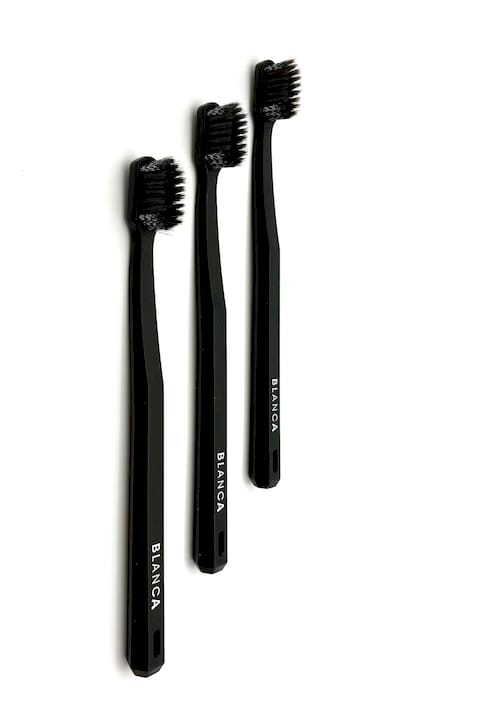
Pro Tip: Pair a low or medium RDA toothpaste with a soft-bristle brush rather than medium or hard bristles. Bristle stiffness and brushing pressure multiply whatever abrasivity is already in the tube, so softening one variable takes real pressure off your enamel even if you don’t change toothpaste at all.
Why Safety-First Formulation Matters More Than Marketing Claims
The abrasivity conversation gets muddied by marketing copy that treats “whitening” and “abrasive” as interchangeable, when they’re not. Chemical whitening and mechanical abrasion solve the same cosmetic problem through completely different mechanisms, and conflating them leads people to reach for the wrong tool. A paste engineered around fine, well-controlled hydrated silica particles can deliver meaningful stain removal without pushing RDA into a range that concerns dental researchers.
What actually reassures me about daily oral care decisions is straightforward: the ingredients and their tested behavior matter far more than a bold claim on the front of a box. Product decisions get built around that same standard, evidence-backed abrasives, clinically informed formulation, and a clear distinction between everyday maintenance and short-term intervention. If you want to go deeper on how whitening interacts with tooth structure, our guides on tooth porosity and whitening results and whether whitening damages enamel cover the mechanics in more detail.
— Blanca
Ready to Build a Safer Daily Routine?
This brand was founded by dental professionals, and its products are built around the same abrasivity and safety logic covered in this article, not around whichever ingredient trends fastest. Where drugstore toothpaste aisles leave you guessing at unpublished RDA numbers, our approach starts from clinically backed ingredients chosen for predictable, low-wear performance alongside real stain results.
If your goal is everyday maintenance, our oral care collection includes toothbrushes and flossers designed to pair gently with any low or medium RDA toothpaste in your routine. If stubborn surface stains are the real target, our whitening strips and gels lift discoloration chemically rather than mechanically, so you’re not relying on a high-RDA paste to do that work every day. Browse the oral care collection now and build a routine that protects your enamel while it brightens your smile.
Where This Article’s Research Comes From
- RDA and REA values of toothpastes using diamond powder and traditional abrasives, covering the diamond powder paradox and testing variability.
- Profilometry-based abrasion study, covering laser-scan methods and silica concentration effects.
- Cleaning efficacy study on bovine dentin, covering RDA versus stain removal performance.
- American Dental Association toothpaste guidance, covering ADA Seal criteria and abrasive agents.
- RDA and REA setting the record straight, covering standard RDA category ranges.
- Impact of RDA on dental hard tissues, covering evidence-based thresholds and clinical context.
Talk to your dentist about your specific enamel health and risk factors before making major changes to your toothpaste routine.
This article is general information, not a substitute for advice from a qualified doctor. Consult a qualified healthcare professional about your own circumstances before acting on anything here.
Sources
- RDA and REA Values of Commercially Available Toothpastes Utilising Diamond Powder and Traditional Abrasives
- Toothpaste abrasion and abrasive particle content (profilometry study)
- Cleaning efficacy of toothpastes with varying abrasiveness—An in vitro investigation on bovine dentin
- Toothpastes | American Dental Association
- Protected by a safe RDA: setting the record straight about toothpaste abrasivity
FAQ
What is the abrasivity of toothpaste?
Toothpaste abrasivity is how much physical wear a toothpaste causes on tooth structure during brushing, measured as RDA for dentin and REA for enamel. Most everyday toothpastes fall in the low to medium RDA range of 0 to 100, which dental researchers consider appropriate for daily use.
Why don’t dentists recommend hydroxyapatite for everyone?
Hydroxyapatite is generally discussed as a remineralizing ingredient rather than an abrasive, and its role in abrasivity specifically isn’t well established in the research reviewed here. If you’re considering it for sensitivity or remineralization, ask your dentist whether it fits your specific enamel condition rather than assuming a universal benefit.
Which toothpaste has the lowest abrasiveness?
Formulas built around fine, low-concentration hydrated silica or polymer abrasives generally sit at the lower end of the RDA scale, though exact scores vary by brand and aren’t always published. Toothpastes marketed specifically for sensitivity typically target this low range, and checking for a stated low RDA or low-abrasion claim is the most reliable way to confirm it.
Is abrasive toothpaste bad for your teeth?
Not inherently. Toothpaste in the low to medium RDA range is considered safe for daily use, and even higher-RDA formulas can be appropriate short-term under dental guidance for stubborn staining. The risk comes from routine daily use of very high-RDA products, especially 151 and above, combined with risk factors like thin enamel or aggressive brushing technique.