

Water Flossers Cut Gum Bleeding in 2–4 Weeks: Canadian Clinician Take
Water flossers reliably reduce gum bleeding and gingival inflammation when used daily alongside brushing, with randomized trials showing measurable improvement within four weeks. They work well as an adjunct for gingivitis and as support for certain periodontitis cases, but they cannot remove hardened tartar or replace professional periodontal treatment. Here’s what the research actually shows, and how to use one correctly.
TL;DR:
- Water flossers are most effective for reducing gum bleeding and inflammation within four weeks when used daily, especially in cases with braces, implants, or gum disease.
- They can reach and remove pathogens in pockets up to six millimeters deep, but cannot remove hardened tartar or treat moderate to advanced periodontal disease on their own.
- Proper technique involves aiming the pulsating stream at a 90-degree angle along the gum margin, starting on low pressure, and cleaning all areas including behind molars; frequent device maintenance is essential.
- Regular use helps improve bleeding and gingival health more reliably than plaque reduction, which shows more variability across studies.
- Combining water flossing with traditional flossing offers the best results, especially for healthy mouths with tight interdental contacts, as each tool complements the other.
Table of Contents
- How Water Flossers Help With Gum Disease
- What Do Clinical Trials Show About Bleeding and Plaque?
- Water Flosser Vs Dental Floss: Which One Actually Wins?
- Who Benefits Most From Daily Water Flossing?
- How Do You Use a Water Flosser Correctly?
- What a Water Flosser Can’t Fix
- BLANCA’s Clinical Approach to Water Flossing
- A Clinician’s Honest Take on Water Flossers
- Add a Water Flosser to Your Daily Gum Care Routine
- Sources
- FAQ
How Water Flossers Help With Gum Disease
A water flosser works through a mechanism called hydrokinetic action: a pressurized, pulsating stream of water hits the gumline and disturbs the sticky biofilm that toothbrushes and floss often miss below the gum margin. That pulsation creates two effects at once, a compression phase that disrupts bacterial colonies and a decompression phase that flushes loosened debris out of the pocket.
This matters because gum disease starts as a bacterial problem, not a mechanical one. Plaque bacteria irritate the gum tissue, triggering the inflammation and bleeding that define gingivitis. A device that physically disturbs that biofilm at the point of irritation, rather than just brushing the tooth surface, addresses the actual cause rather than the symptom.
Research backs up the mechanism in ways that go beyond just “it feels clean.” A 12-week randomized controlled trial found that daily water flossing shifted the supragingival plaque microbiota toward a more aerobic, less pathogenic profile, with a measurable drop in anaerobic bacteria linked to gum disease. A comparative review of water flossers in periodontal therapy also found that the water stream can reach and reduce pathogens in many pockets measuring up to 6 millimeters deep, which is well within the range clinicians consider early to moderate periodontal involvement.
Three things happen when you use a water flosser correctly:
- The pulsating stream disrupts biofilm at and just below the gumline, where a toothbrush bristle cannot reach.
- Trapped food particles and loose plaque get flushed out of the sulcus (the shallow space between tooth and gum).
- When a clinician recommends it, the reservoir can carry a diluted antimicrobial rinse for targeted subgingival delivery.
That third point matters for anyone managing active gum inflammation. Standard tap water works for daily maintenance, but a dentist may recommend an antimicrobial solution for a defined period during active treatment. That is a clinical decision, not a default setting.
What Do Clinical Trials Show About Bleeding and Plaque?
The strongest, most consistent evidence for water flossers concerns bleeding, not plaque. A systematic review and meta-analysis pooling 18 randomized controlled trials found that adjunctive water flosser use produced short-term improvements in both bleeding index and gingival index compared to toothbrushing alone. Plaque index results were far less consistent across studies, and the review rated the certainty of that particular outcome as low to very low.
What the RCTs found: A four-week randomized controlled trial comparing a pulsating water flosser plus brushing against dental floss plus brushing found statistically significant greater reductions in bleeding on probing and gingival index in the water flosser group over just four weeks.
The timeline pattern that shows up across trials is fairly consistent:
- Weeks 1 to 2: Reduced bleeding on brushing is often the first noticeable change.
- Weeks 2 to 4: Bleeding on probing and gingival index scores show measurable, often statistically significant improvement.
- Weeks 4 to 12: Plaque and gum tissue changes become more visible, with the 12-week trial also documenting reduced oral malodor and a shift in plaque microbiota away from odor and disease-associated bacteria.
Orthodontic patients tend to show a larger relative benefit in these studies, likely because brackets and wires make effective string flossing difficult, leaving more biofilm for a water stream to address. That said, the evidence certainty varies by outcome and by study design. Bleeding reduction shows up reliably across trials; plaque index improvements are less consistent, and researchers attribute that partly to differences in device settings, tip type, and how long each trial ran. Nobody should read “moderate certainty” as “guaranteed,” but they also shouldn’t read it as weak evidence. It’s a genuinely useful, moderately well-supported adjunct.
Water Flosser Vs Dental Floss: Which One Actually Wins?
Neither tool wins outright, and the honest answer depends on your mouth and your gums. For people with active gum inflammation, braces, implants, or limited hand dexterity, a water flosser tends to outperform floss on bleeding reduction. The four-week RCT mentioned above found greater reductions in bleeding, gingival index, and plaque with the water flosser group than the floss group, using the same brushing routine as a baseline for both.
String floss still holds an edge in one specific scenario: healthy mouths with tight, healthy interdental contacts where mechanical scraping against the tooth surface removes plaque that a water stream might not fully dislodge. If your gums are healthy and your teeth are well aligned, floss remains an efficient, no-equipment option.
Here’s where a water flosser tends to earn its keep:
- Braces and orthodontic appliances, where wires and brackets make string floss nearly impossible to maneuver correctly.
- Dental implants and fixed prostheses, where floss threading around abutments is tedious and often skipped entirely.
- Limited manual dexterity, including arthritis or other conditions that make the pinching motion of floss difficult.
- Existing gum inflammation, where the goal is reducing bleeding and biofilm below the gumline, not just between tight contacts.
The two are not strict competitors. Many periodontists recommend combining both: floss for tight interdental contacts, a water flosser for the gumline and around appliances. If you’re deciding between floss picks and traditional string floss for the parts a water flosser doesn’t fully cover, the choice usually comes down to comfort and consistency rather than one being objectively superior.
Who Benefits Most From Daily Water Flossing?
Not everyone needs a water flosser, but several groups see outsized benefit. If you fall into one of these categories, the evidence supports adding one to your routine.
- Gingivitis patients dealing with red, puffy, or bleeding gums often see the fastest response, since gingivitis is reversible with consistent biofilm disruption.
- Early-stage periodontitis patients using a water flosser as an adjunct to professional cleanings, not a replacement for them.
- Orthodontic patients with braces, where brackets trap plaque that string floss struggles to reach.
- People with dental implants or peri-implant mucositis, where a gentler stream helps manage inflammation around the implant without irritating soft tissue.
- Anyone with limited manual dexterity, since the device does the mechanical work that pinching and threading floss requires.
Expect bleeding improvement within two to four weeks of consistent daily use, with more visible changes in gum tone and texture by the eight to twelve week mark. If you notice pus, increasing pocket depth, tooth mobility, or bleeding that hasn’t improved after several weeks of correct daily use, that’s not a water flosser problem. That’s a signal to see a periodontist, since those symptoms point toward disease progression a home device cannot reverse on its own.
How Do You Use a Water Flosser Correctly?
Technique matters as much as the device itself. A poorly aimed stream at high pressure can irritate healthy tissue instead of helping it.
- Fill the reservoir with lukewarm water, or a diluted antimicrobial rinse only if your dentist has specifically recommended one.
- Lean over the sink and place the tip in your mouth before turning the unit on, to avoid spraying water everywhere on the first try.
- Start on the lowest pressure setting, especially if you have sensitive or inflamed gums, and increase gradually as your tissue tolerates it.
- Aim the tip at a 90 degree angle to your gumline for general daily use, tracing along the gum margin and pausing briefly between each tooth.
- Switch to a soft or Pik Pocket tip for subgingival access if a clinician has recommended targeted pocket care, using a lower angle for gentler entry beneath the gum tissue.
- Work around the entire mouth, including behind the back molars and along the tongue side of the lower teeth, where plaque commonly accumulates unnoticed.
- Floss or water floss before brushing, a sequence many clinicians recommend since it loosens debris that brushing then clears away.
For step-by-step technique with photos, Blancawhitening’s guide on how to use a water flosser walks through the same sequence in more visual detail.
Pro Tip: If your gums bleed heavily during your first few sessions, that’s often inflamed tissue reacting to disturbance, not damage from the device. Keep the pressure low and stay consistent. Bleeding typically drops within two weeks if the technique is correct.
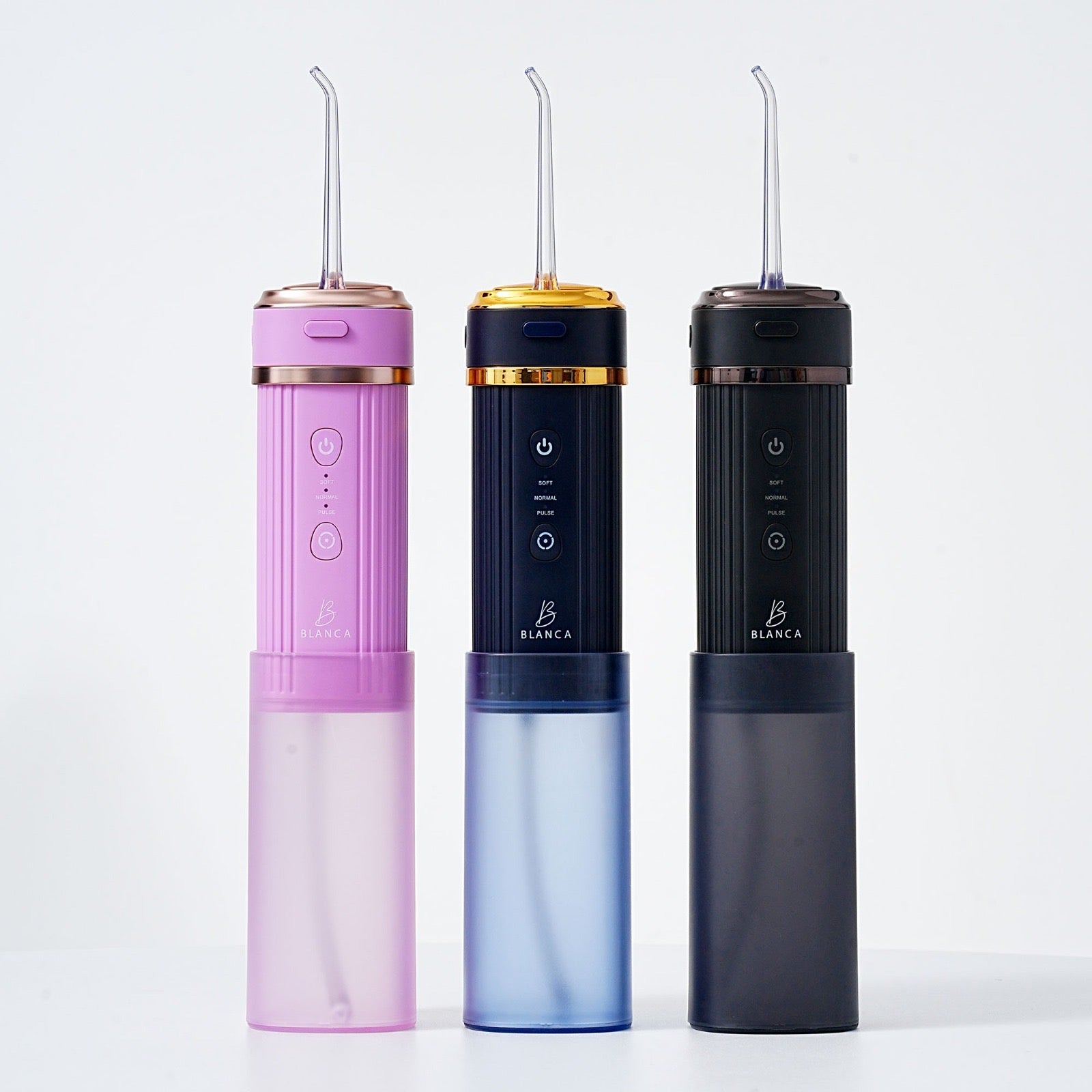
Device hygiene deserves equal attention. Flush the reservoir after each use and leave it open to air dry, since a damp, closed reservoir is an easy place for biofilm to grow inside the unit itself. Never share tips between household members, and replace tips on the schedule the manufacturer recommends, generally every three months, to keep the spray pattern effective and the tip itself sanitary. Blancawhitening’s cleaning and maintenance guide covers the full care routine in more depth.
What a Water Flosser Can’t Fix
A water flosser is a maintenance and adjunct tool, not a treatment for existing disease. It cannot remove tartar, also called calculus, the hardened mineral deposit that forms when plaque sits on the tooth surface long enough to calcify. Once plaque hardens into tartar, only professional scaling by a dentist or hygienist can remove it. No water pressure, however strong, will dissolve it.
It also cannot regenerate bone lost to periodontitis or reverse deep pocket formation on its own. Moderate to advanced periodontal disease requires professional intervention, typically scaling and root planing, and sometimes surgical treatment, alongside home care rather than instead of it.
Safety-wise, the evidence is reassuring for daily use. The comparative review of water flossers in periodontal therapy found them safe for regular use when the technique is correct, though people with active infections or recent oral surgery should check with their dentist before resuming use. Watch for these warning signs that call for a dental visit rather than more home care:
- Bleeding that persists beyond several weeks of correct daily use.
- Gum pockets that seem to be getting deeper or gums that appear to be receding further.
- Any tooth mobility, looseness, or shifting.
- Visible pus, swelling, or persistent bad taste near a specific tooth.
- Sharp or worsening pain rather than mild sensitivity.
None of those symptoms are something a water flosser, or any home device, should be expected to resolve.
BLANCA’s Clinical Approach to Water Flossing
Blancawhitening was founded by dental professionals, and that clinical background shapes how the brand approaches every product in its oral care line, not just its whitening systems. The guidance in this article, on pressure settings, tip selection, and hygiene, reflects the same evidence-based thinking behind the products themselves.
A few resources worth bookmarking if you’re building out a gum-focused routine:
- How to use a water flosser for technique specifics.
- Water flosser cleaning and maintenance to keep your device free of internal biofilm.
- Water flossing benefits for a broader look at what daily use does for your smile.
Clinician-designed doesn’t mean complicated. It means the pressure settings, tip design, and reservoir engineering were built with actual periodontal outcomes in mind, not just marketing claims.
A Clinician’s Honest Take on Water Flossers
The evidence here is genuinely good, but it’s also specific. Water flossers reduce bleeding and inflammation reliably enough that I recommend them to most patients as a daily habit, not an occasional extra. What I won’t do is tell someone with deep pockets or bone loss that a water flosser replaces their periodontal appointments. Use one daily, use it correctly, and still show up for your cleanings.
— Blanca
Add a Water Flosser to Your Daily Gum Care Routine
The water flosser is designed with input from dental professionals to optimize pressure range, tip design, and reservoir size to support gum health, focusing on function rather than aesthetics. The BLANCA Water Flosser runs $45 and pairs naturally with the brand’s electric toothbrush line for a full gumline routine in one collection.
If your tips are worn down or overdue for a swap, replacement tips are sold separately so you’re not stuck buying a whole new unit every few months. And if what you’re really managing is active gum disease rather than daily maintenance, a water flosser supports that work, it doesn’t substitute for it, so keep your periodontal appointments on the calendar alongside it. Browse the oral care collection to see the water flosser alongside the rest of BLANCA’s clinician-designed lineup and find the setup that fits your routine.
Sources
This article draws on peer-reviewed clinical research, including a systematic review and meta-analysis of 18 RCTs, a 12-week randomized controlled trial on gingival inflammation and plaque microbiota, a comparative review of water flossers in periodontal therapy, and a four-week RCT comparing water flossing to dental floss. These sources represent a starting point for further reading, not the complete body of periodontal literature.
This article is general information, not a substitute for advice from a qualified doctor. Consult a qualified healthcare professional about your own circumstances before acting on anything here.
- Effects of water flossing on gingival inflammation and supragingival plaque microbiota: a 12-week randomized controlled trial
- Efficacy of water flossing on clinical parameters of inflammation and plaque: A four-week randomized controlled trial
FAQ
Will a water flosser help gum disease?
Yes, for gingivitis and as an adjunct for early to moderate periodontitis, daily water flossing reduces bleeding and gingival inflammation, based on randomized controlled trials. It works alongside brushing and professional care, not in place of either.
Why don’t dentists recommend water flossers to everyone?
Most dentists do recommend them, especially for patients with braces, implants, or gum inflammation, but they’re clear that a water flosser cannot remove hardened tartar or replace professional periodontal therapy for moderate to advanced disease. Some dentists also emphasize that technique and consistency matter more than the device itself.
Does a water flosser affect gums positively or negatively?
Used correctly at an appropriate pressure setting, a water flosser reduces gum bleeding and inflammation within a few weeks. Used at high pressure aimed too aggressively at the gumline, it can cause temporary irritation, so starting low and increasing gradually protects sensitive tissue.
What is the quickest way to reduce early gum disease at home?
Consistent daily water flossing combined with proper brushing technique typically reduces gum bleeding within two to four weeks, according to clinical trial data. Pairing a BLANCA Water Flosser with a professional cleaning gives you both the daily maintenance and the tartar removal a home device can’t provide on its own.
Can a water flosser replace string floss entirely?
Not entirely. It outperforms floss for bleeding reduction in people with braces, implants, or gum inflammation, but tight interdental contacts in healthy mouths often still benefit from the mechanical scraping action of string floss. Most periodontists recommend combining both rather than choosing one permanently.