

Best Time to Whiten Teeth Daily: Night Routine That Works
For most adults, the best time to whiten teeth daily is at night, right before bed — and ideally within a couple of days after a professional dental cleaning. That combination gives you the longest uninterrupted contact time, the lowest saliva flow, and the cleanest enamel surface for the whitening agent to work on.
Here is what to keep in mind before you start:
- Night before bed is the recommended daily slot for most adults because saliva production drops during sleep, reducing dilution of the whitening gel.
- Start within about two days after a professional cleaning for the most uniform, effective results. Plaque and pellicle begin to reform quickly, so starting soon after cleaning helps with better penetration.
- Daily indefinite whitening is not safe. Follow your product’s prescribed course, then allow recovery days. Sensitivity is a real signal to slow down.
Table of Contents
- Why timing and your dental cleaning window change everything
- Morning vs. night: which daily slot is right for you?
- How often should you whiten your teeth safely?
- A safe nightly whitening routine you can actually follow
- Who should avoid whitening, and when to see a dentist first
- Key Takeaways
- The timing advice most people get half right
- Blancawhitening fits right into your nightly routine
- Useful sources and further reading
Why timing and your dental cleaning window change everything
The chemistry behind whitening is straightforward: peroxide-based agents penetrate the enamel and break apart stain molecules. But how well that process works depends on two things most people overlook — the state of your enamel surface and how much saliva is present.
During sleep, saliva flow decreases significantly. Lower saliva means the whitening gel stays in contact with your enamel longer without being diluted or displaced. That extended contact is a key physiological reason nighttime wear is often favored by dental professionals.
The cleaning window matters just as much. A professional dental cleaning removes hardened plaque and tartar that physically block whitening agents from reaching the enamel surface evenly. Once that barrier is gone, the agent can penetrate more uniformly. Pellicle — the thin protein film that coats your teeth — begins to reform within hours of cleaning, so waiting too long after your appointment reduces that advantage.
“Plaque and pellicle begin to reform within hours, so initiating whitening soon after cleaning gives the most exposed, clean surface for even whitening.” — dental expert guidance via Today.com
Pro Tip: If you cannot start whitening the same day as your cleaning, do a thorough rinse that evening, avoid dark-colored foods and drinks, and begin your whitening routine the following morning — still within that 48-hour window.
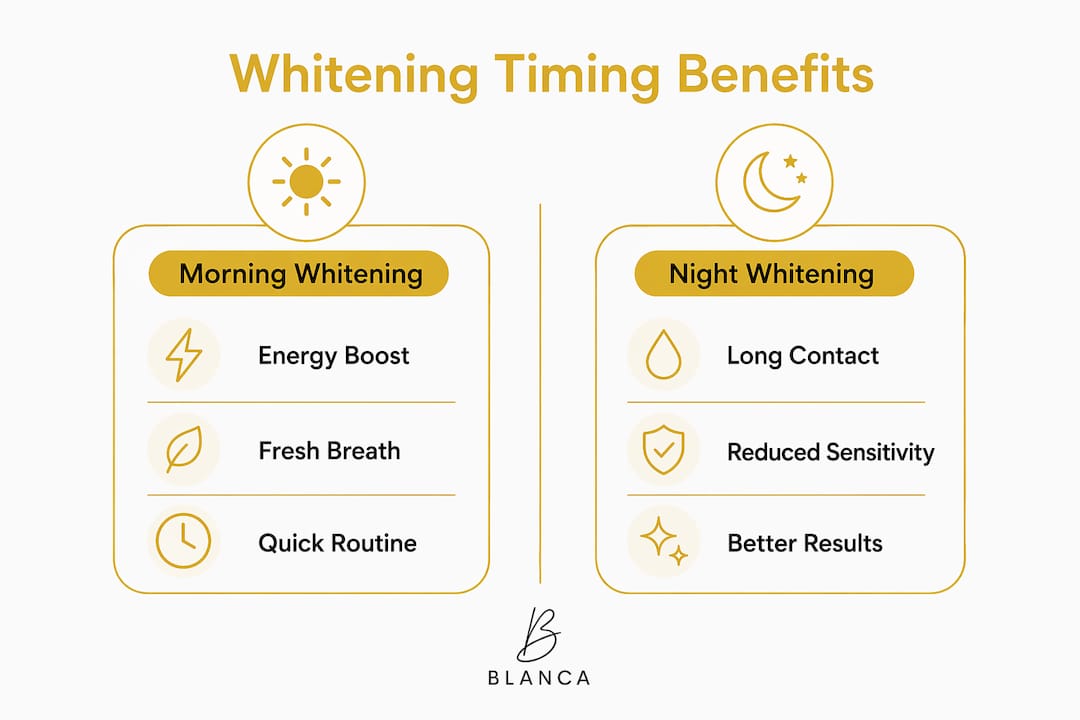
Morning vs. night: which daily slot is right for you?
There is no single universally correct hour. What dental experts consistently emphasize is that the time you will actually stick to reliably tends to produce better results than an ideal time you keep skipping. That said, the two options have real, practical differences.
Why nighttime works better for most people
- Longest uninterrupted wear: Sleep gives you 6–8 hours of contact time without eating, drinking, or rinsing.
- Lower saliva flow: Reduced dilution means the gel stays concentrated on the enamel surface.
- No post-whitening staining risk: You are not reaching for coffee or red wine while asleep.
- Sensitivity recovery: Minor sensitivity often subsides overnight, so you wake up more comfortable.
When morning whitening makes sense
- You prefer to notice and manage sensitivity while you are awake.
- Your product specifically warns against overnight use (always read the label).
- A consistent morning routine makes adherence easier for your lifestyle.
The main drawback of morning whitening is practical: eating breakfast, drinking coffee, and the natural rise in saliva flow all reduce effective contact time and can dilute the gel before it finishes working. If you whiten in the morning, wait at least 30–60 minutes after eating before applying — saliva pH drops after meals, and letting it recover first protects your enamel.
Pro Tip: Whatever time you choose, anchor it to an existing habit — brushing after dinner or your morning skincare routine. Habit-stacking is the most reliable way to stay consistent with any whitening teeth routine.

How often should you whiten your teeth safely?
Short answer: not every day, indefinitely. Most dental professionals recommend a structured approach — an initial course followed by spaced maintenance — rather than open-ended daily use.
- Complete an initial prescribed course. Many at-home products call for daily or twice-daily use for 7–14 days. Whitening strips, for example, are typically applied twice daily for 30 minutes over 14 days, or once daily with newer formulations. Tray-based systems using carbamide peroxide gel are often worn 2–4 hours daily or overnight.
- Take a rest period. After your initial course, stop daily whitening. Your enamel needs time to rehydrate and remineralize before the next cycle.
- Schedule maintenance touch-ups. Most dental professionals advise waiting at least six months before a top-up, with many patients needing only 1–2 short sessions annually.
- Use a cycle approach for ongoing brightness. Short cycles — roughly one week on, one to two weeks off — are safer than continuous daily whitening. After a cycle, assess where you are before starting another.
- Adjust for sensitivity. Sensitivity commonly peaks the day after treatment, not during it. If that happens, shift to alternate nights or an M/W/F schedule and consult your dentist for a tailored plan.
Key point: After an initial course, routine daily whitening is not recommended. Maintenance with periodic touch-ups preserves results without overexposing enamel to peroxide.
A useful whitening schedule pairs your initial course with your dental cleaning calendar — start within 48 hours of your cleaning, complete the course, then plan your next touch-up around your next hygiene visit.
A safe nightly whitening routine you can actually follow
A consistent routine removes the guesswork and protects your enamel. Here is a dentist-aligned nightly sequence:
- Brush and floss after dinner. Clean teeth give the whitening agent direct access to the enamel surface. Wait 30 minutes after eating before applying.
- Apply the correct amount of gel. Use only the amount your product specifies. More gel does not mean faster results — it increases the risk of gum irritation.
- Wear for the product-specified time. Follow your product’s instructions exactly. Use overnight trays only if your product and dentist explicitly approve it.
- Remove, rinse, and clean your tray. Rinse your mouth with water and clean the tray thoroughly to prevent bacterial buildup.
- Apply a desensitizing product if needed. A fluoride toothpaste or a desensitizing gel applied after whitening helps enamel recover and reduces discomfort.
Aftercare that protects your results
- Avoid coffee, tea, red wine, berries, and dark sauces for 24–48 hours after whitening. Enamel pores remain temporarily open after treatment and absorb pigments more readily.
- Use a fluoride toothpaste daily to support remineralization.
- Stay hydrated — water helps neutralize acids and rinse away potential staining agents.
- If you smoke, avoid it immediately after whitening. Tobacco is one of the fastest ways to reverse results.
For guidance on eating before and after whitening, the timing of your meals relative to treatment matters more than most people realize.
Pro Tip: Keep a simple log — just a note on your phone — of which nights you whitened and any sensitivity you noticed. After a week, you will have clear data to adjust your cadence before problems compound.
Who should avoid whitening, and when to see a dentist first
Whitening is safe for most healthy adults when used as directed, but several conditions require a dentist’s evaluation before you start. Clinical guidance is clear that aggressive or repeated bleaching can cause temporary sensitivity and enamel surface changes — which is why knowing your contraindications matters.
Pause or skip whitening if you have:
- Active tooth decay or untreated cavities
- Exposed dentin from gum recession or enamel wear
- Recent restorations — crowns, veneers, or bonding will not whiten and may end up visibly mismatched
- Significant gum disease or open sores in the mouth
See a dentist before starting if you are:
- Under 18 years old
- Pregnant or breastfeeding
- Experiencing persistent sensitivity that has lasted more than a week
- Noticing uneven whitening between natural teeth and restorations
“Aggressive bleaching and repeated use can lead to temporary sensitivity and enamel changes; moderate professional whitening is generally safe when used as directed.” — Scientific American
Enamel is temporarily more porous during whitening treatment. That porosity is normal and short-lived, but it is why recovery time between sessions matters. Enamel remineralizes with the help of fluoride and saliva — skipping rest days interrupts that process. For a deeper look at overuse whitening risks, the relationship between peroxide exposure and enamel health is worth understanding before you commit to a schedule.
This article is general information, not professional dental advice. Confirm the right schedule and approach for your specific situation with a licensed dentist.
Key Takeaways
Night-before-bed whitening, started within 48 hours of a professional cleaning and followed by structured rest periods, is the safest and most effective routine approach for most adults.
| Point | Details |
|---|---|
| Best daily timing | Night before bed offers 6–8 hours of uninterrupted contact and lower saliva flow. |
| Post-cleaning window | Start whitening within ~48 hours of a professional cleaning for the most even results. |
| Safe frequency | Complete an initial course, then wait at least six months before a top-up; 1–2 sessions annually is typical. |
| Sensitivity management | If sensitivity appears, shift to alternate nights or M/W/F and consult your dentist. |
| Blancawhitening products | Blancawhitening’s at-home whitening range is designed to fit a nightly routine with clinically backed formulations. |
The timing advice most people get half right
Most whitening guides tell you to whiten at night. That part is correct. What they leave out is the other half of the equation: when in your dental calendar you start matters just as much as what time of day you apply the product.
The 48-hour post-cleaning window is not a minor detail. It is arguably the single biggest lever most at-home whiteners never pull. Whitening over a layer of plaque and pellicle is like painting over dust — the result is uneven and less durable. Yet the majority of people start a whitening kit whenever it arrives in the mail, with no reference to their last cleaning.
The second thing people underestimate is recovery time. Enamel is not passive during whitening — it is actively remineralizing between sessions. Treating it like a surface you can bleach indefinitely leads to the sensitivity and translucency problems that make people swear off whitening entirely. Short cycles with genuine rest periods are not a compromise. They are how you get lasting results without damaging what you are trying to improve.
At Blancawhitening, the approach we recommend is simple: align your whitening start date with your hygiene visit, use the nightly routine consistently for the prescribed course, then step back and let your enamel recover. Pair that with a whitening-safe oral care routine and you have a system that works long-term.
Blancawhitening fits right into your nightly routine
Brighter teeth do not require complicated protocols. Blancawhitening’s at-home whitening collection is built around the same dentist-aligned principles covered in this article: clinically backed peroxide formulations, evening-friendly formats, and clear instructions that take the guesswork out of timing and dosage.
Whether you are starting your first whitening course after a cleaning or looking for a reliable maintenance option, the best-selling Blancawhitening products are designed to work with your enamel, not against it. Use them as directed, pair them with recovery days, and consult your dentist if sensitivity persists. Browse the full collection and find the format that fits your nightly routine.
Useful sources and further reading
- The Best Time To Whiten Your Teeth, According to Dentists — Today.com — supports the 48-hour post-cleaning window
- Tooth Whitening: What We Now Know — PMC / NCBI — clinical overview of whitening strip and tray protocols
- Best Time to Whiten Teeth: After Cleaning or Before Bed? — Remi — nighttime timing rationale and saliva pH guidance
- How Often Can You Whiten Your Teeth Safely? — MD.co.uk — six-month maintenance interval guidance
- When Is Too Much Teeth Whitening Harmful? — Scientific American — safety and enamel risk from over-whitening
- How Often Can You Safely Whiten Teeth? — Minnetonka Dental — post-course maintenance guidance
- Morning or Night? Choosing the Best Time to Wear Your Whitening Trays — Smile Dentist London — morning vs. night comparison
- Whitening Schedule Recommended for a Brighter Smile — Blancawhitening — sample maintenance schedules and lifestyle tips
- Overuse Whitening Risks Explained: Protect Your Enamel — Blancawhitening — enamel protection and overuse risks
- Eating Before and After Teeth Whitening — Blancawhitening — meal timing and re-staining prevention