

When to Brush After Whitening Strips: Safe Timing Guide
Wait 30 minutes before brushing after whitening strips. That single rule protects your enamel, reduces sensitivity, and preserves your results. Dental professionals recommend rinsing with plain water immediately after removing strips, then waiting at least 30 minutes before picking up a toothbrush.
Here’s what to do the moment you remove your strips:
- Spit and rinse with cool or lukewarm water to clear residual gel
- Do not brush for at least 30 minutes
- Avoid acidic or staining drinks (coffee, tea, citrus juice) during this window
- Skip alcohol-based mouthwash right after removal — it can further dry enamel
- After 30 minutes, brush gently with a soft-bristled toothbrush and a non-abrasive fluoride toothpaste
Pro Tip: Avoid abrasive whitening toothpastes right after a strip session. The gritty particles in many whitening pastes can scratch temporarily softened enamel. A plain fluoride toothpaste is the safer choice for your first post-strip brush.
Key Takeaways
Waiting 30 minutes before brushing after whitening strips is the single most important step for protecting enamel and reducing sensitivity.
| Point | Details |
|---|---|
| Wait 30–60 minutes | Brush only after this window so enamel can rehydrate and begin remineralizing. |
| Rinse immediately | Spit and rinse with cool water right after removing strips to clear residual gel. |
| Use the right tools | Soft-bristled toothbrush and non-abrasive fluoride toothpaste protect recovering enamel. |
| Avoid staining foods | Skip coffee, tea, acidic drinks, and temperature extremes for at least the first hour. |
| Blancawhitening tools | The Blancawhitening electric and manual toothbrushes are designed for the gentle technique strips require. |
Table of Contents
- Why does brushing timing matter after whitening strips?
- Should you brush your teeth before applying whitening strips?
- What to do right after removing whitening strips
- How to brush safely after the wait period
- Managing sensitivity after whitening strips
- How often can you safely use whitening strips?
- A note on safe whitening from Blanca
- Gentle tools that support safe whitening aftercare
- Sources
Why does brushing timing matter after whitening strips?
Peroxide-based whitening gels penetrate enamel to lift stains from within. That process leaves enamel temporarily dehydrated and more porous than usual, which is why enamel dehydration and increased porosity are the core reasons to wait before brushing. Saliva needs time to buffer residual acids and begin remineralizing the enamel surface. Brushing before that window closes adds mechanical abrasion to an already vulnerable surface, raising both sensitivity and the risk of microscopic enamel wear.
The consensus wait window: 30–60 minutes
| Time after strip removal | Enamel state | Recommended action |
|---|---|---|
| — | Dehydrated, gel residue present | Spit and rinse with water only |
| 5–30 minutes | Still porous, saliva beginning to buffer | Avoid brushing; skip acidic/staining foods |
| 30–60 minutes | Rehydrating, remineralization starting | Safe to brush gently with fluoride toothpaste |
| 60+ minutes | Approaching normal surface stability | Normal oral hygiene routine resumes |
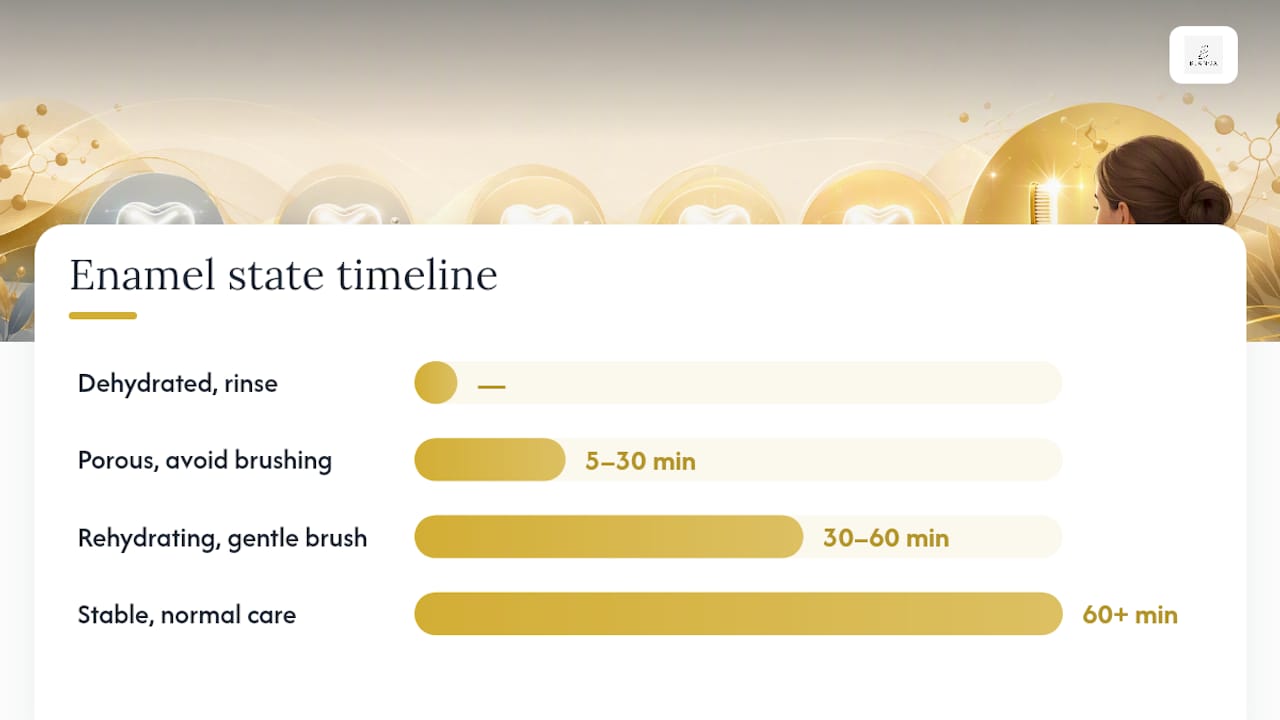
After whitening, enamel is temporarily more porous and more likely to absorb pigments — which is why the wait window matters for stain prevention as much as for sensitivity. The American Dental Association supports conservative, dentist-supervised whitening approaches and recommends following product instructions carefully to protect enamel long-term.
Should you brush your teeth before applying whitening strips?
Yes, and it’s actually a good idea. Brushing before applying strips removes plaque and food particles that would otherwise sit between the strip and your tooth surface, improving gel contact and whitening consistency. The key is how you brush, not whether you brush.
Do before applying strips:
- Brush gently with a soft-bristled toothbrush to clear debris
- Floss to remove particles from between teeth
- Rinse with water
Avoid before applying strips:
- Hard-bristle brushing or aggressive scrubbing, which can irritate gum tissue right before peroxide contact
- Abrasive whitening paste immediately before application
- Applying strips to wet, freshly rinsed gums without a short dry-off pause
Pro Tip: If you brush vigorously or use a whitening paste in the morning, wait 15–30 minutes before applying your strips. A gentler brush requires only a brief pause. This sequence — gentle brush, short wait, then strips — tends to minimize gum sensitivity during the whitening session itself.
What to do right after removing whitening strips
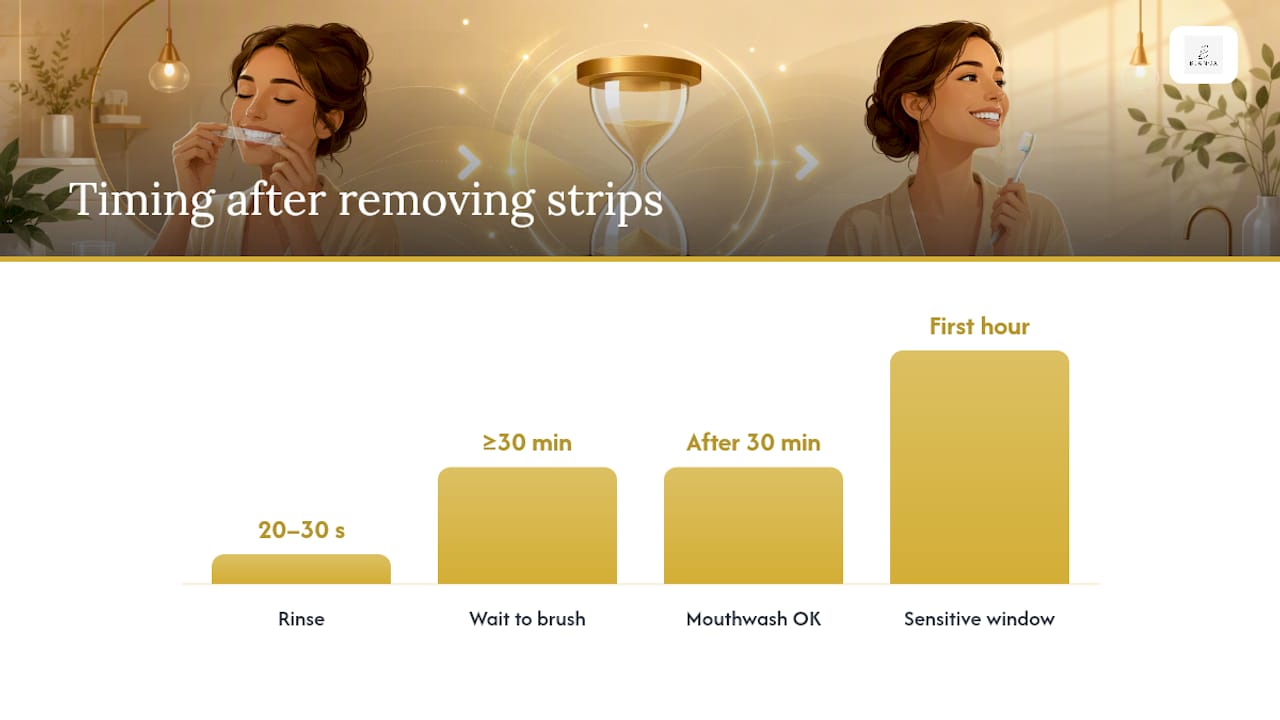
The first hour after removal is the most important window for protecting your results and your comfort. Follow these steps in order:
- Spit out any residual gel from your mouth immediately after removing the strips.
- Rinse with cool or lukewarm water for 20–30 seconds to clear remaining gel from tooth surfaces and gum line.
- Skip the mouthwash for now — alcohol-based rinses can further dehydrate enamel during this sensitive period. If you want to use a rinse, choose an alcohol-free fluoride mouthwash after the 30-minute mark.
- Wait at least 30 minutes before brushing. Rinsing rather than brushing immediately removes residual gel without adding mechanical stress to temporarily weakened enamel.
- Avoid eating or drinking anything staining or acidic during this window.
What to steer clear of in the first hour:
- Coffee, tea, red wine, and dark sodas
- Citrus fruits, vinegar-based foods, and carbonated drinks
- Very hot or very cold foods and beverages, which can trigger sharp sensitivity in dehydrated enamel
- Abrasive toothpastes or hard-bristle brushes
For a detailed breakdown of which foods to avoid and for how long, the whitening before and after eating guide from Blancawhitening covers the full dietary picture.
How to brush safely after the wait period
After 30–60 minutes, you can brush safely — the key is using the right tools and technique. Here’s the step-by-step approach:
- Choose a soft-bristled toothbrush. A soft-bristle manual brush or an electric toothbrush with a gentle mode both work well. Hard or medium bristles add unnecessary abrasion during the rehydration phase.
- Use a non-abrasive fluoride toothpaste. Plain fluoride toothpaste remineralizes enamel without the grit found in whitening or baking-soda formulas. Save the whitening paste for your regular morning or evening routine, not the post-strip brush.
- Apply light pressure. Let the bristles do the work. Pressing harder does not clean better — it just increases abrasion risk on still-recovering enamel.
- Use gentle circular motions along the gum line and across all tooth surfaces for a full two minutes.
- Rinse thoroughly with water and spit.
Pro Tip: If a specific tooth or area feels particularly sensitive after whitening, apply a pea-sized amount of potassium nitrate sensitive toothpaste directly to that spot, leave it for about a minute, then spit without rinsing. This targeted approach can calm sensitivity more effectively than brushing alone.
Managing sensitivity after whitening strips
Some sensitivity after a whitening session is normal. Peroxide temporarily opens microscopic channels in enamel, and those channels can transmit temperature and pressure signals more readily until enamel rehydrates. Most sensitivity resolves within 24–48 hours.
Practical steps to reduce discomfort:
- Switch to a desensitizing toothpaste containing potassium nitrate for the days surrounding your whitening sessions
- Use an alcohol-free fluoride mouthwash after the 30-minute wait to support remineralization
- Avoid temperature extremes in food and drinks for the first few hours
- Reduce session frequency temporarily if sensitivity is building up over consecutive uses
For readers who want a deeper look at whitening options designed for sensitive teeth, Blancawhitening’s science-backed guide covers the full range of gentler approaches.
See a dentist if you experience any of the following:
- Sensitivity lasting longer than 48–72 hours after a session
- Sharp, spontaneous pain that is not triggered by temperature or pressure
- Visible gum irritation, redness, or white patches that persist beyond 24 hours
- Any sign of enamel damage, such as increased translucency or rough texture at the tooth edges
How often can you safely use whitening strips?
Most over-the-counter whitening strip courses are designed for daily use over 7–14 days, followed by a maintenance phase. Staying within the manufacturer’s recommended schedule matters because repeated peroxide exposure without adequate recovery time can compound enamel dehydration and sensitivity.
General safety guidance from dental sources:
- Complete one full course as directed, then pause before starting another
- For maintenance, occasional single-session use (once a week or less) is generally well-tolerated after the initial course
- Stop use immediately if sensitivity increases noticeably between sessions
| Use pattern | Description | Recommended approach |
|---|---|---|
| Short course | Daily use for 7–14 days per manufacturer instructions | Follow label exactly; monitor sensitivity throughout |
| Maintenance use | Occasional use after completing a course | Once weekly or less; use desensitizing toothpaste on session days |
| Overuse risk | Repeated courses back-to-back or exceeding daily limits | Pause use; consult a dentist if sensitivity or enamel changes appear |
The at-home whitening best practices guide from Blancawhitening covers frequency, product selection, and long-term enamel care in more detail.
A note on safe whitening from Blanca
At Blancawhitening, our products are developed by dental professionals who take enamel safety as seriously as whitening performance. The guidance in this article reflects the same conservative, clinically grounded approach we apply to every product we design. We believe the best whitening results come from consistency and patience, not from pushing past what your enamel can comfortably handle. If you have questions about a specific Blancawhitening product or want guidance tailored to your sensitivity level, our team is available to help.
Gentle tools that support safe whitening aftercare
Protecting your enamel after whitening starts with the right brush. The Blancawhitening electric toothbrush is designed with a soft-bristle head and a pressure-sensitive mode that makes it easy to stay within the gentle technique this article recommends — no guesswork about how hard you’re pressing. For those who prefer a manual option, the Blancawhitening manual toothbrush delivers the same soft-bristle protection at a lower price point.
Both tools pair naturally with a non-abrasive fluoride toothpaste for post-strip brushing. Browse the full range of Blancawhitening oral care tools and current offers at the Blancawhitening sales page to find the right fit for your routine.
Sources
- Should you brush after using whitening strips? — Celebrate Dental
- Can you brush your teeth after whitening strips? — Uptown DDS
- Can I Brush My Teeth Before or After Using Whitestrips? — Fine Dentistry Orlando
- Brushing after teeth whitening and preventing stains — Town Square Dental Idaho
- Can I brush my teeth after whitening strips? — Radiant Dentistry FL
- How long are teeth porous after whitening? — Smile4Ever Dental
- American Dental Association — ADA
This article is general information, not a substitute for advice from a qualified doctor. Consult a qualified healthcare professional about your own circumstances before acting on anything here.