

Home Whitening: Intrinsic vs Extrinsic Stains and What You Can Fix
Extrinsic stains sit on the surface of your enamel and usually come off with cleaning or whitening. Intrinsic stains form inside the tooth, in the dentin or pulp, and typically need a dentist’s help to fix. Knowing which one you’re dealing with determines whether a whitening strip will work or whether you need a different kind of appointment altogether.
TL;DR:
- Whitening strips effectively remove surface stains caused by chromogens, especially from coffee, wine, and tobacco, but they do not address intrinsic discoloration.
- External stains tend to relapse without changes in diet and habits, so regular rinsing and professional cleanings help maintain results.
- Intrinsic stains from development, trauma, or aging often require internal bleaching or restorative procedures like bonding or veneers, not over-the-counter products.
- A single discolored tooth, sudden darkening, or stains resistant to cleaning and bleaching indicate a need for a dental examination before treatment.
- Higher peroxide concentrations may accelerate whitening but increase sensitivity risks, so persistent stains may need a dentist’s intervention rather than DIY escalation.
Table of Contents
- What Causes Tooth Stains: Enamel vs Internal Mechanisms
- Extrinsic Stains: What They Look Like and How Dentists Remove Them
- Intrinsic Stains: Causes and Clinical Solutions
- How Dentists Tell Intrinsic From Extrinsic Stains
- Does Teeth Whitening Work on Every Stain Type?
- Preventing Stains and Keeping Your Whitening Results
- When to See a Dentist About a Stained Tooth
- A Clinician’s Notes on Choosing the Right Fix
- Where Blanca’s Products Fit Into Your Stain Treatment Plan
- Sources
What Causes Tooth Stains: Enamel vs Internal Mechanisms
Extrinsic stains form when colored compounds called chromogens bind to the pellicle, a thin protein film that coats your enamel within minutes of brushing. Coffee, wine, and tobacco tar all contain chromogens eager to grab onto that film. Intrinsic stains work differently. They form inside the tooth, either during development (when a drug or excess fluoride gets built into dentin as it mineralizes) or later, when trauma damages the pulp and blood byproducts seep into the dentin from the inside out.
- Chromogens attach to the pellicle layer, not the enamel itself, which is why polishing removes most surface stains
- Developmental staining happens while teeth are still forming before they ever erupt into the mouth
- Cracked or eroded enamel can let surface stains seep inward, turning what started as extrinsic into a stain that behaves more like an internalized case
Extrinsic Stains: What They Look Like and How Dentists Remove Them
Coffee, tea, red wine, tobacco, and certain mouthwashes, particularly those with stannous fluoride or chlorhexidine, are the usual suspects behind extrinsic staining. Colored sauces and berries add to the pile-up, and plaque buildup gives all of it more surface area to cling to.
The color often tells you the cause. Yellow and brown streaks usually point to tobacco or dark beverages, while green or orange tints suggest chromogenic bacteria living along the gumline. A black line near the gums is frequently iron, sometimes from supplements or well water, reacting with sulfide-producing bacteria. According to Dentalcare’s continuing education material, these color patterns actually change which removal technique a hygienist reaches for.
Treatment tends to follow a predictable order:
- Improve home care first: brushing technique, flossing, and cutting back on the worst offenders
- Get a professional cleaning (scaling and polishing) to remove what brushing can’t touch
- Move to in-office bleaching if the tooth color underneath still isn’t where you want it
- Use dentist-dispensed take-home trays for touch-ups between visits
- Maintain results with periodic cleanings and mindful drinking habits
Pro Tip: Rinse with water right after coffee, tea, or wine. You won’t undo the stain, but you cut down on how long the chromogens sit on your enamel before your next brushing.
Relapse is normal here, not a failure. Stains that were extrinsic to begin with tend to return over time if the diet and habits that caused them haven’t changed.
Intrinsic Stains: Causes and Clinical Solutions
Intrinsic discoloration comes from inside the tooth, and the list of causes reads differently than the extrinsic one. Tetracycline antibiotics taken during childhood tooth development can bind permanently into dentin, often leaving gray or banded stains. Fluorosis from excess fluoride during enamel formation creates white or brown mottling. Trauma to a tooth can trigger internal bleeding that darkens it from within, sometimes turning it gray or even black within weeks. Aging naturally thins enamel and darkens dentin underneath, and pulp necrosis, dead nerve tissue inside the tooth, produces its own grayish discoloration.
- Suspect an intrinsic cause when only one tooth has changed color while its neighbors stayed normal
- Banded or streaky patterns across several teeth often point to a developmental cause like tetracycline or fluorosis
- Gray or purplish tones after a childhood dental injury usually mean internal bleeding, not surface buildup
WebMD notes that these stains often resist scaling or polishing entirely, since there’s nothing to scrub off the surface. For a tooth that has lost its nerve, dentists can perform internal bleaching, placing a whitening agent inside the tooth chamber itself. For milder cases, external bleaching still helps some patients, particularly with tetracycline staining that responds better than expected to patience and multiple treatment cycles. When bleaching falls short, bonding, veneers, or crowns cover the discoloration outright. Bonding is the cheapest and fastest option but wears faster; veneers look more natural and last longer but cost more and require removing a thin layer of enamel; crowns solve the problem completely but are the most invasive route.
How Dentists Tell Intrinsic From Extrinsic Stains
A short history often reveals more than the naked eye. Dentists ask about childhood antibiotic use, fluoride exposure, dental trauma, tobacco habits, and diet before they even pick up a mirror.
- A quick test polish clears away surface pigment instantly, isolating what’s extrinsic from what remains stubbornly intrinsic
- Single-tooth discoloration versus a pattern across multiple teeth changes the likely diagnosis considerably
- Pulp vitality testing and dental X-rays reveal internal bleeding, necrosis, or developmental damage invisible from outside
This diagnostic sequence, outlined in dental continuing education, matters because it sets realistic expectations before any whitening product touches the tooth.
Does Teeth Whitening Work on Every Stain Type?
Professional peroxide bleaching, whether applied in-office or through dentist-dispensed take-home trays, breaks apart the chromogen molecules responsible for most staining. Cleveland Clinic confirms this approach reliably lightens extrinsic stains and can improve some intrinsic cases too, though results vary far more with internal causes than surface ones.

Severe fluorosis and dense tetracycline banding often don’t respond fully to bleaching alone, no matter how many cycles you run. That’s when restorative options take over. Non-vital teeth, ones that have lost their nerve, get a different approach entirely: internal bleaching, where the whitening agent works from inside the tooth chamber outward.
Concentration matters more than people assume. Higher-percentage peroxide works faster but raises the risk of sensitivity and enamel irritation if left on too long or used too often.
Pro Tip: If a tooth doesn’t lighten at all after two full cycles of consistent at-home whitening, stop and see a dentist rather than pushing the concentration higher on your own. Choosing between carbamide and hydrogen peroxide formulas also affects how quickly and gently you see results.
Preventing Stains and Keeping Your Whitening Results
Small daily habits do more for stain prevention than any single whitening session. Brush at a 45-degree angle along the gumline, where plaque and chromogens both like to gather, and don’t skip the spaces between teeth where a brush can’t reach.
- Rinse with water after coffee, tea, wine, or dark sauces to limit how long chromogens sit on enamel
- Swap out chlorhexidine or stannous fluoride mouthwashes for stain-friendlier alternatives when your dentist approves it
- Book a professional cleaning roughly every six months to clear buildup before it hardens
- Quit tobacco, which remains one of the fastest ways to reverse whitening progress
- Use touch-up trays or strips periodically rather than waiting until stains are fully back
If your staining sources are mostly dietary, small adjustments around coffee, tea, and wine tend to buy the most time between professional visits.
When to See a Dentist About a Stained Tooth
Certain signs mean it’s time to book an appointment rather than reach for another whitening strip. A single tooth that darkens suddenly after an injury, visible pitting or banding across the enamel, or stains that don’t budge after a proper cleaning and a full bleaching cycle all point to something beyond surface staining.
- Sudden, isolated darkening after trauma often signals internal bleeding that needs prompt evaluation
- Pitted or banded enamel usually traces back to a developmental cause, not diet
- Stains that survive both professional cleaning and bleaching are a sign restorative work may be next
Dentists typically stage treatment from least to most invasive: diagnosis first, then a conservative bleaching attempt, and restorative options only if bleaching doesn’t yield desired results. Timelines vary accordingly. A scale and polish can often resolve extrinsic staining in a single visit. Bleaching, whether in-office or take-home, generally requires consistent use over a period of time. Veneers or crowns require multiple visits for impressions, fabrication, and fitting, potentially taking several weeks from consultation to completion. In some cases involving bite issues or grinding alongside discoloration, a broader assessment, like specialized treatment for bruxism, may run alongside cosmetic care.
A Clinician’s Notes on Choosing the Right Fix
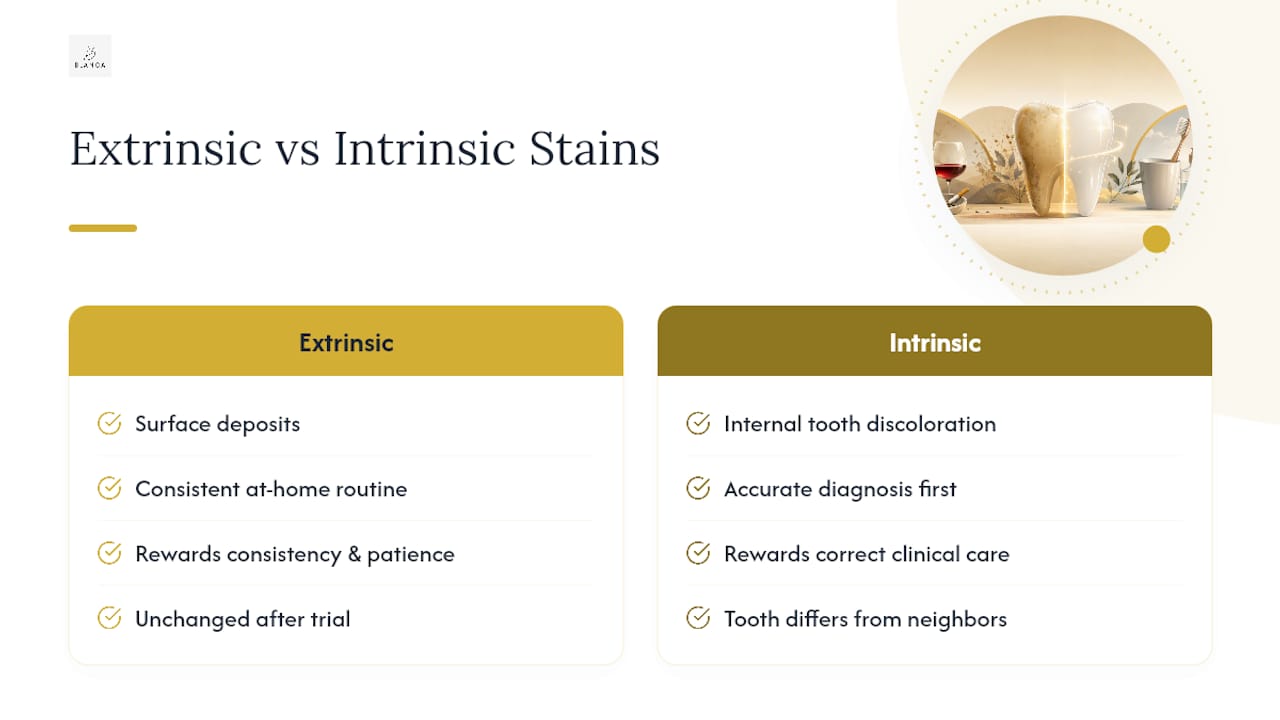
Blanca was built by dental professionals who got tired of watching people whiten aggressively at home when the real problem was sitting inside the tooth, not on its surface. Most of the frustration we hear about failed whitening isn’t a product problem. It’s a mismatch between the stain type and the treatment chosen.
Extrinsic stains reward consistency and patience with the right at-home routine. Intrinsic stains reward an accurate diagnosis first. If a tooth looks different from the ones next to it, or a whitening product isn’t budging a stain after a reasonable trial, that’s your cue to talk to a dentist before spending more money guessing.
— Blanca
Where Blanca’s Products Fit Into Your Stain Treatment Plan
Extrinsic stains from coffee, wine, or tobacco are exactly what Blanca’s at-home whitening strips are built to handle, and they also work well as a touch-up routine after professional cleanings.
Peroxide-based strips and pens can be formulated to lift chromogen buildup gently, without the harsh sensitivity spikes that come from unregulated high-strength kits. Pair whitening with the Blanca electric toothbrush and daily flossing, and you slow down how fast surface stains rebuild between sessions. What Blanca’s products won’t do is fix tetracycline banding, fluorosis, or a tooth darkened by old trauma. Those cases genuinely need a dentist, and no amount of at-home product changes that math. If your stains are surface level, browse the best-selling whitening kits and start with a strip regimen this week. If you suspect something deeper, book a dental exam first, then come back to build your maintenance routine around it.
Sources
- Staining Types and Causes - What to Know About Whitening (Dentalcare)
- Tooth Discoloration: Causes & Treatment (Cleveland Clinic)
- Tooth Discoloration: Causes, Types, and Treatments (WebMD)
This article is general information, not a substitute for advice from a qualified doctor. Consult a qualified healthcare professional about your own circumstances before acting on anything here.