

Are Your Whitening Strips Expired? What You Need to Know
Using whitening strips that are past their expiration date is not recommended. They are unlikely to cause serious harm, but degraded peroxide-based gel loses potency, produces uneven or minimal results, and raises the chance of gum irritation or unexpected sensitivity. The single most useful thing you can do right now: check the “EXP” date on the box and on at least one foil pouch, then inspect the strips themselves before you commit to a full treatment.
Key Takeaways
Expired whitening strips are not recommended: degraded peroxide loses potency, produces uneven results, and raises the risk of gum irritation and tooth sensitivity, making replacement the safer and more effective choice.
| Point | Details |
|---|---|
| Check date and condition first | Look for the EXP date on both the box and foil pouches; inspect for dryness, gel separation, or loss of stickiness. |
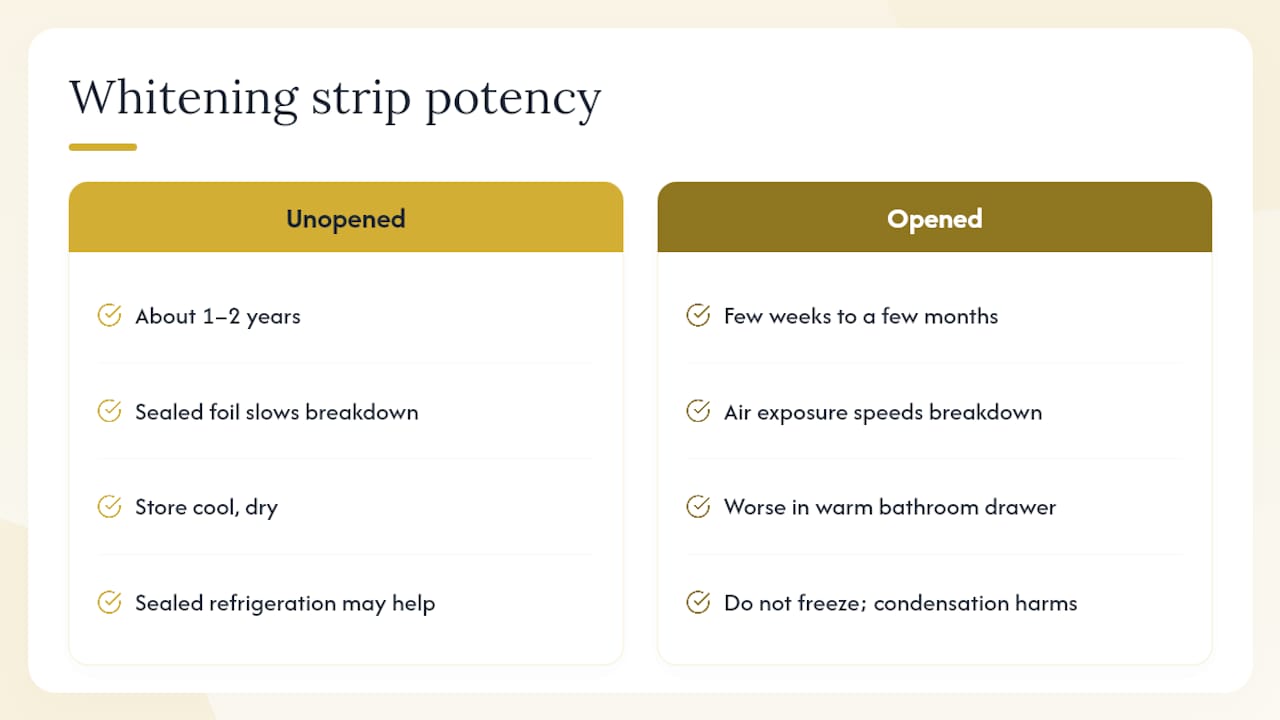
| Shelf life drops after opening | Unopened strips last roughly 1–2 years; once opened and exposed to air, usable life falls to weeks or a few months. |
| Expired strips carry real risks | Degraded formulas can cause gum irritation, uneven whitening, and increased tooth sensitivity. |
| Never extend application time | Longer contact with weakened peroxide raises sensitivity and enamel risk without improving results. |
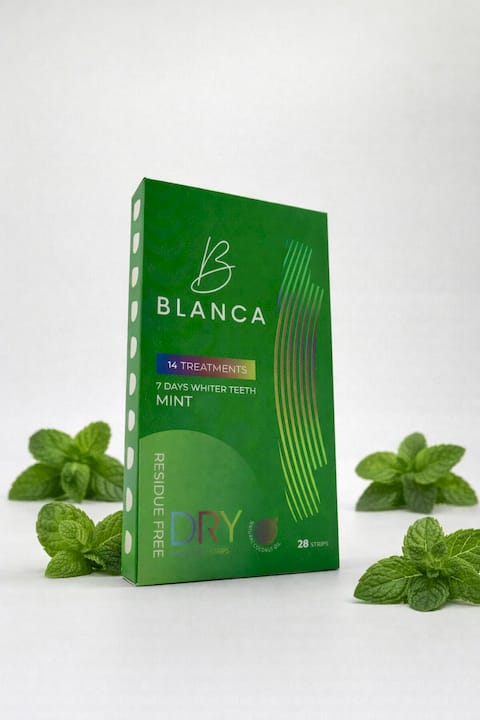
| Blancawhitening fresh strips | BLANCA’s dental-led at-home strips deliver stable, predictable potency — the recommended replacement for expired products. |
Table of Contents
- How to quickly check whether your strips are still good
- Why whitening strips lose their potency over time
- Specific signs that your strips are past their prime
- Health and sensitivity risks from using expired whitening strips
- What to do when you find expired strips at home
- How to store whitening strips so they stay potent
- When it’s time to replace your strips and what to use instead
- Why Blancawhitening recommends discarding expired strips
- A note from Blancawhitening
- Fresh strips, predictable results: BLANCA’s at-home whitening strips
- Sources
How to quickly check whether your strips are still good
Before you decide to use or discard a pack, run through this checklist. It takes under a minute and gives you a clear answer.
Find the expiration date:
- Look for “EXP” or “Best By” printed on the outer box, usually near the bottom or on a side panel.
- Check at least one individual foil pouch — the date is often printed there separately.
- If the date is missing or illegible, treat the product as expired.
Inspect the strips and gel:
- Dry or brittle strips that crack when you unfold them.
- Yellowing or visible discoloration of the strip material.
- Gel that looks separated, clumpy, or has pulled away from the strip surface.
- Loss of stickiness — if the strip won’t adhere to your tooth, the adhesive has broken down.
- A strong, sharp, or chemical odor that wasn’t there when the pack was new.
Check packaging integrity:
- A torn, punctured, or unsealed foil pouch means the strip was exposed to air. Discard it regardless of the printed date.
According to Joyce the Dentist, physical signs like dryness, brittleness, gel separation, and loss of stickiness are reliable indicators that strips are past their prime.
Pro Tip: Write the date you first opened a box directly on the outer packaging. Strips degrade faster once the seal is broken, and a handwritten note removes any guesswork later.
Why whitening strips lose their potency over time
The active ingredient in virtually every whitening strip, whether hydrogen peroxide or carbamide peroxide, is inherently unstable. Both compounds break down through oxidation, a chemical reaction that accelerates when the product is exposed to heat, light, or air. As the peroxide degrades, it converts into water and oxygen, leaving behind a gel with little to no bleaching power.
CDHP notes that heat, light, and air all accelerate this breakdown, which is why sealed foil pouches and cool, dry storage matter so much. An unopened strip stored in a cool cabinet degrades far more slowly than one left in a warm bathroom drawer.
Typical shelf-life ranges, drawn from dental practice sources, are generally about one to two years for unopened products stored properly and a few weeks to a few months once opened and exposed to air, though exact times vary by product and storage. | Short-term refrigeration (sealed) | May extend unopened life modestly | Do not freeze; condensation can damage strips |
Lane & Associates confirms that most whitening strips remain effective for roughly 1–2 years unopened, and that usable life drops to weeks or a few months once the packaging is opened and the product is exposed to air.
Crest 3D White Whitestrips, one of the most widely used over-the-counter options, follows the same chemistry. The peroxide concentration printed on the box reflects potency at manufacture, not at the moment you apply the strip.
Specific signs that your strips are past their prime
A printed date is useful, but physical condition tells you just as much. If any of the following are present, discard the strips rather than attempting a treatment.
- Dry or brittle texture: A fresh strip is pliable and slightly moist. Brittleness means the gel has dried out and the peroxide has largely dissipated.
- Yellowing or discoloration of the strip: The strip material itself should be clear or lightly tinted. Visible yellowing signals chemical breakdown.
- Gel separation or clumping: Healthy gel sits evenly across the strip surface. Clumps, gaps, or a watery layer underneath indicate the formula has destabilized.
- Loss of stickiness: Whitening strips not sticking to your teeth is one of the clearest signs of degradation. The adhesive and the gel degrade together.
- Unusual odor: A sharp, acrid, or unfamiliar chemical smell suggests the peroxide has broken down into byproducts.
- Damaged foil pouch: Any puncture, tear, or incomplete seal means air and moisture have already reached the strip.
If any single sign is present, stop. A partial or full treatment with a degraded strip is unlikely to whiten effectively and raises the risk of irritation.
Health and sensitivity risks from using expired whitening strips
The most likely outcome of using expired strips is simply disappointment: weak or uneven whitening that doesn’t justify the effort. But the risks go beyond cosmetic frustration.
Degraded peroxide formulas become chemically less predictable. As the active ingredient breaks down, the pH of the gel can shift, and the remaining chemical compounds may irritate soft tissue more readily than a fresh, stable formula would. Great Lakes Dental warns that expired whitening products can increase tooth sensitivity and gum irritation precisely because degraded formulas are more unstable.
Specific risks include:
- Increased tooth sensitivity: Degraded peroxide may penetrate enamel unevenly, triggering sensitivity in the dentin layer beneath.
- Gum irritation: Unstable gel that contacts soft tissue can cause redness, tenderness, or minor swelling.
- Uneven whitening: Patchy results occur when gel potency varies across the strip surface.
- Unpredictable reactions: Rarely, a degraded formula can trigger a mild allergic-type response in people with sensitivities.
Stop use immediately if you experience persistent pain, visible gum swelling, or discomfort that lasts more than a few hours. Rinse thoroughly with water and consult a dentist if symptoms don’t resolve. For readers who experience recurring sensitivity even with fresh products, whitening without sensitivity is worth reading before your next treatment.
What to do when you find expired strips at home
Finding a pack of expired strips doesn’t automatically mean you throw them away without a second thought, but it does mean you need to be cautious and methodical. Here is a step-by-step approach.
- Verify the date and packaging. Check the EXP date on both the box and a foil pouch. If the pouch is torn or unsealed, discard immediately.
- Run a visual and tactile inspection. Look for every sign listed in the section above. If any are present, stop here and discard.
- Spot test on a rear tooth. Apply one strip to a lower back molar for 5–10 minutes only. CDHP recommends this precaution before attempting any broader treatment with an out-of-date product.
- Monitor for 24 hours. Check for sensitivity, gum tenderness, or any unusual reaction. If anything feels off, discard the remaining strips.
- If you proceed, keep applications short and infrequent. Expect minimal results. Use shorter contact times than the package recommends, not longer.
- Stop immediately if irritation occurs. Rinse with water and do not retry.
One critical caution: do not extend application times to compensate for weakened peroxide. Longer contact does not restore lost potency. It only increases the risk of sensitivity and enamel stress, as Joyce the Dentist explains. For a fuller picture of why overuse creates its own problems, overuse whitening risks covers the enamel side of the equation clearly.
Disposal: Seal used or discarded strips in a small bag and place them in household trash. Do not rinse gel down the sink in large quantities. Check your local municipality’s guidelines for cosmetic or chemical disposal if you are discarding a large number of strips at once.
How to store whitening strips so they stay potent
Good storage habits are the simplest way to avoid finding expired strips in the first place. Family Tree Dentist confirms that proper storage, including sealed original packaging, cool and dry locations, and keeping strips out of sunlight, helps preserve potency for as long as possible.
- Keep strips in their original sealed foil pouches until you are ready to use them.
- Store in a cool, dry location. A bedroom drawer or linen closet works well. Avoid the bathroom, where heat and humidity fluctuate daily.
- Keep away from direct sunlight and heat sources such as radiators or sunny windowsills.
- Short-term refrigeration of sealed, unopened pouches is acceptable and may modestly extend usable life. Do not freeze — condensation from temperature changes can damage the strip and alter the gel.
- Store away from strong-smelling products. Peroxide gel can absorb odors from nearby chemicals.
- Write the date you first open a box on the outer packaging. Once any foil pouch is opened, plan to use the remaining strips within a few weeks to a couple of months.
For a detailed guide on protecting your whitening products long-term, Blancawhitening’s resource on storing teeth whitening products correctly covers the full picture.
Pro Tip: If you travel with strips, carry them in a small protective case rather than loose in a bag. Pouch damage from pressure or heat is one of the fastest ways to shorten a strip’s usable life.
When it’s time to replace your strips and what to use instead
Some situations call for a straightforward decision: replace the strips and move on.
- Replace immediately if: the strips show any physical sign of degradation, the expiration date has passed, or you experience any irritation during a spot test.
- Replace proactively if: you have had a pack open for more than two to three months, even if the strips look fine.
Fresh at-home strips are the most direct replacement. BLANCA’s at-home whitening strips are formulated by dental professionals, available in multiple flavors, and designed with comfort in mind for people who experience sensitivity. They deliver predictable potency because the peroxide concentration is stable at the time of use.
For faster or more dramatic results, professional in-office whitening delivers a controlled, higher-concentration treatment under dental supervision. It is the right call if you have recurring sensitivity concerns or want results in a single appointment.
Whitening toothpastes and maintenance routines can help manage minor surface staining between treatments, though they do not replace the deeper whitening action of peroxide-based strips. For tips on keeping results going after a fresh treatment, making whitening results last longer is a practical next read.
If sensitivity has been a recurring issue for you, consult a dentist before starting any new whitening regimen. A quick conversation can clarify whether your enamel and gum health are ready for treatment and which concentration is appropriate.
Why Blancawhitening recommends discarding expired strips
From a dental-led perspective, the calculus is straightforward. The potential cosmetic gain from an expired strip is small and unpredictable. The potential for irritation, uneven results, or a sensitizing reaction is meaningfully higher than with a fresh product. That asymmetry consistently points toward one conclusion: discard and replace.
Several trust signals support this position. Manufacturer instructions for products like Crest 3D White Whitestrips include expiration dates for a reason: the printed date reflects the period during which the formula performs as tested. Dental professionals broadly advise against using expired whitening products. Spot-testing, while a reasonable precaution, does not eliminate the underlying problem of degraded chemistry. And proper storage, while it slows degradation, cannot reverse it.
A note from Blancawhitening
At Blancawhitening, we believe safe whitening and effective whitening are the same thing. A strip that has lost its potency is not just a cosmetic disappointment — it is a product that no longer performs as intended, and that unpredictability is reason enough to replace it. Fresh, properly stored strips are the foundation of any whitening routine worth trusting.
Fresh strips, predictable results: BLANCA’s at-home whitening strips
If you have decided to replace expired strips, the difference a fresh formulation makes is immediate.
BLANCA’s at-home whitening strips are developed by dental professionals and available in multiple flavors, including the Blush Berry Flavored Whitening Strips, designed for people who want an effective treatment without the clinical taste. Every strip delivers a stable, consistent peroxide concentration — the kind of predictable potency that expired strips simply cannot offer. BLANCA ships across the United States, and current promotions are available on the sales page. Check the collection, pick the option that fits your sensitivity level and flavor preference, and start your next treatment with confidence.
Sources
- Do Teeth Whitening Strips Expire? - Lane & Associates
- Can I Use Out Of Date Teeth Whitening? (Everything You Need To Know) - CDHP
- Do Teeth Whitening Strips Expire? - Family Tree Dentist
- Do Whitening Strips Expire? Shelf Life and Safety Tips - Joyce the Dentist
- What to Avoid When Whitening Your Teeth - Great Lakes Dental
This article is general information, not a substitute for advice from a qualified doctor. Consult a qualified healthcare professional about your own circumstances before acting on anything here.