

Charcoal Teeth Whitening Only Removes Surface Stains, Dentists Warn
Charcoal teeth whitening does not deliver the bright, even results marketing promises. Any visible change comes from scrubbing away surface stains, not from actual bleaching, and that scrubbing action carries real risk to your enamel. Dentists and researchers consistently point to safer, evidence-backed options like peroxide-based strips and professionally supervised treatments for anyone who wants results that last without wearing down what protects your teeth.
TL;DR:
- Charcoal whitening only removes surface stains through abrasion, which can increase enamel roughness and lead to faster future staining.
- Studies show charcoal can cause enamel damage, sensitivity, and gum irritation, with no proven long-term whitening benefits over peroxide-based products.
- Regular use of charcoal toothpaste is risky, especially for restorations or sensitive teeth, and none currently hold ADA approval for safety or efficacy.
- Safer whitening options include peroxide strips, professional treatments, and ADA-approved toothpaste that chemically bleach or gently polish teeth without damaging enamel.
- Occasional use of charcoal is acceptable but should be limited, followed by fluoride treatment, and avoided if you notice irritation or sensitivity.
Table of Contents
- What Activated Charcoal Is and How It’s Marketed for Teeth
- Does Charcoal Actually Whiten Teeth? Here’s What the Studies Found
- The Real Risks of Charcoal Teeth Whitening
- Safer Whitening Options Dentists Actually Recommend
- If You Still Want to Try Charcoal, Do This
- Why We Built Blanca Around Enamel Safety, Not Trends
- Whitening That Doesn’t Bet on Your Enamel
- Sources
What Activated Charcoal Is and How It’s Marketed for Teeth
Activated charcoal is a fine, porous powder typically made from coconut shells, wood, or peat that has been treated with heat and gas to increase its surface area. That extra surface area is what makes it useful for filtering water or absorbing toxins in medical settings, and it’s the same property brands lean on when they claim charcoal “pulls” stains off your teeth.
In reality, charcoal doesn’t dissolve or lift color the way a bleaching agent does. It works almost entirely through abrasion. The gritty particles physically scrub away surface buildup, meaning charcoal can only ever affect extrinsic stains (the surface discoloration from coffee, wine, or tobacco) and does nothing for intrinsic stains embedded deeper in the tooth structure.
You’ll typically see charcoal marketed in three formats:
- Charcoal toothpaste, blended with a standard paste base
- Loose charcoal powder, applied wet with a toothbrush
- Charcoal-infused mouthwash, positioned as a rinse-and-scrub hybrid
Common claims include “detoxifies,” “removes toxins,” and “naturally whitens.” None of those claims hold up to the adsorption-versus-abrasion distinction dental researchers draw, since charcoal isn’t bleaching anything. It’s sanding it.
Does Charcoal Actually Whiten Teeth? Here’s What the Studies Found
The clinical picture is more modest than the marketing. A 90-day simulated-use study testing charcoal-containing whitening toothpaste and mouthwash found a statistically measurable color change compared to a control. But that same study also documented altered enamel surface morphology and increased surface roughness, meaning the whitening effect came bundled with physical damage to the tooth’s outer layer.
Other lab research backs this up. Comparisons of activated charcoal powder against standard whitening toothpaste found charcoal could remove extrinsic stains, but it showed no clear superiority over conventional whitening formulas, and it consistently increased surface roughness on enamel. A separate study on composite specimens reached a similar conclusion: charcoal caused measurable color change, but it never outperformed peroxide-containing toothpaste, and the roughness increase was significant enough to raise concerns about long-term wear.
Charcoal cleans the way a scrub brush cleans a countertop. It removes what’s sitting on top. It does not change the color of the material underneath, which is the entire premise behind chemical bleaching agents like peroxide.
Rougher enamel isn’t a cosmetic footnote. It’s the mechanism that undercuts charcoal’s own promise: a scratched surface catches new stains faster than smooth enamel does, so any whitening gain can reverse itself within weeks. Combine that with medium-to-high risk-of-bias ratings across the existing trials, and the honest verdict is that charcoal’s whitening effect is real but shallow, inconsistent, and not built to last.
The Real Risks of Charcoal Teeth Whitening
The abrasion that gives charcoal its stain-lifting reputation is the same property that makes dentists cautious about it. Enamel doesn’t regenerate once it’s worn away, so repeated scrubbing with a gritty powder chips away at a layer you can’t get back.
Here’s what that abrasion sets off downstream:
- Enamel wear and sensitivity. Thinner enamel exposes the dentin underneath, which is more porous and prone to picking up new stains, plus it often triggers sensitivity to hot and cold.
- Increased surface roughness. A rougher tooth surface holds onto plaque and pigment more easily, which can make future whitening attempts less effective, not more.
- Gum irritation. Coarse particles can inflame gum tissue with regular contact, especially with heavier brushing pressure.
- Embedded particles around restorations. Charcoal can work its way into microcracks and settle around crown or veneer margins, sometimes leaving gray or black lines that are harder to reverse than the stains you started with.
- No fluoride protection. Most charcoal products skip fluoride entirely, and some research suggests charcoal can bind to fluoride ions, which may blunt the cavity protection you’d otherwise get from your regular toothpaste.
Notably, no charcoal toothpaste currently carries the ADA Seal of Acceptance, the industry benchmark for products that meet safety and efficacy standards.
Pro Tip: If you notice new sensitivity, bleeding gums, or a chalky white patch appearing on a tooth after using charcoal, stop immediately and book a dental visit. Those are early signs of enamel thinning, not a sign you need to “push through” for results.
You can read more about how abrasive whitening habits erode enamel over time if you want the fuller picture on cumulative damage.
Safer Whitening Options Dentists Actually Recommend
If your goal is a brighter smile without gambling on enamel wear, the alternatives to charcoal are well documented and far more predictable.
- Peroxide-based whitening strips and gels. These work through actual bleaching. Hydrogen peroxide or carbamide peroxide penetrates the enamel and breaks down the compounds causing intrinsic discoloration, not just surface buildup. Sensitivity is the most common side effect, usually temporary, and results are far more consistent than anything abrasion-based.
- Professional in-office whitening. A dentist applies a higher-concentration peroxide gel under controlled conditions, often paired with light activation, producing the fastest and most dramatic shade change available.
- Dentist-supervised take-home trays. Custom-fitted trays with a prescribed peroxide concentration split the difference between speed and convenience, giving you professional-level oversight on your own schedule.
- ADA-accepted OTC whitening toothpaste. These use gentle chemical or low-abrasion polishing agents to produce modest, safe improvement over time, without the roughness spike seen in charcoal studies.
If you have crowns, veneers, exposed roots, or existing sensitivity, talk to a dentist before starting any whitening method. Restorations don’t respond to bleaching agents the way natural enamel does, and a professional can set expectations before you spend money on something that won’t work on that particular tooth. For a deeper look at how peroxide compares to abrasive approaches, see this guide on safe hydrogen peroxide whitening use.
If You Still Want to Try Charcoal, Do This
Some readers will try charcoal anyway. If that’s you, treat it as an occasional touch-up, never a daily habit.
- Limit use to once or twice a week at most, never a daily part of your routine.
- Use a soft-bristle brush and light pressure. Charcoal’s abrasiveness does the work; you don’t need to add more.
- Skip it entirely if you have crowns, veneers, exposed roots, or existing sensitivity.
- Follow every charcoal session with a fluoride toothpaste to help offset the mineral loss and cavity risk.
- Stop immediately if you notice irritation, sensitivity, or rough patches on your teeth.
Pro Tip: If you’ve used charcoal products regularly for more than a few months, schedule a dental check-up. Enamel wear doesn’t always announce itself until sensitivity sets in, and a quick exam can catch it early. For daily habits that support whitening results without abrasive risk, this rundown of oral care steps that support whitening is worth a look.
Why We Built Blanca Around Enamel Safety, Not Trends
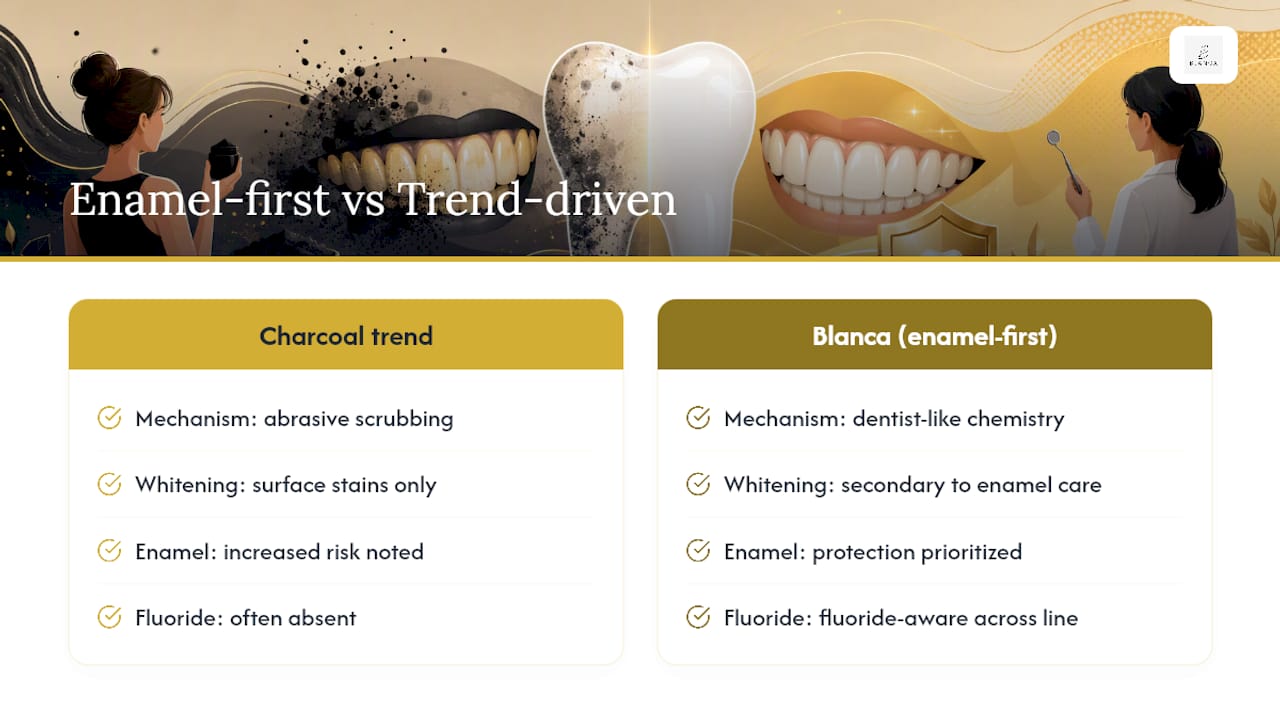
Blancawhitening was founded by dental professionals who watched trend-driven products like charcoal powder gain popularity faster than the research could catch up. That gap between hype and evidence is exactly what shaped our approach: every product we design accounts for enamel health first, whitening second, because a bright smile that costs you enamel isn’t a good trade.
Our formulations avoid the abrasive scrubbing mechanism that drives charcoal’s risks and instead rely on chemistry closer to what dentists use in-office. We also stay fluoride-aware across our oral care line, addressing the gap that shows up in most charcoal products. If you want a second opinion on your specific case, including restorations or sensitivity, talk to your dentist. Our enamel damage explainer is a good starting point for understanding what “safe” whitening actually requires.
— Blanca
Whitening That Doesn’t Bet on Your Enamel
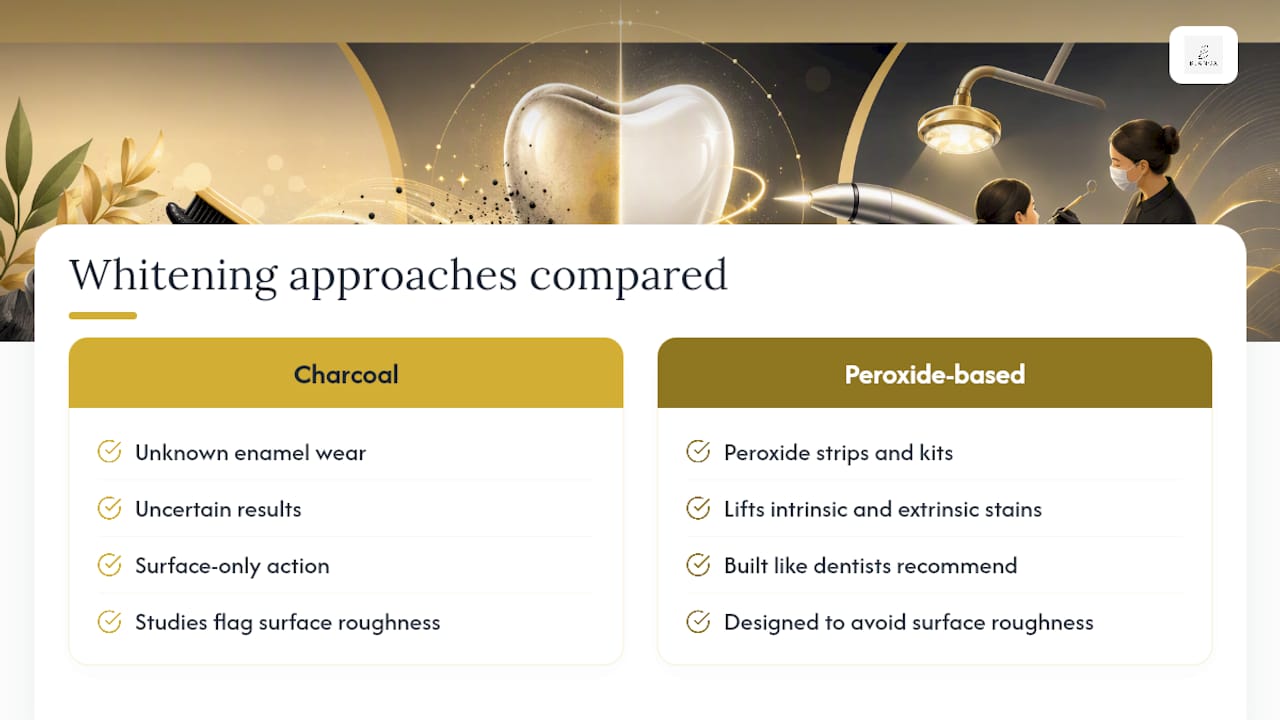
Charcoal asks you to trade unknown enamel wear for uncertain results. Blancawhitening’s at-home whitening strips take a different approach: peroxide-based formulas built the way dentists actually recommend, designed to lift intrinsic and extrinsic stains without the surface roughness that charcoal studies keep flagging.
Every product in our lineup, from whitening strips to professional-grade kits, is formulated with fluoride awareness and enamel preservation as the starting point, not an afterthought. If you’re weighing options after reading about charcoal’s risks, our tooth whitening serum partner line offers another peroxide-based route worth understanding alongside ours. For daily maintenance that protects the results you get, pair whitening with an electric toothbrush built for gentle, thorough cleaning between treatments.
Ready to see results without the guesswork of DIY charcoal? Browse Blancawhitening’s at-home whitening collection and pick a system that matches your goals, or check our oral care essentials to build a fluoride-conscious routine around it. If you have restorations or sensitivity concerns, a quick conversation with your dentist before you start will save you a headache later.
Sources
This article draws on peer-reviewed enamel studies published in the Journal of Clinical and Diagnostic Research and the Journal of Esthetic and Restorative Dentistry, alongside guidance from Harvard Health, the ADA, and Consumer Reports.
This article is general information, not a substitute for advice from a qualified doctor. Consult a qualified healthcare professional about your own circumstances before acting on anything here.
- Effect of novel charcoal-containing whitening toothpaste and mouthwash on color change and surface morphology of enamel
- Effects of activated charcoal powder and whitening toothpastes on enamel color and surface properties (PMC)