

3–10% Peroxide Strips and Cavities: Wait Until a Dentist Clears You
No. If you have an untreated cavity, do not use whitening strips until a dentist has treated it. Peroxide gel can seep through weakened enamel straight into the tooth’s nerve tissue, causing sharp sensitivity or pulp irritation that goes well beyond normal whitening zing. Stop use, book a dental exam, and know upfront that any fillings or crowns already in your mouth will not lighten no matter how long you wear the strips. For more on the science and safety of whitening treatments, see our complete whitening guide.
TL;DR:
- Whitening strips can cause severe sensitivity or pulp irritation if used on untreated cavities or weakened enamel, making dental assessment essential beforehand.
- Cavities or decay allow peroxide to penetrate deeper into the tooth, increasing risk of sharp pain, pulp inflammation, or chemical burns from poorly fitted strips.
- Fillings, crowns, and metal restorations are unaffected by whitening gels and will not change color, so whitening should be followed by matching restorations to new tooth shades.
- A dental exam, including visual, probing, thermal, and X-ray assessments, is necessary to confirm teeth are free of decay and suitable for whitening treatment.
- Using lower-concentration, properly fitted strips, and stopping immediately at first localized pain, significantly reduces safety risks during at-home whitening.
Table of Contents
- How Whitening Strips and Cavities Interact at the Enamel Level
- The Real Risks of Whitening Over Untreated Decay
- Why Fillings and Crowns Never Change Shade
- What a Dentist Checks Before Clearing You to Whiten
- Safer Steps to Take Before You Reach for Strips
- What a Dental Clearance Actually Looks Like
- A Dental Brand’s Take on Chasing a Brighter Smile Safely
- Ready to Whiten Once You’re Cleared
- Sources
- FAQ
How Whitening Strips and Cavities Interact at the Enamel Level
Whitening strips deliver either hydrogen peroxide or carbamide peroxide, usually at concentrations between 3% and 10% for over-the-counter formulas. Once the gel contacts your teeth, the peroxide breaks down into smaller molecules that diffuse through microscopic channels in the enamel and dentin, oxidizing the stain compounds that dull your smile. That process works well on healthy, intact tooth structure.
A cavity changes the equation entirely. Decay eats through enamel’s protective mineral layer, and once that barrier is compromised, peroxide has a much shorter path to the dentin and, eventually, the pulp chamber where nerves and blood vessels live.
A few conditions make that path even shorter:
- Exposed dentin from erosion, cracks, or worn enamel
- Active decay that has already thinned the enamel wall
- Old, leaking fillings with gaps at the margins
- Naturally thin enamel, which some people simply have regardless of cavities
Laboratory research backs this up. An in vitro comparison of whitening strip formulations found that hydrogen peroxide penetration into the pulp chamber varies significantly by product formulation, meaning some strips let more peroxide through than others even at similar strengths. Formulation matters, but a cavity matters more.
The Real Risks of Whitening Over Untreated Decay
Whitening strips carry a reasonably good safety record on healthy teeth. A systematic review comparing strips to dentist-supervised bleaching found strips actually carry a lower risk of sensitivity, with a risk ratio of 0.78 compared to supervised at-home systems. That statistic describes intact teeth, not decayed ones.
Layer a cavity into the picture and the risk profile shifts fast. Here is what tends to happen:
- Localized, sharp pain. Peroxide reaching exposed dentin or the pulp often triggers pain that is sudden and specific to one tooth, not the generalized tingling associated with normal whitening sensitivity.
- Pulp inflammation. In more serious cases, repeated peroxide exposure to an already-compromised tooth can inflame the pulp badly enough that a root canal becomes the only fix.
- Gum irritation or chemical burns. Decay near the gumline often sits close to soft tissue, and a poorly fitted strip touching that area can cause a burn rather than mild irritation.
- Uneven or disappointing results. Whitening does nothing to reverse decay. It can actually make a discolored, decayed spot stand out more against newly brightened enamel around it.
Many cavities don’t announce themselves early on. A tooth can look and feel fine right up until whitening gel finds the one weak spot enamel was hiding, which is exactly why “no pain” isn’t proof of a clean bill of dental health.
Why Fillings and Crowns Never Change Shade
Whitening strips lighten only your natural tooth structure. Composite fillings, ceramic crowns, and metal restorations are chemically inert to peroxide, so they stay exactly the color they were installed at, no matter how many rounds of strips you run.
That mismatch creates a real planning decision:
- Whiten your natural teeth first, then have visible restorations replaced or refinished to match the new, lighter shade.
- Treat the decay and plan any needed restorations to match the shade you expect your teeth to reach after whitening is complete.
If you’ve had a filling placed recently, dental guidance generally recommends waiting some time before applying any whitening product. The restored tooth and the surrounding enamel need a settling period, and skipping it raises the odds of transient, uncomfortable sensitivity right after treatment.
What a Dentist Checks Before Clearing You to Whiten
A proper whitening clearance is not a rubber stamp. Dentists run through a specific sequence before giving the green light:
- Visual exam. Checking for visible decay, cracks, or worn enamel across all whitening-candidate teeth.
- Probing. Testing suspicious spots for softness or breakdown that a visual check alone might miss.
- Bite-time or thermal checks. Assessing how a tooth responds to cold or pressure, which flags pulp irritation before it becomes painful.
- Radiographs when indicated. X-rays catch decay between teeth or under old fillings that no visual exam will ever reveal.
Timing varies by case. A single small filling might only need that standard two-week wait. Extensive restorations, a recent root canal, or active periodontal disease can push clearance out much further, since inflamed gums and open dentin both raise the risk of a painful reaction to peroxide.
Pro Tip: Bring a written list of every filling, crown, or root canal you’ve had, along with the approximate dates, to your whitening consult. It saves the dentist a round of guesswork and speeds up your clearance.
Safer Steps to Take Before You Reach for Strips
If you know or suspect you have oral health issues, the smartest move is sequencing, not skipping.
- Get active decay and any gum disease treated first. Whitening does not disinfect or repair anything; it is purely cosmetic.
- Schedule a professional cleaning to knock out surface stains before you ever touch a peroxide product, since some discoloration is plaque or tartar, not enamel staining.
- Start using a desensitizing toothpaste or a topical fluoride treatment in the weeks before whitening to lower your baseline sensitivity.
- Once cleared, choose a lower-concentration, well-fitting strip and keep gel off your gums. A 2026 randomized trial on 3% hydrogen peroxide strips found measurable whitening with only mild, self-limiting side effects and no serious adverse events.
- Stop immediately at the first sign of sharp, localized pain in one tooth. That is not normal whitening sensitivity. Our guide to using strips safely covers fit and application in more detail.
Pro Tip: If you already used strips and now have severe, isolated pain in one tooth, don’t wait it out. See a dentist within a day or two. Isolated pain like that usually means peroxide found a weak spot.
What a Dental Clearance Actually Looks Like
This oral care brand was founded by dental professionals, so the whitening guidance starts from the clinic, not the checkout cart. A real clearance exam covers more ground than most people expect:
- A full check for decay, leaking restorations, and gum recession
- An evaluation of overall gum health, since inflamed tissue reacts more sharply to peroxide
- A sensitivity baseline, so you and your dentist know what to expect afterward
Depending on your case, a clinician might recommend whitening before replacing an old, discolored filling, or waiting several weeks after a new one. Our safety checklist before whitening walks through the exact questions worth asking at that visit.
A Dental Brand’s Take on Chasing a Brighter Smile Safely
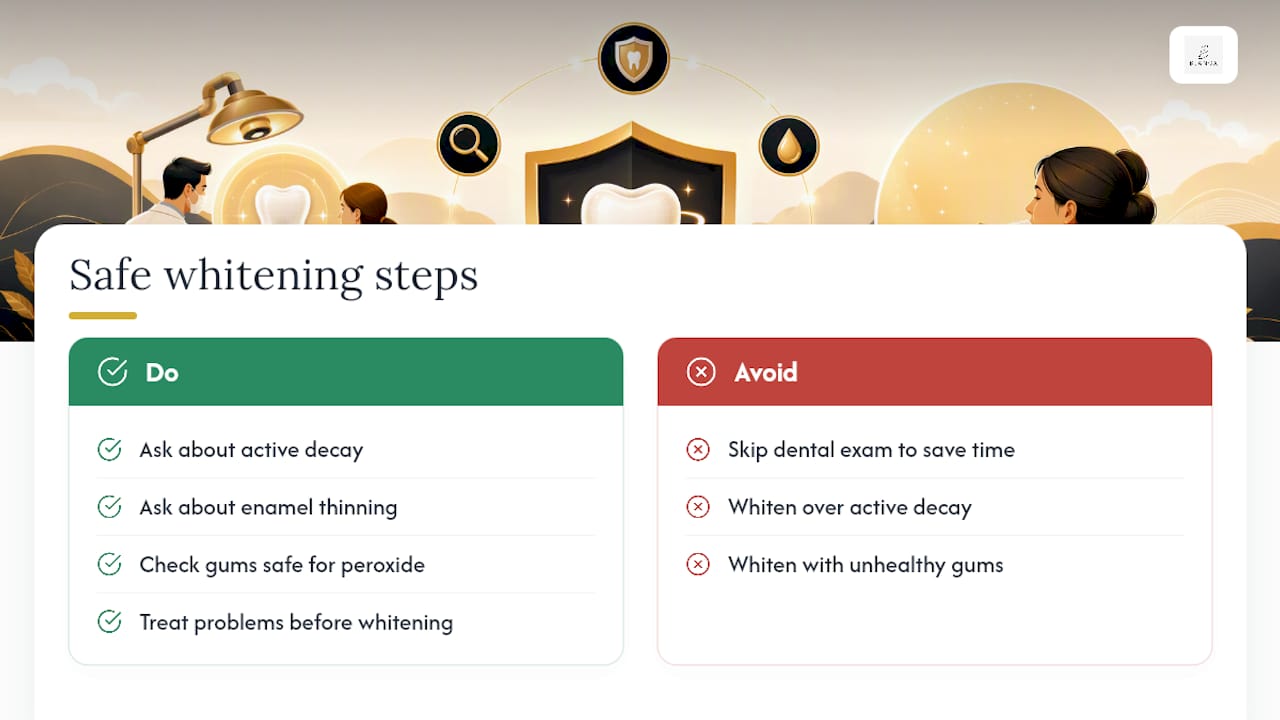
Most people want two things from whitening: a fast result and no regrets. You can have both, but only in that order: treat the problem first, then whiten. Skipping the exam to save two weeks is the single most common mistake we see, and it’s the one that turns a simple cosmetic fix into a dental emergency.
At your next dental visit, ask directly whether any tooth has active decay, whether your enamel shows thinning, and whether your gums are healthy enough to handle peroxide contact. Most people, once decay and gum issues are addressed, go on to whiten safely and predictably. The wait is short. The payoff is a result that actually lasts instead of one you have to redo after a filling.
— Blanca
Ready to Whiten Once You’re Cleared
Once your dentist gives you the go-ahead, the brand offers at-home whitening products that are designed to avoid guesswork about concentration or fit. The brand’s strips and kits are developed with attention to safety and come with instruction sheets reflecting dental safety considerations rather than marketing copy.
Only start whitening after your dental clearance, and follow the included directions closely: apply strips flush against the tooth surface, keep the gel off your gumline, and pair treatment with a desensitizing routine if your dentist recommends one. If sensitivity was a concern at your exam, our guide to whitening without sensitivity is worth reading before your first strip. When you’re ready, browse Blancawhitening’s at-home whitening collection and start with a formula built for comfort as much as results.
This article is general information, not a substitute for advice from a qualified doctor. Consult a qualified healthcare professional about your own circumstances before acting on anything here.
Sources
- Systematic review: whitening strips vs dentist-supervised bleaching (PubMed)
- Low-concentration whitening strips RCT (Frontiers in Oral Health, 2026)
- Comparative study of whitening strips: HP penetration, color change, and enamel morphology (ScienceDirect)
FAQ
Should I use whitening strips if I have cavities?
No. Wait until a dentist treats any active decay, since peroxide can reach exposed dentin or the pulp through a cavity and cause serious sensitivity or irritation.
Do whitening strips work on cavity fillings?
No. Whitening strips only lighten natural tooth enamel and dentin. Composite, ceramic, or metal restorations stay the same shade regardless of how many treatments you run.
Why am I suddenly getting so many cavities?
New or increasing cavities usually trace back to changes in diet, dry mouth, reduced brushing or flossing consistency, or gum recession that exposes root surfaces. A dentist can pinpoint the cause with an exam and X-rays rather than guessing from symptoms alone.
Do dentists approve of whitening strips?
Many dentists consider well-formulated, lower-concentration strips a reasonable option for healthy teeth, and research shows they carry a lower sensitivity risk than supervised at-home bleaching, though supervised bleaching tends to produce a greater color change. Approval always depends on a clean bill of dental health first.