

Teeth Whitening Consent: Complete U.S. Guide and Template
A valid teeth whitening consent document states that the patient received both verbal and written information, understands the procedure’s risks and limitations, and agrees voluntarily before treatment begins. According to the American Dental Association (ADA), whitening is generally safe but carries inherent risks including transient tooth sensitivity and gum irritation. A signed form alone is not enough. Without a recorded verbal discussion, the consent process is legally incomplete.
Every whitening consent form should cover:
- Procedure type (in-office light-activated bleaching or at-home trays/strips) and the active ingredient with its concentration
- Risks and side effects (sensitivity, gum irritation, chemical burns, allergic reaction) and their typical timeline
- Limitations (whitening does not change the shade of crowns, veneers, or composite restorations; results vary by stain type; no guaranteed shade outcome)
- Alternatives to whitening and realistic outcome expectations
- Patient’s right to withdraw consent before or during treatment
- Special-case disclosures for minors (parent/guardian signature required), pregnancy, active decay, and orthodontic appliances
- Post-treatment instructions and how to contact the provider
- Signature block with date, provider signature, and parent/guardian line if applicable
- Copy provided to patient and original retained in the patient record
The editable sample template appears in the section below titled “Ready-to-copy consent template you can adapt today.”
Key Takeaways
A valid teeth whitening consent requires verbal discussion, written disclosure of risks and limitations, a signed form with a copy provided to the patient, and a chart note confirming the process was completed.
| Point | Details |
|---|---|
| Verbal + written consent required | A signed form without a documented verbal review is generally insufficient under state board standards. |
| Restorations will not change shade | Crowns, veneers, and composites are unaffected by whitening; disclose this in writing before treatment. |
| Sensitivity usually resolves in 24–48 hours | Include this timeline on the form so patients know what is normal and when to call. |
| Copy to patient, original in chart | Both Oregon and Washington state templates require this; follow your state board’s retention period. |
| Adapt the template to your procedure type | In-office and at-home disclosures differ; use bracketed fields to customize product, concentration, and session details. |
Table of Contents
- What must every teeth whitening consent form include?
- How should you explain risks to patients?
- Special cases that require additional disclosures
- How does consent wording differ for in-office vs at-home whitening?
- What should providers document after whitening treatment?
- U.S. legal considerations and state board expectations
- Ready-to-copy consent template you can adapt today
- What should you review before the patient signs?
- Why consent is a conversation, not just a signature
- Sources
What must every teeth whitening consent form include?
A whitening consent form that holds up to state board review contains specific, verifiable elements. Vague language (“patient agrees to treatment”) is not sufficient. Each item below must appear in clear, patient-facing language.
1. Patient identification Full name, date of birth, and contact information. This ties the signed document to a specific individual and prevents record mix-ups.
2. Description of the procedure and product Patients have the right to know what chemical agent is being applied to their teeth.
3. Verbal information acknowledgment Include an explicit line: “I have been given the opportunity to ask questions and have received verbal and written information about this procedure.” State-level templates consistently require this language. The Oregon Health Authority’s Board of Denture Technology consent template frames informed consent as both a process and a document, meaning the form without the verbal review is incomplete.
4. Risks and side effects checklist A checkbox list (covered in detail in the next section) allows patients to confirm they have read each risk individually rather than signing a block of dense text.
5. Limitations of whitening A clear statement that whitening agents do not alter the color of porcelain crowns, veneers, or composite restorations, and that results vary by individual and stain type.
6. Alternatives Brief mention that alternatives exist, such as professional cleaning, dental bonding, or veneers, so the patient’s consent is truly informed.
7. Right to withdraw One sentence: “I understand I may withdraw my consent and stop treatment at any time before or during the procedure without penalty.”
8. Minor/guardian provision If the patient is under 18, a parent or legal guardian must sign. Include a separate signature line labeled “Parent/Guardian Signature (if patient is a minor)” with a date field.
9. Signature block and copy acknowledgment Patient signature, printed name, date, and provider signature. Add: “A copy of this signed form has been provided to the patient.” The Washington State Department of Health’s denturist consent template requires the original to be retained in the patient record and a copy given to the patient.
How should you explain risks to patients?
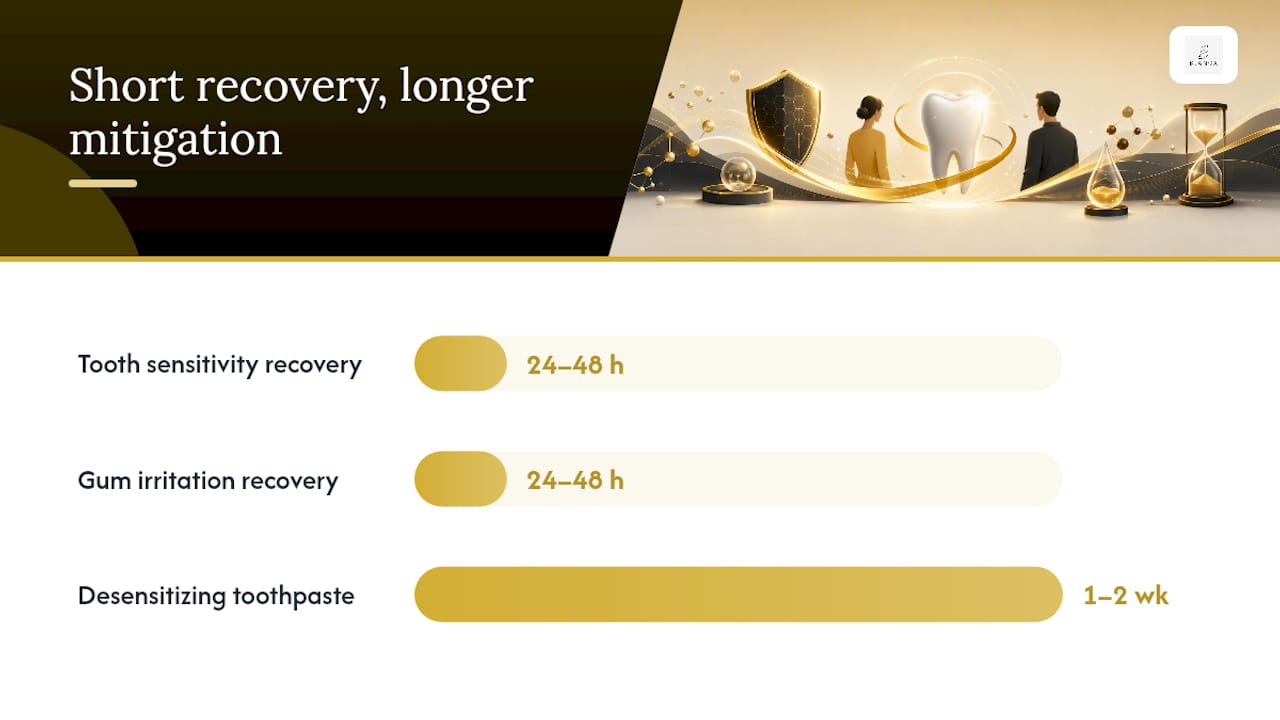
Tooth sensitivity and gum irritation are the two most common side effects of whitening. The ADA notes that sensitivity typically begins during or shortly after treatment and resolves within 24–48 hours for most patients. Gum irritation usually follows tray contact with soft tissue and clears within the same window.
Patient-facing wording for sensitivity: “You may experience temporary tooth sensitivity during or after whitening. This usually resolves within 24–48 hours. If sensitivity is severe or persists beyond 48 hours, stop use and contact our office.”
Patient-facing wording for gum irritation: “Mild gum irritation can occur if the whitening gel contacts soft tissue. It typically resolves within one to two days. Avoid applying gel beyond the tooth surface.”
Chemical burns and soft-tissue injury The form should state: “In-office whitening uses a high-concentration peroxide gel. A protective barrier will be applied to your gums. Despite precautions, temporary soft-tissue sensitivity or irritation may occur.”
Allergic reactions Though uncommon, peroxide-based agents can trigger allergic responses in sensitive individuals. Include: “If you experience swelling, hives, or difficulty breathing during treatment, notify the provider immediately.” Patients with known peroxide sensitivity should not undergo whitening.
Clinician mitigation notes to add to the chart:
- Recommend a desensitizing toothpaste (containing potassium nitrate or fluoride) for one to two weeks before treatment for patients with a history of sensitivity
- For at-home trays, instruct patients to reduce wear time if sensitivity develops rather than stopping abruptly
- Document any pre-existing sensitivity in the chart before treatment begins
Pro Tip: Ask patients directly: “Do your teeth feel sensitive to cold drinks or air?” before handing over the consent form. A positive answer changes your product recommendation and should be noted in the chart. Patients with known sensitivity often do better with lower-concentration carbamide peroxide at-home options.
Special cases that require additional disclosures
Several patient scenarios change expected outcomes or contraindicate whitening entirely. Each one needs specific language on the consent form.
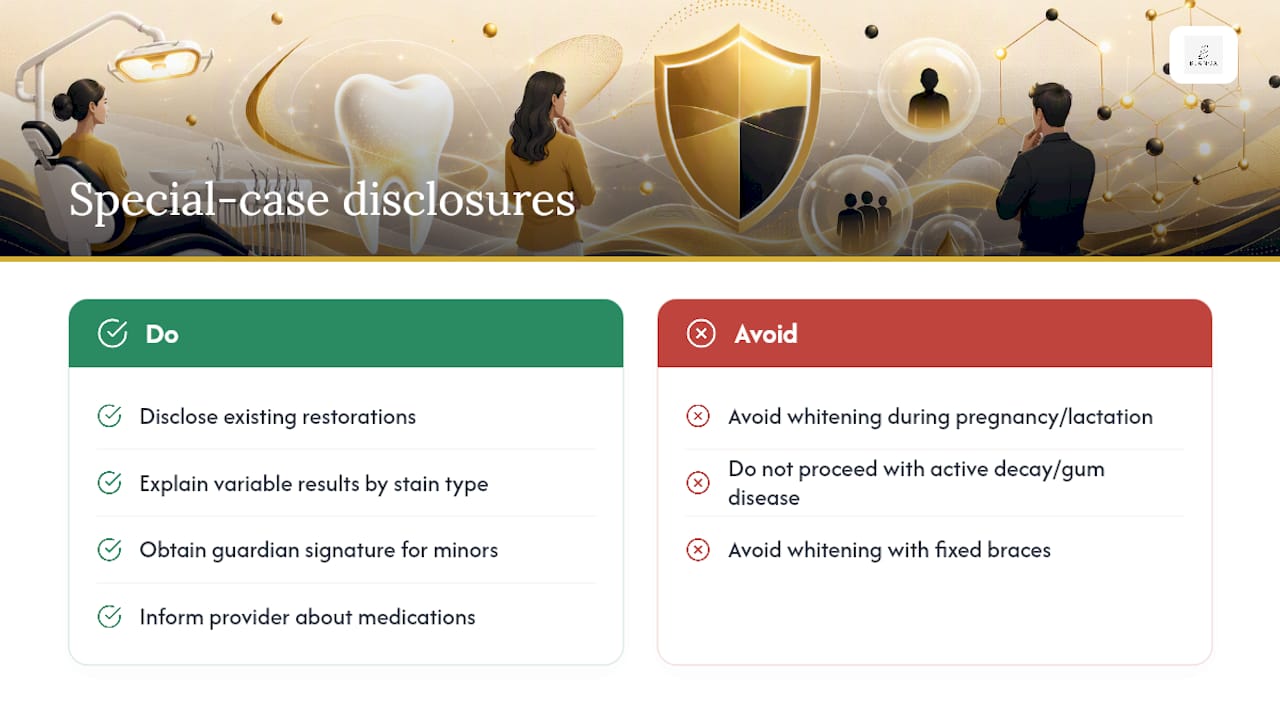
Restorations (crowns, veneers, composites) Whitening agents do not penetrate artificial dental materials. Porcelain crowns, veneers, and composite restorations will not change shade. The form should state: “Whitening will not alter the color of existing crowns, veneers, bridges, or composite fillings. After whitening, visible color differences between natural teeth and restorations may require replacement or rebonding of those restorations.” Patients considering whitening after dental work need this disclosure before they decide.
Stain type and variable outcomes Yellow or yellow-brown stains typically respond well to peroxide-based whitening. Gray or bluish-gray discolorations respond less predictably. Tetracycline staining and severe fluorosis often produce uneven or limited results, per ADA guidance. Recommended wording: “Results depend on the nature and cause of your tooth discoloration. Tetracycline staining and fluorosis may respond minimally or unevenly. No specific shade outcome is guaranteed.”
Pregnancy and lactation Clinic-level consent templates widely advise against whitening during pregnancy or while breastfeeding, as noted in the Zoom! informed consent documentation. Add: “Whitening is not recommended during pregnancy or lactation. If you are pregnant or breastfeeding, please inform your provider before proceeding.”
Photosensitizing medications Patients taking medications that increase light sensitivity (certain antibiotics, diuretics, antidepressants) face elevated risk during light-activated in-office procedures. The Zoom! consent template lists this as a contraindication. Wording: “Inform your provider of all current medications. Photosensitizing drugs may increase the risk of adverse reactions during light-activated whitening.”
Minors A parent or legal guardian must sign for any patient under 18. The form should include a dedicated guardian signature line and a statement that the guardian has received the same verbal and written information as an adult patient would.
Active decay, periodontal disease, or open lesions Whitening should not proceed over untreated cavities or inflamed gum tissue. Gum health before whitening matters because peroxide can penetrate exposed dentin through decay or open margins. Add: “Whitening is not recommended if you have untreated cavities, active gum disease, or open sores in the mouth. A dental exam is advised before treatment.”
Orthodontic appliances Fixed braces create uneven gel contact. Wording: “Whitening with fixed orthodontic appliances in place may produce uneven results. At-home tray use is generally deferred until appliances are removed.”
How does consent wording differ for in-office vs at-home whitening?
The procedure type shapes every disclosure on the form. In-office and at-home treatments carry different risks, time commitments, and user responsibilities.
In-office light-activated whitening
- Session structure: typically 3–4 applications of 15 minutes each in a single appointment, as documented in the Zoom! consent form
- Disclose UV/LED or plasma arc light use and the duration of light exposure
- Gingival barrier placement and its limitations must be stated
- Immediate post-treatment expectations: sensitivity and possible soft-tissue redness for 24–48 hours
- Note that shade regression can occur over time and maintenance may be needed
At-home trays and strips
- Disclose daily wear time ([e.g., 30 minutes to 2 hours per day, or overnight]) and total treatment duration ([e.g., 10–14 days])
- Explain the risk of gel leakage from ill-fitting trays onto gum tissue
- Instruct patients not to eat, drink (except water), or smoke during tray wear
- User-error risks: overfilling trays, extending wear beyond instructions, using with active decay
| Disclosure element | In-office | At-home |
|---|---|---|
| Session structure | 3–4 applications of 15 min each | Daily wear per product instructions |
| Light/equipment use | UV/LED or plasma arc; disclose exposure | Not applicable |
| Concentration | High concentration peroxide gel | Lower concentration carbamide peroxide |
| Gingival protection | Barrier placed by provider | Patient manages tray fit |
| Sensitivity onset | During or immediately after session | May develop after first few uses |
| User-error risk | Minimal (provider-controlled) | Moderate (patient-controlled) |
| Post-treatment regression | Possible; maintenance advised | Possible; maintenance advised |
For a deeper look at how these two approaches compare overall, the professional vs at-home whitening guide covers the clinical tradeoffs in detail.
What should providers document after whitening treatment?
Post-treatment documentation protects both the patient and the provider. A chart note that records the verbal discussion, product details, and shade outcome creates a defensible record if questions arise later.
Patient-facing aftercare instructions to include on the consent form:
- Sensitivity, if it occurs, usually resolves within 24–48 hours; use a desensitizing toothpaste if needed
- Avoid dark-colored foods and beverages (coffee, red wine, berries) for 24–48 hours after treatment
- Avoid tobacco products for at least 24 hours
- Apply lip balm if lips feel dry after in-office treatment
- Contact the provider if sensitivity persists beyond 48 hours, if gum tissue appears white or blistered, or if any allergic symptoms develop
Provider documentation checklist:
- Verbal discussion completed and noted in the chart
- Pre-treatment shade recorded (using a standard shade guide such as VITA Classical)
- Post-treatment shade recorded at the same appointment or follow-up
- Product name, concentration, and lot number documented
- Session details: number of applications, duration per application, light type if used
- Signed consent form retained in the patient record
- Copy of signed consent provided to the patient and noted in the chart
Sample chart-note language: “Informed consent reviewed verbally with patient. Risks, limitations, and post-care instructions discussed. Patient had opportunity to ask questions. Pre-treatment shade: [A3]. Product: [Product Name], [concentration]. [Number] applications of [X] minutes each. Post-treatment shade: [A1]. Signed consent retained; copy provided to patient.”
Documenting a pre-treatment shade and confirming verbal counseling occurred reduces disputes about outcomes, as noted in Washington State’s denturist consent guidance. Shade photography can supplement the written record; see the guidance on recording before-and-after results for practical tips.
U.S. legal considerations and state board expectations
Informed consent for whitening sits at the intersection of dental practice law, patient rights, and HIPAA. No single federal standard governs every detail, so state board rules take precedence.
- Signed consent is widely required. Most state dental and denturist boards require a signed whitening consent form before treatment. The Oregon Health Authority’s Board of Denture Technology template explicitly frames consent as both a process and a document.
- Retention periods vary by state. Many boards recommend retaining signed consents for a minimum of several years; some states tie retention to the patient’s age (e.g., until the minor reaches adulthood plus a set number of years). Confirm your state’s specific requirement with your licensing board or legal counsel.
- Copy to patient is standard practice. Both the Oregon and Washington state templates require that a copy of the signed form be given to the patient and the original retained in the chart.
- Verbal discussion must be charted. A signed document without a recorded verbal review is generally considered insufficient. Note in the chart that the discussion occurred and that the patient had the opportunity to ask questions.
- HIPAA applies. Signed consent forms contain protected health information. Store originals in the patient record, limit access to authorized staff, and follow your practice’s standard HIPAA protocols for storage, transmission, and disposal.
- Off-label and non-FDA-cleared products. If a product is not FDA-cleared for the intended use, state this on the form: “This product has not been evaluated or approved by the FDA for this specific use. Use is at the patient’s discretion after informed discussion.”
- Consult your state board or legal counsel before finalizing your form. This article provides general guidance, not legal advice, and state rules change.
Ready-to-copy consent template you can adapt today
Copy the template below and replace all bracketed fields with your practice-specific details. This structure mirrors the elements required by Oregon and Washington state board templates and aligns with ADA guidance on whitening safety.
TEETH WHITENING INFORMED CONSENT FORM
Patient Information
- Patient Name: ___________________________
- Date of Birth: ___________________________
- Date of Consent: ___________________________
- Provider Name: ___________________________
Treatment Selected (check one)
- ☐ In-office light-activated whitening
- ☐ At-home custom trays
- ☐ At-home whitening strips
- ☐ Other: ___________________________
Estimated Session Length / Wear Time: [e.g., 3 applications of 15 minutes / 30–60 minutes per day for 14 days]
Risks and Side Effects (initial each item to confirm you have read and understood it)
- _____ Tooth sensitivity during or after treatment, typically resolving within 24–48 hours
- _____ Gum irritation or soft-tissue redness, typically resolving within 1–2 days
- _____ Possible chemical burn to soft tissue if gel contacts unprotected gum tissue
- _____ Possible allergic reaction to peroxide-based agents; notify provider immediately if swelling or hives occur
- _____ Temporary white spots or uneven appearance, particularly with fluorosis or tetracycline staining
Limitations of Whitening (initial to confirm)
- _____ Whitening does not change the color of crowns, veneers, bridges, or composite restorations
- _____ Results vary by stain type; tetracycline staining and fluorosis may respond minimally or unevenly
- _____ No specific shade outcome is guaranteed
- _____ Shade regression may occur over time; maintenance treatment may be needed
Alternatives to Whitening I understand that alternatives to whitening include professional cleaning, dental bonding, porcelain veneers, and no treatment. These have been discussed with me.
Contraindications Checked (provider completes)
- ☐ Patient is not pregnant or lactating
- ☐ No active decay or open lesions present
- ☐ No photosensitizing medications reported
- ☐ No fixed orthodontic appliances in treatment area
- ☐ Gum health assessed and acceptable for treatment
Post-Treatment Instructions I have received written post-care instructions and understand I should:
- Avoid dark-colored foods and beverages for 24–48 hours
- Use a desensitizing toothpaste if sensitivity occurs
- Contact the provider if sensitivity persists beyond 48 hours or if gum tissue appears blistered
Right to Withdraw I understand I may withdraw my consent and stop treatment at any time before or during the procedure without penalty.
Verbal Information Acknowledgment I confirm that I have received verbal and written information about this procedure, have had the opportunity to ask questions, and all questions have been answered to my satisfaction.
Signature Block
Patient Signature: ___________________________ Date: ___________ Printed Name: ___________________________
Parent/Guardian Signature (if patient is under 18): ___________________________ Date: ___________ Printed Name: ___________________________
Provider Signature: ___________________________ Date: ___________
☐ Copy of this signed form provided to patient ☐ Original retained in patient record
What should you review before the patient signs?
Use this two-column checklist at the appointment to confirm the consent process is complete before the patient signs.
Print this checklist and attach it to the chart alongside the signed consent form. A quick two-minute review at this stage prevents the most common documentation gaps that lead to disputes.
Why consent is a conversation, not just a signature
Consent forms are often treated as administrative paperwork. That framing misses the point. A well-constructed whitening consent form is the written record of a conversation that should have already happened.
Patients who understand that sensitivity is temporary, that their crowns will not change shade, and that results depend on their stain type arrive at treatment with accurate expectations. They are less likely to call the office alarmed by normal post-treatment sensitivity, and less likely to dispute outcomes that were clearly disclosed. Documenting that the verbal discussion occurred, as both the Oregon and Washington state templates require, is not a bureaucratic formality. It is the difference between a defensible record and a he-said-she-said dispute.
The consent process also gives clinicians a structured moment to catch contraindications they might otherwise miss in a busy schedule. A patient who mentions photosensitizing medication during the consent review, or who reveals they are in the first trimester of pregnancy, has just prevented a preventable adverse event. That is the consent form doing exactly what it is designed to do.
Sources
- American Dental Association (ADA)
- Board of Denture Technology — Oregon Health Authority: Teeth Whitening Trays — Informed Consent
- Washington State Department of Health — Denturist informed consent for custom teeth-whitening trays
- Informed Consent for Zoom! ® Tooth Whitening Treatment
This article is general information, not a substitute for advice from a qualified doctor. Consult a qualified healthcare professional about your own circumstances before acting on anything here.