

30–60 Minutes to 4–8 Weeks: How to Triage White Spots After Whitening
Most white spots you notice right after whitening are temporary dehydration, and they typically fade within a short time. Stop whitening for now, drink water regularly, and avoid acidic or staining foods while your enamel rehydrates. If a spot is isolated, rough, sensitive, or still visible after some time, it likely points to demineralization or fluorosis underneath, and that calls for a dental exam rather than more waiting.
TL;DR:
- White spots caused by dehydration typically fade within 24 hours, especially with proper rehydration, but isolated or persistent spots may indicate underlying enamel issues.
- Patterns of spots—uniform across multiple teeth and appearing immediately after whitening—usually signal dehydration, whereas isolated, dark, or non-fading spots suggest pre-existing structural defects.
- Active remineralization treatments such as fluoride, nano-hydroxyapatite, or CPP-ACP can speed up recovery if white spots remain after 48 hours, with visible improvement often occurring within 4 to 8 weeks.
- Avoiding further whitening and harsh toothpastes, along with maintaining good oral hygiene, helps prevent worsening or new spots during recovery.
- Structural white spots or lesions that do not improve within two weeks warrant a dental exam for options like resin infiltration, microabrasion, or bonding.
Table of Contents
- Why Does Whitening Cause White Spots?
- How Long Do White Spots Last After Whitening?
- What Helps White Spots Fade at Home?
- When Should You See a Dentist About White Spots?
- How Can You Prevent White Spots Before Your Next Whitening Session?
- A Dental-Professional-First Approach to White Spots
- Support Recovery With the Right At-Home Routine
- Sources
- FAQ
Why Does Whitening Cause White Spots?
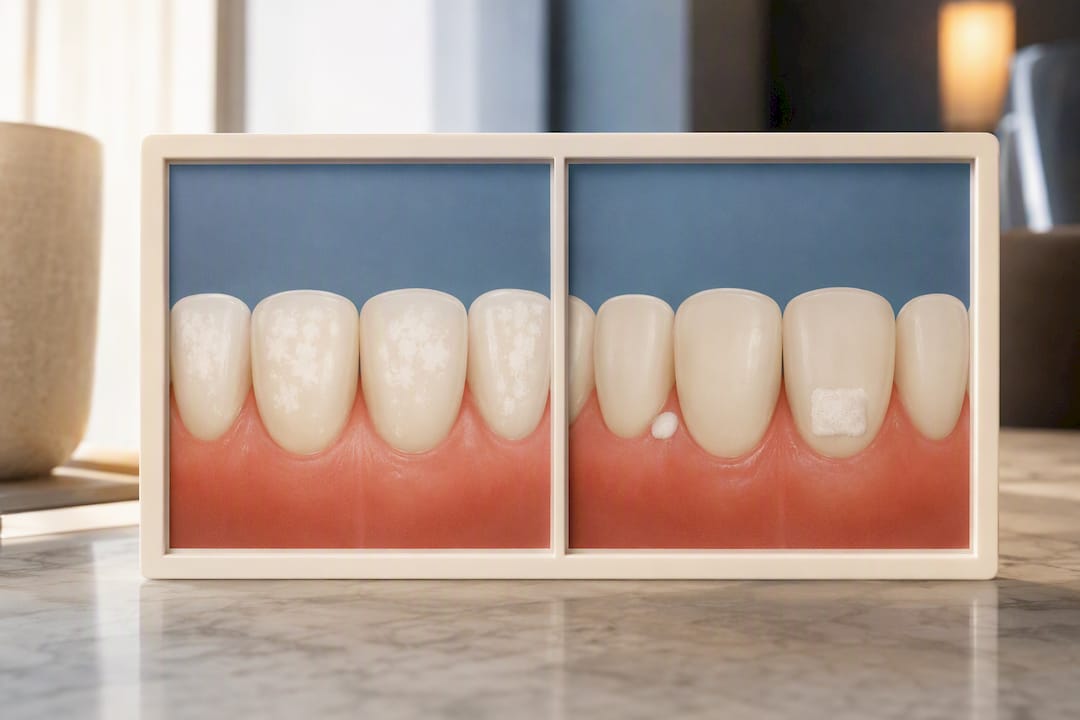
Whitening gel dehydrates enamel temporarily, and dehydrated enamel scatters light differently than hydrated enamel. Spots with lower mineral density scatter even more light when dry, so they show up chalky and opaque against the surrounding tooth, according to a peer-reviewed review of whitening research. Once the enamel reabsorbs moisture from saliva, that scattering effect settles down and the spot blends back in.
That mechanism explains the harmless version. The less harmless version is that whitening sometimes reveals something that was already there. Enamel hypomineralization, fluorosis, and old white spot lesions left behind from orthodontic brackets do not appear because of whitening. They become visible because whitening brightens the healthy enamel around them, and the contrast makes a pre-existing defect stand out for the first time.
You can usually tell the two apart by pattern. Dehydration spots tend to show up uniformly across every tooth you treated, appear right after the session, and fade evenly. Structural spots are usually isolated to one or two teeth, often cluster near the gumline or in the rectangular outline where a bracket used to sit, and they do not fade at the same rate as the teeth around them.
How Long Do White Spots Last After Whitening?
Dehydration spots follow a fairly predictable clock. Fading often begins within 30 to 60 minutes, and most cases resolve within 2 to 24 hours, per the Canadian Dental Association’s position statement on tooth bleaching. If you have a dry mouth or low saliva flow, it may take longer before you should worry.
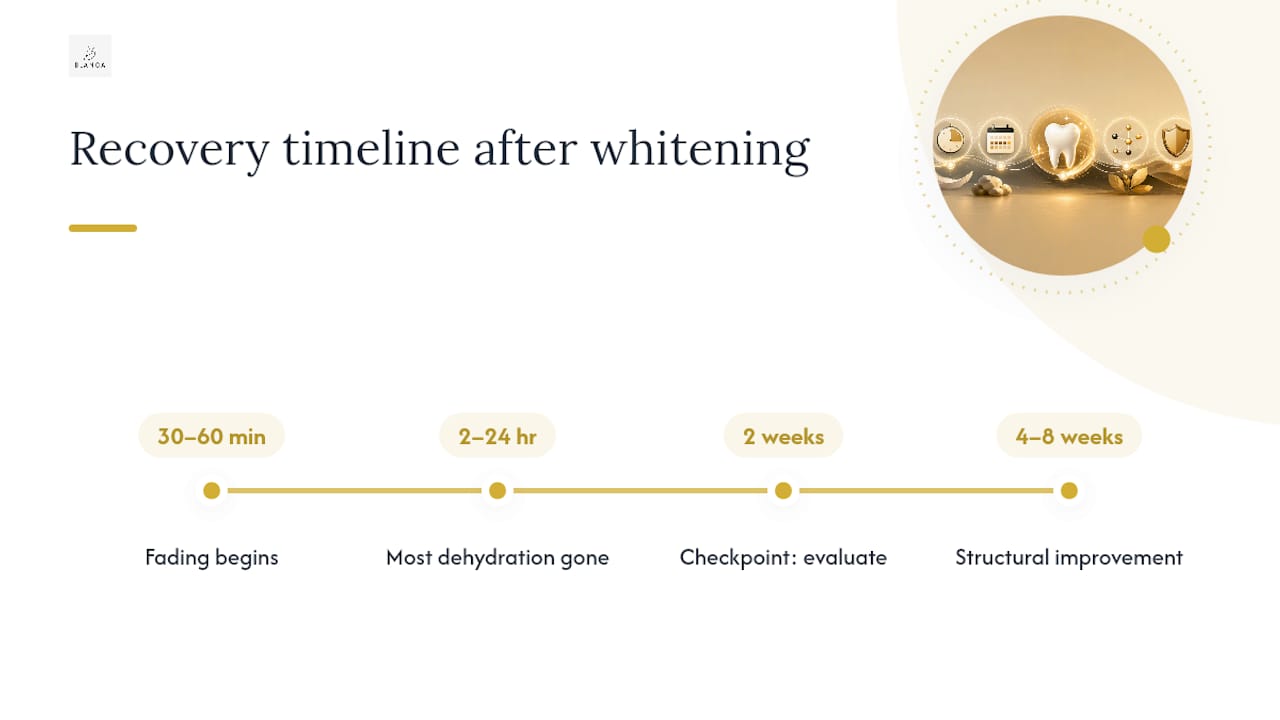
Structural spots move on a much slower timeline. With active remineralization, superficial lesions often show visible improvement over several weeks. Deeper lesions can take longer, and some never fully resolve without treatment. The same Canadian Dental Association guidance flags anything still present past that window as a signal to get evaluated. Treat two weeks as your checkpoint: if a spot is worsening, painful, textured, or spreading before then, do not wait for the 4 to 8 week mark. Book an exam.
What Helps White Spots Fade at Home?
The first 48 hours matter more than anything you do afterward. Stop whitening, sip water throughout the day instead of chugging it once, and hold off on coffee, wine, citrus, and other acidic or staining foods until your enamel has had a chance to rehydrate. Avoid extreme hot or cold, too. Temperature swings on dehydrated enamel tend to trigger the same sharp sensitivity that overuse of peroxide causes, according to a Cochrane systematic review of whitening research, which found sensitivity and soft-tissue irritation to be the most common side effects across whitening studies, though generally mild and temporary.
If the spots stick around past 48 hours, they are worth actively treating rather than just monitoring. A few approaches have real evidence behind them:
- Fluoride toothpaste or a prescription high-fluoride paste, applied at night after brushing, to support remineralization at the surface.
- Nano-hydroxyapatite toothpaste, used twice daily, as a fluoride-free option that rebuilds mineral structure directly.
- CPP-ACP products (MI Paste style), applied topically for a few minutes and left on rather than rinsed off immediately.
- Xylitol gum after meals, which stimulates saliva flow and helps the minerals in your saliva do their job.
Clinicians frequently point to nano-hydroxyapatite and CPP-ACP as practical, evidence-aligned home measures for speeding up visible improvement in superficial lesions, typically within that 4 to 8 week window when used consistently.
Pro Tip: Resist the urge to run another whitening cycle to “even things out.” Additional whitening on top of an already dehydrated or demineralized spot usually makes the contrast more noticeable, not less, because it further dries the surrounding enamel while doing nothing for the mineral loss underneath.
Skip harsh whitening toothpastes with high abrasives while you are in recovery mode, and do not extend peroxide contact time past what the product instructs. Higher concentrations and longer exposure both trend toward more sensitivity and irritation, per European Commission review data on tooth whitening products. For more on managing side effects during treatment, see our guide on preventing gum irritation while whitening your teeth.
When Should You See a Dentist About White Spots?
Certain patterns mean home care alone is not enough. Book an exam if you notice any of the following:
- A spot isolated to one tooth rather than spread evenly across your smile.
- Discoloration still visible after two weeks despite consistent remineralization.
- Roughness, sensitivity, or pain at the site.
- A lesion that appears to be growing rather than shrinking.
A dentist has options beyond what you can do at home, and the right one depends on how deep the defect actually sits in the enamel. Fluoride varnish and supervised remineralization programs handle mild to moderate cases conservatively, giving the enamel more time and a stronger mineral source than over the counter products provide.
For lesions that do not respond, resin infiltration (marketed as ICON) is a minimally invasive option. It works by infusing porous, demineralized enamel with a resin that changes how light passes through it, masking the spot rather than removing it. Many patients see improvement quickly, and cost typically ranges around a few hundred dollars per tooth depending on the provider. Microabrasion physically polishes away a thin surface layer and works well for shallow discoloration. For deeper or wider defects, composite bonding or veneers become the more realistic fix. A dentist has to diagnose the depth and cause before recommending any of these, since guessing wrong means paying for a treatment that will not hold.
How Can You Prevent White Spots Before Your Next Whitening Session?
Prevention starts before you ever open the whitening kit:
- Get a dental exam first. A dentist can spot early fluorosis or hypomineralization that whitening would otherwise expose, letting you address existing issues before treatment rather than discovering them mid-session.
- Treat active demineralization before you whiten. Running a few weeks of fluoride or nano-hydroxyapatite paste beforehand strengthens weak spots so whitening does not dehydrate them into visibility.
- Follow product instructions on concentration and timing exactly. Do not extend contact time hoping for faster results. Our pre-whitening safety guide walks through the questions worth asking before you start.
- Keep plaque control tight during and after treatment, since good daily habits support the same remineralization process your enamel needs to recover.
A Dental-Professional-First Approach to White Spots
Most people who message us about white spots are more scared than they need to be. The pattern almost always tells the story: uniform, faded evenly, gone by day two, that is dehydration doing exactly what dehydration does. What we push back on is the instinct to whiten again to “fix” it. Diagnosis has to come before treatment, and treatment has to match what is actually happening in the enamel. When a spot crosses the two-week mark, stop guessing and get it looked at.
— Blanca
Support Recovery With the Right At-Home Routine
While dehydration spots resolve on their own, giving your enamel the right daily support makes remineralization faster and more consistent. Blancawhitening’s oral care collection includes remineralizing and sensitive-formula options built to work alongside the fluoride and nano-hydroxyapatite regimens dentists recommend, without the guesswork of comparing a dozen different drugstore tubes.
Pair that with a gentle cleaning routine. Our electric toothbrush and water flosser remove plaque effectively without the abrasive scrubbing that can aggravate already-sensitive enamel, and consistent plaque control is part of what lets natural remineralization happen. None of these products replace a dental exam if your spots are structural rather than temporary. For those, see a dentist. But if you are in the rehydration and remineralization window, browse the at-home whitening and aftercare collection and build a routine that supports your enamel instead of working against it.
This article is general information, not a substitute for advice from a qualified doctor. Consult a qualified healthcare professional about your own circumstances before acting on anything here.
Sources
FAQ
How do you get rid of white spots on teeth after whitening?
Stop whitening, rehydrate with water for 24 to 48 hours, and if spots persist, start a remineralizing regimen with fluoride or nano-hydroxyapatite toothpaste for several weeks. Persistent or isolated spots need a dentist to evaluate options like resin infiltration or microabrasion.
How long do white spots on teeth last after whitening?
Dehydration-related spots usually begin fading within 30 to 60 minutes and resolve within 2 to 24 hours, occasionally up to 48 hours in dry mouths. Structural spots from demineralization can take 4 to 8 weeks to visibly improve with active treatment.
Why are there white spots after using whitening strips?
Whitening strips dehydrate enamel the same way professional gels do, and dry enamel scatters light differently, which makes low-mineral areas look chalky. If the spots are isolated rather than spread evenly, they may be pre-existing enamel defects the strips simply made visible.
Will white spots on teeth go away on their own?
Dehydration spots resolve on their own within a day or two as enamel reabsorbs moisture. Spots caused by demineralization or fluorosis will not disappear without a remineralizing regimen or, in some cases, professional treatment like resin infiltration or microabrasion.