

Contact Time Beats Whitening Gel Percentage, Canadian Dental Advice
At-home whitening gels typically range from 3% to 20% hydrogen peroxide, or 10% to 22% carbamide peroxide, while in-office formulas run from about 16% up to 44% hydrogen peroxide equivalent. Carbamide peroxide breaks down into roughly a third as much active hydrogen peroxide, so the two scales aren’t directly comparable. Higher percentages aren’t automatically better. Talk to a dentist before using anything above conservative at-home ranges.
TL;DR:
- Concentrations of hydrogen peroxide or carbamide peroxide are not directly comparable; a 16% carbamide peroxide gel behaves similarly to a 5-6% hydrogen peroxide gel in bleaching power.
- Longer contact time often yields comparable or better results than simply increasing peroxide percentage, especially with lower concentrations.
- Higher peroxide percentages increase the risk of tooth sensitivity and gum irritation, with professional applications offering safety measures like isolation and short exposure times.
- For safe and effective whitening, choose moderate peroxide concentrations based on your sensitivity, dental work, and desired timeline rather than chasing the highest percentage.
- Consistent use of well-formulated gels at lower concentrations tends to produce results comparable to higher-percentage products without added sensitivity risk.
Table of Contents
- What Does the Whitening Gel Percentage Actually Measure?
- How Do At-Home and In-Office Gel Strengths Compare?
- Does a Higher Percentage Actually Whiten Faster?
- What Are the Safety Risks at Higher Concentrations?
- How Do I Choose the Right Whitening Gel Percentage?
- How Should You Apply Whitening Gel Safely?
- Why Trust Blanca’s Approach to Whitening Gel Strength
- The Real Lesson Behind Every Whitening Gel Percentage
- Ready to Start Whitening the Safe Way?
- Sources
- FAQ
What Does the Whitening Gel Percentage Actually Measure?
The percentage on a whitening gel box tells you the concentration of the active bleaching agent, but which agent matters more than the number itself. Most products use one of two compounds: hydrogen peroxide (HP) or carbamide peroxide (CP). They aren’t interchangeable, and confusing them is where most consumer misunderstanding starts.
Hydrogen peroxide is the direct bleaching agent. It breaks down into water and oxygen radicals that penetrate enamel and dentin, oxidizing the pigmented molecules that cause staining. Carbamide peroxide is a stable compound that slowly releases hydrogen peroxide as it breaks down in your mouth.
That single conversion detail explains a lot of confusing marketing. A 16% CP gel behaves closer to a 5% to 6% HP gel in terms of active bleaching power. Reviews on topical bleaching agents note that concentration is only one input among several that determine how a gel actually performs in your mouth.
Several other factors change how strong a gel feels in practice, even at the same labeled percentage:
- pH level: More alkaline formulas tend to release oxygen radicals faster, which can increase both whitening speed and sensitivity.
- Formula stability: Gels with thickening agents and stabilizers hold peroxide at the tooth surface longer, improving contact without raising the percentage.
- Delivery method: A custom tray seals gel against enamel far more effectively than a one-size strip, changing real-world exposure time.
- Fluoride or potassium nitrate additives: These desensitizing ingredients can allow a slightly higher percentage to be tolerated more comfortably.
Pro Tip: When comparing two products, check whether the label says hydrogen peroxide or carbamide peroxide before comparing the numbers. A “10% gel” and a “10% gel” can differ by a factor of three in actual bleaching strength. For a deeper breakdown of how these two compounds behave differently in the mouth, see our guide on carbamide vs hydrogen peroxide.
How Do At-Home and In-Office Gel Strengths Compare?
Whitening gels cluster into two rough categories, and each comes with its own typical application pattern. Understanding both helps you read a product label the way a dentist would, instead of assuming that a bigger number always means a better result.
At-home products generally fall between 3% and 20% hydrogen peroxide, or 10% to 22% carbamide peroxide. These are designed for repeated, unsupervised use over one to three weeks, so manufacturers keep concentrations low enough for daily contact without professional oversight. Whitening strips usually sit at the lower end of the HP range and are worn for 30 to 60 minutes a day. Custom or boil-and-bite trays filled with CP gel are often left on for one to several hours, sometimes overnight, which is where lower-percentage products can still deliver strong results simply because contact time is so much longer.
In-office treatments use a different logic entirely. Professional guides describe a tiered system: lower professional concentrations around 16% HP equivalent for conservative or sensitive cases, 25% to 35% HP for routine chairside whitening, and 36% to 44% HP fresh-mix formulas reserved for advanced or stubborn staining, according to professional whitening gel guidance. These fresh-mix, dual-barrel systems combine the peroxide with an activator only seconds before application, since concentrations that high aren’t stable enough to sit premixed on a shelf.
| Setting | Typical concentration | Common delivery | Typical session length |
|---|---|---|---|
| At-home strips | 3% to 20% HP | Pre-loaded plastic strips | 30 to 60 minutes daily |
| At-home tray | 10% to 22% CP | Custom or boil-and-bite tray | 1 to several hours, 1 to 3 weeks |
| In-office standard | 25% to 35% HP | Single-syringe gel | 15 to 20 minutes per pass |
| In-office advanced | 36% to 44% HP | Dual-barrel fresh-mix gel | 15 to 20 minutes, provider-only |
The real lesson in that table isn’t the top-end numbers. It’s the contact time column. Neither approach is “wrong.” They’re solving the same problem on different timelines, and that tradeoff, speed against percentage, is the one thing every gel label tries to hide behind a single number.
For readers curious about what else shapes gel performance beyond concentration, our piece on what accelerates whitening gels walks through formulation details that matter just as much as the percentage on the box.
Does a Higher Percentage Actually Whiten Faster?
Clinical evidence gives a more nuanced answer than the marketing on most whitening boxes suggests. Both groups reached similar final shade improvements, according to the randomized trial on 10% and 16% carbamide peroxide gels. The higher concentration didn’t produce a dramatically whiter smile. It mostly produced more complaints about sensitivity along the way.
In vitro research backs this up from a different angle. Studies comparing carbamide peroxide concentrations found that when contact time is held constant or extended, lower concentrations can match higher ones at the end of treatment, according to in vitro research on carbamide peroxide concentrations. Contact time, not raw percentage, is often the variable doing the heavy lifting.
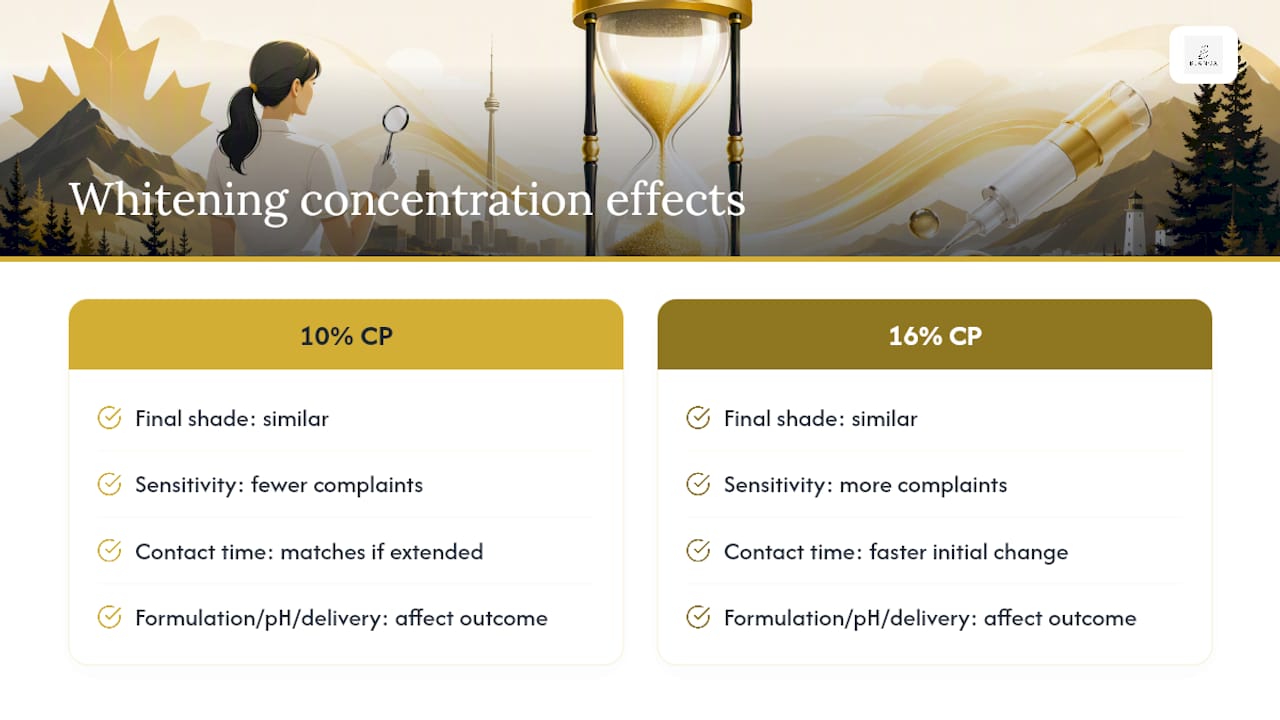
That finding runs against the instinct most people have when standing in front of a whitening display: grab the strongest one for the fastest result. Here’s what the trial data actually shows:
That last point deserves more attention than it usually gets. Reviews on topical bleaching agents note that formulation, pH, and delivery system modify how a given percentage performs just as much as the number itself, according to research on topical bleaching agent effects.
There are real limits to how far this evidence generalizes. That tradeoff gets less favorable, not more, as concentrations climb further.
What Are the Safety Risks at Higher Concentrations?
Tooth sensitivity is the most common side effect of any peroxide-based whitening product, and it scales with concentration. Peroxide penetrates through enamel into the dentin layer, where it can irritate the nerve endings inside microscopic tubules. Reviews compiling multiple clinical studies confirm this pattern: sensitivity is common at higher concentrations but typically resolves within days of stopping treatment, according to clinical evidence on whitening safety and sensitivity.
Gum and soft-tissue irritation is the second major risk, and it has less to do with the gel’s percentage and more to do with how well it’s kept off the tissue. A high-percentage gel that touches the gumline for even a few minutes can cause a chemical burn, a whitish patch that stings for a day or two. This is precisely why professional strength gels are applied only by trained providers using rubber dam isolation or a painted-on gingival barrier.
Health Canada’s consumer guidance on whitening products centers on exactly this distinction: follow the product’s instructions closely, avoid exceeding recommended wear time, and consult a dental professional if you experience unusual pain or have existing dental work, according to Health Canada’s safe-use guidance for home whitening kits. That guidance isn’t about scaring people away from whitening. It’s about matching the product to the setting it was designed for.
Professional safeguards exist for a reason:
- Isolation: Dentists use dams or barrier gels to keep high-percentage HP off the gums entirely.
- Trained application: Fresh-mix formulas up to 44% HP are handled by providers who know the correct volume and timing.
- Short duty cycles: In-office sessions run 15 to 20 minutes precisely because longer exposure at that concentration raises burn risk.
- Desensitizing follow-up: Many clinics apply fluoride or potassium nitrate treatments immediately after high-concentration sessions.
Reviews on professional whitening systems reinforce that concentrations in the 36% to 44% HP range are appropriate only in a supervised clinical setting with these protections in place, according to research on dental whitening gel strengths. A simple rule covers most of this territory: if a product’s percentage requires professional isolation to use safely, it isn’t meant to go home in your bathroom cabinet. Our guide on preventing gum irritation while whitening covers practical tray and strip techniques that reduce this risk further.
How Do I Choose the Right Whitening Gel Percentage?
Matching a gel to your situation matters more than chasing the highest number on the shelf. A few honest questions will point you toward the right starting concentration faster than any product review will.
Start with your sensitivity history. If you’ve had sensitive teeth in the past, or you know you have thin enamel, a lower CP percentage with a longer wear time is almost always the better first move. If you’ve never had trouble with sensitivity and want faster results, you still don’t need to jump straight to the top of the range.
Existing dental work changes the calculation too. Crowns, veneers, and fillings don’t whiten the way natural enamel does, which can create uneven shading if you push concentration or duration too aggressively around them. Anyone with visible restorations in their smile line should get a dentist’s opinion before starting a whitening course, not after noticing a mismatch.
A short checklist covers most decision points:
- Have you experienced tooth sensitivity with any whitening product before?
- Do you have crowns, veneers, or fillings in visible teeth?
- Is this your first time using a tray or strip product?
- Are you looking for a gradual result over weeks, or a faster result you’d get through a dental office?
- Has it been more than six months since your last dental checkup?
The American Dental Association has historically accepted 10% (plus or minus 1%) carbamide peroxide as safe for at-home custom-tray bleaching, which gives that concentration a longer safety track record than most others on the shelf. Before trying anything above that range, ask your dentist directly whether your enamel, gum health, and any restorations make a higher percentage appropriate for you.
How Should You Apply Whitening Gel Safely?
Getting the technique right matters as much as picking the right percentage.
- Brush and floss first. Removing surface plaque lets the gel contact enamel directly instead of working through debris.
- Apply a thin, even layer. A rice-grain-sized amount per tooth well is enough for most tray systems. More gel doesn’t whiten faster; it just increases the chance of gum contact.
- Keep gel off the gumline. Wipe away any excess that spreads past the tooth surface with a clean finger or cotton swab before inserting the tray.
- Follow the recommended daily duration exactly. Most at-home CP protocols call for one to a few hours per day; strips are typically worn for 30 to 60 minutes.
- Don’t exceed the maximum course length, usually one to three weeks depending on the product, without a break or professional check-in.
- Rinse and avoid staining foods or drinks for at least an hour afterward, since enamel is more porous immediately after treatment.
In-office sessions follow a different rhythm. Expect the dentist or hygienist to isolate your gums first, apply a higher-concentration gel for a short 15 to 20 minute cycle, and sometimes use a curing light to activate the formula, before rinsing and possibly repeating the cycle once or twice. Supervision matters here specifically because the concentrations involved carry real soft-tissue risk without proper isolation.
Pro Tip: If you notice sharp, brief sensitivity to cold air or water during your course, that’s usually normal and temporary. If pain lingers for hours after removing the tray, pause treatment for a day or two and consider dropping to a lower concentration. Our detailed walkthrough on at-home whitening best practices covers troubleshooting for slower-than-expected results.
Why Trust Blanca’s Approach to Whitening Gel Strength
We think about percentage claims on a whitening box carefully. It’s better to recommend a conservative concentration with a track record than a headline number with an asterisk attached. This philosophy runs through many product lineups, from flavored whitening strips to professional-grade kits designed for dentists, all built around the principle: match the formula to the setting it’s actually meant for.
Our safety-focused content, including our breakdowns of gum irritation prevention and sensitivity-free whitening methods, reflects the same clinical reasoning dentists use chairside: concentration is a tool, not a shortcut. We also work directly with dental providers through a certification course for in-office whitening, which keeps our understanding of professional-strength protocols grounded in how they’re actually used in clinics, not just how they’re marketed.
The Real Lesson Behind Every Whitening Gel Percentage
Both concentrations reached similar endpoints. The higher concentration was associated with increased sensitivity without a clear advantage in whitening effectiveness.
Where most advice online falls short is treating percentage as the only variable that matters. It isn’t. Contact time, formula stability, and delivery method all shape the outcome as much as the number on the label, and marketing rarely mentions any of that.
If you’re weighing your first whitening purchase, prioritize a well-formulated, moderate concentration you can use consistently over a course, rather than the highest percentage you can find. Consistency beats intensity almost every time in this category. That’s the reasoning behind Blanca’s conservative at-home lineup, and it’s the same reasoning any careful dentist would walk you through in an office visit.
— Blanca
Ready to Start Whitening the Safe Way?
Skipping straight to the highest percentage you can find online skips the part that actually matters: matching concentration to your teeth, your sensitivity, and your patience for a multi-week routine. Blanca’s at-home whitening collection is built around conservative, dentist-informed concentrations designed for consistent daily use rather than a one-time jolt of peroxide.
If you’re new to whitening, or you’ve had sensitivity in the past, start with a lower-concentration product and give it the full recommended course before judging results. If you have crowns, veneers, or ongoing dental work, talk to your dentist before starting any peroxide-based routine, regardless of the brand. For everyone else looking for a dependable starting point, browse Blanca’s best-selling products to find a strip or gel kit matched to your goals, and place your order when you’re ready to begin.
This article is general information, not a substitute for advice from a qualified doctor. Consult a qualified healthcare professional about your own circumstances before acting on anything here.
Sources
- Effectiveness of different carbamide peroxide concentrations used for tooth bleaching: an in vitro study - PMC
- Efficacy and Safety of 10% and 16% Carbamide Peroxide Tooth-whitening Gels: A Randomized Clinical Trial
- Safe use of home tooth whitening kits - Health Canada
FAQ
Is 6% Whitening Gel Stronger Than 16%?
It depends entirely on which compound each percentage refers to.
Is 35% Teeth Whitening Gel Too Strong for Home Use?
Yes.
How Long Should You Leave 16% Whitening Gel on For?
Always follow the specific product’s instructions, since formulations vary.
Does a Higher Whitening Gel Percentage Whiten Faster?
Not necessarily.